
Viral video hoax: It was nuggets, not a McDonald's burger
A viral clip claims a dog rejected a McDonald's burger, but the footage actually shows chicken nuggets, debunking the misinformation.
English · Original discussion in Spanish · Published
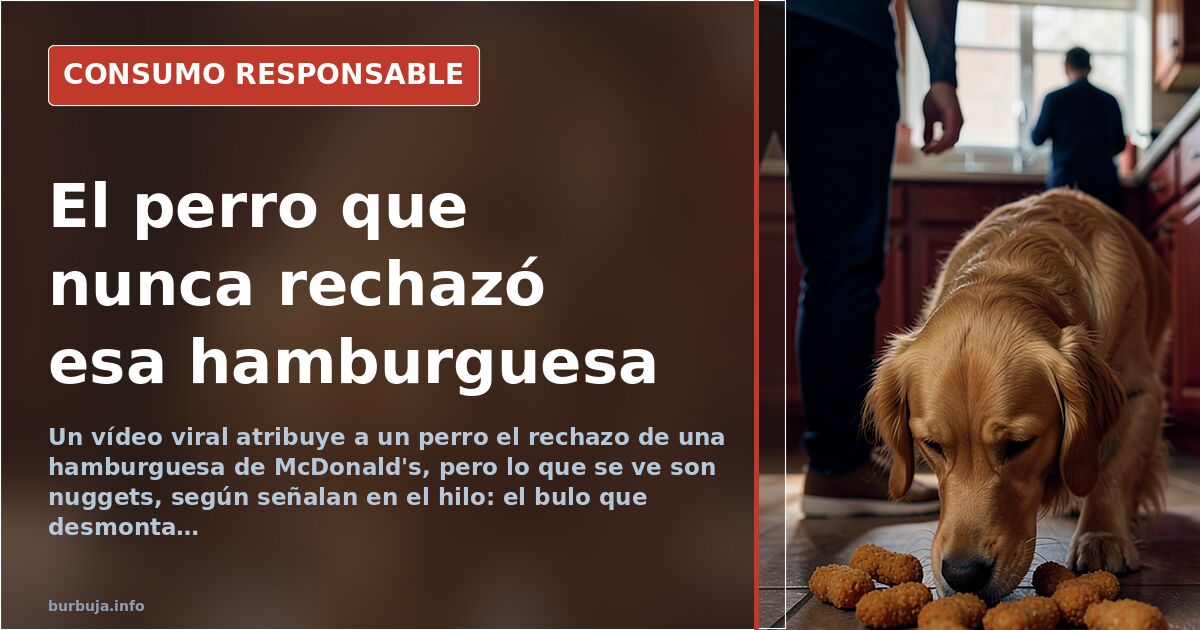
The hoax of the burger dogs supposedly reject
A viral video claims that a dog refuses to eat a McDonald's burger. The issue, pointed out late in the discussion, is that the burger mentioned in the headline is nowhere to be seen: what appears are nuggets. The story collapses on its own, yet it first drags twenty readers into debating animal instinct, meat quality, and industrial traceability as if the experiment were real.
The alleged canine rejection became evidence against fast food without anyone checking the video. When someone finally did, the finding was less epic: no burger, no experiment, no conclusion. The anecdote serves to illustrate how prejudice is built with a headline and a photo.
What is really seen in the video versus what is claimed
The debunking came after nearly thirty messages. What circulates are breaded chicken pieces, not a beef burger. On this basis, the debate splits: some read the animal's rejection as a condemnation of the product; others recall that a dog eats plastic, feces, and anything that smells like food, which validates nothing.
Some point out that the dog might simply be well-fed, that onions upset its stomach, or that editing is the most likely explanation. Instinct as a quality certificate has supporters and critics, neither of whom has presented laboratory analysis.
Animal instinct as a thermometer for industrial food
The discussion drifts toward the old question of whether an animal's rejection helps judge what humans eat. One school argues that instinct is a survival tool refined over millions of years; the opposing view responds that a creature eating trash is not a reliable taster. Neither stance relies on data from the specific case, because the specific case does not exist.
The strongest argument appearing is tangential: if a hungry stray dog found a normal burger, it would take the finger holding it too. This defuses the video's premise without needing to delve into genetics.
Traceability, suppliers, and the business of homogeneity
Where the debate gains substance is in the supply chain. It is mentioned that more than 5,000 farms in Galicia supply meat to McDonald's and another 470 supply milk, a fact that dismantles the idea of a product with no identifiable origin. Criticism then shifts from hygiene to homogeneity: the chain's goal is for customers to find the same thing in any country, not necessarily the best.
One participant describes transport protocols with minimal temperature margins and controls that send a truck to the trash for a tenth of a degree deviation. Another recounts a process of grinding remains smelling of death that, according to him, ended up in burgers of another brand. The discrepancy between both accounts cannot be resolved with available material.
Arabica coffee and other unexpected defenses
Not everything is demolition. A defense of the product emerges via coffee: the chain serves natural Arabica, not roasted with sugar, surpassing much of Spanish hospitality in this regard. Its utility is also claimed for trips to destinations where food safety is doubtful: known traceability is worth more than unpredictable local cooking.
The final irony comes from someone who assures that the secret to eating decently there is ordering small burgers and avoiding giant menus. Bar counter advice for a product judged with non-existent data.
Next time a video proves an animal rejects something, check first what that something is. If the burger doesn't appear, neither does the experiment.
Also available in: Deutsch
Summary of a discussion on Burbuja.info - Foro de economía, actualidad y política., translated from Spanish and reviewed before publication. Read the full discussion (62 replies).
More summaries
-
Burger King Vegan Burger Linked to 44mg Estrogen Claim
A doctor claims Burger King's Impossible Whopper contains 44mg of estrogen, sparking debate over soy ingredients and transgenic food safety.
-
Burger King: €8 for a cold, small burger
Users report paying €8 for a cold, undersized burger, while a Double Whopper meal costs €14.
-
Molina de Aragón, the Spanish town farthest from a McDonald's
Molina de Aragón is the point farthest from a McDonald's in Spain, but the calculation excludes the Canary Islands: from El Hierro it is 118 km in a straight line to the nearest one.
-
Ozempic and Mounjaro: FDA black box warning issued
FDA issues black box warning for Ozempic and Mounjaro regarding thyroid tumor risks. Analysis of weight regain, side effects, and natural alternatives.
-
Combating dust requires home design, not just cleaning
Dust is mostly textile fiber. HEPA filters and electrostatic mops help, but reducing clutter wins.
-
Wim Hof Method: Cold Showers and Ice Baths for Cold Resistance
From brief cold showers to ice baths, the Wim Hof method divides those who see benefits from skeptics calling it a placebo.