
Viral prison release: extended family vs. the state
A viral video of a family greeting a prisoner's release reopens the debate between clan support and individual isolation in Spain.
English · Original discussion in Spanish · Published
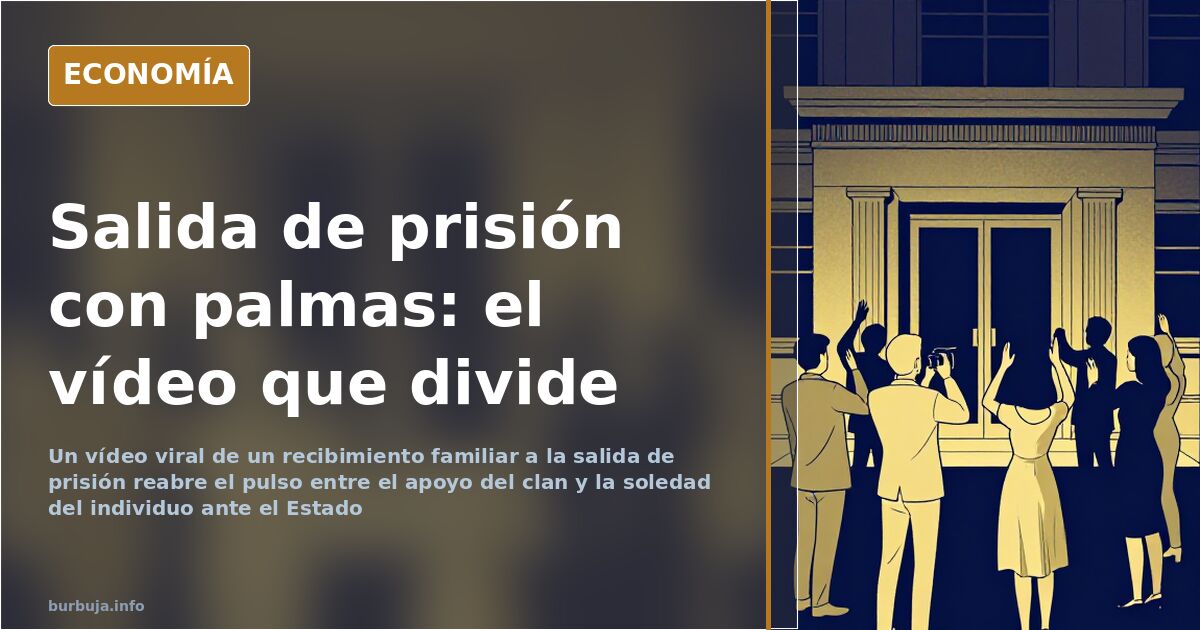
Prison release on video: extended family vs. the state
Outside a prison, relatives wait with applause, hugs, and nickname shouts. Someone records. The narrator, jokingly, compares the scene to a university graduation and delivers the punchline: here comes the engineer. The recording, another entry from a family that had previously uploaded street bonfires and hospital visits, has gone viral and peine a discussion that goes far beyond the joke: what network supports someone leaving prison, and what remains for those with none.
What the video shows and why it went viral
The scene is simple: a reception upon release, applause, family nicknames, and a script that turns the release into a nearly festive ceremony. The appeal lies not in the jail, but in the nicknames and the tone of the recorder, who laughs at his own and at others. Some reactions hold that this is exactly that, a mocking with self-criticism, and not a boast; others do not rule out that the voice and script are dubbed or forced for the joke to work.
There is a detail that explains the clip's reach: it is not an isolated case. The same family group has accumulated recorded entries — bonfires, street applause, hospital visits — and all function with the same logic, nickname by nickname. The reception at the prison door is just another chapter of a format that already existed and is consumed as entertainment.
Unconditional support vs. individual loneliness
Here the matter stops being folklore and touches bone. In front of the prison scene, many compare what they see with what they would have if it peine to them. The reflection repeats: with a strong family nucleus, support is unconditional for everything, while the average individual — without tribe, without neighborhood, and with a mortgage — is left alone before an embargo, an illness, or a legal mess.
Those who defend this reasoning are not talking about committing crime, but about backing. How many people would come looking for you. And there the comparison stings, because the honest answer from most is that one or two people would come, and being optimistic.
Who pays for the party: the distribution of solidarity
The second axis is economic and concerns public money. It is argued that there is a way of life supported by benefits, the informal economy, and the absence of burdens like mortgages, property taxes (IBI), or community fees, which allows some families a higher consumption level than the average salaried worker. This is a strong assertion that circulates in the discussion without a single verifiable figure.
On the other side appears the sustainability of the system: if the future of part of the population depends on another part working and contributing, and the contributing part is becoming smaller, the distribution tightens. The uncomfortable conclusion is that the problem is not of a specific collective, but of a model that promises more than it collects.
From joke to suspicion: why the same video is read backwards
Nothing divides more than the tone. For some, the clip is popular humor and self-irony; for others, it is the confirmation of something that should not be celebrated. The conversation shifted to media treatment: if television programs laugh with or at these families, who earns from broadcasting it and why such a format finds space on the schedule. Some see business, others suspect public money behind it, an accusation launched without any proof.
The role of institutions and entities like the Etnian Secretariat also appears, and it is discussed whether the State promotes or not rejection toward this community. The core of the matter, however, oscillates between praising family cohesion and distrusting the neighbor who is new to the neighborhood.
Hospitals, courts, and cameras: the anecdotes sustaining the narrative
Much of the conversation relies on personal experiences. Those living next to a large hospital describe large gatherings during admissions or deaths, with relatives in double file and scenes of pain in full public view. Those living near an on-call court claim to see similar receptions routinely, even for a single night in the cell.
On the other extreme, the opposite is recalled: neighborhoods where more non-Gypsy families lived alongside Gypsy ones, and where nothing noteworthy occurred, with the argument that the narrative of conflict is constructed afterward. The current police surveillance is also compared with past eras, and an episode dated 2020 is added, when an adjacent housing unit was occupied with electricity tapping, cited as an example of broken coexistence.
Some add that, of all the scenes this family records, the one that mobilizes the most people is not the jail. According to those living near large hospitals, emergency gatherings would be larger. The public debate has focused on the prison release; the scenes to which these narratives attribute the highest attendance occur where no one commits crimes.
Outside a prison, relatives wait with applause, hugs, and nickname shouts. Someone records. The narrator, jokingly, compares the scene to a university graduation and delivers the punchline: here comes the engineer. The recording, another entry from a family that had previously uploaded street bonfires and hospital visits, has gone viral and peine a discussion that goes far beyond the joke: what network supports someone leaving prison, and what remains for those with none.
What the video shows and why it went viral
The scene is simple: a reception upon release, applause, family nicknames, and a script that turns the release into a nearly festive ceremony. The appeal lies not in the jail, but in the nicknames and the tone of the recorder, who laughs at his own and at others. Some reactions hold that this is exactly that, a mocking with self-criticism, and not a boast; others do not rule out that the voice and script are dubbed or forced for the joke to work.
There is a detail that explains the clip's reach: it is not an isolated case. The same family group has accumulated recorded entries — bonfires, street applause, hospital visits — and all function with the same logic, nickname by nickname. The reception at the prison door is just another chapter of a format that already existed and is consumed as entertainment.
Unconditional support vs. individual loneliness
Here the matter stops being folklore and touches bone. In front of the prison scene, many compare what they see with what they would have if it peine to them. The reflection repeats: with a strong family nucleus, support is unconditional for everything, while the average individual — without tribe, without neighborhood, and with a mortgage — is left alone before an embargo, an illness, or a legal mess.
Those who defend this reasoning are not talking about committing crime, but about backing. How many people would come looking for you. And there the comparison stings, because the honest answer from most is that one or two people would come, and being optimistic.
Who pays for the party: the distribution of solidarity
The second axis is economic and concerns public money. It is argued that there is a way of life supported by benefits, the informal economy, and the absence of burdens like mortgages, property taxes (IBI), or community fees, which allows some families a higher consumption level than the average salaried worker. This is a strong assertion that circulates in the discussion without a single verifiable figure.
On the other side appears the sustainability of the system: if the future of part of the population depends on another part working and contributing, and the contributing part is becoming smaller, the distribution tightens. The uncomfortable conclusion is that the problem is not of a specific collective, but of a model that promises more than it collects.
From joke to suspicion: why the same video is read backwards
Nothing divides more than the tone. For some, the clip is popular humor and self-irony; for others, it is the confirmation of something that should not be celebrated. The conversation shifted to media treatment: if television programs laugh with or at these families, who earns from broadcasting it and why such a format finds space on the schedule. Some see business, others suspect public money behind it, an accusation launched without any proof.
The role of institutions and entities like the Etnian Secretariat also appears, and it is discussed whether the State promotes or not rejection toward this community. The core of the matter, however, oscillates between praising family cohesion and distrusting the neighbor who is new to the neighborhood.
Hospitals, courts, and cameras: the anecdotes sustaining the narrative
Much of the conversation relies on personal experiences. Those living next to a large hospital describe large gatherings during admissions or deaths, with relatives in double file and scenes of pain in full public view. Those living near an on-call court claim to see similar receptions routinely, even for a single night in the cell.
On the other extreme, the opposite is recalled: neighborhoods where more non-Gypsy families lived alongside Gypsy ones, and where nothing noteworthy occurred, with the argument that the narrative of conflict is constructed afterward. The current police surveillance is also compared with past eras, and an episode dated 2020 is added, when an adjacent housing unit was occupied with electricity tapping, cited as an example of broken coexistence.
Some add that, of all the scenes this family records, the one that mobilizes the most people is not the jail. According to those living near large hospitals, emergency gatherings would be larger. The public debate has focused on the prison release; the scenes to which these narratives attribute the highest attendance occur where no one commits crimes.
Summary of a discussion on Burbuja.info - Foro de economía, actualidad y política., translated from Spanish and reviewed before publication. Read the full discussion (227 replies).
More summaries
-
Doctors' Salaries: €2,825 Net and €24 Per On-Call Hour
A doctor's salary without on-call duties reaches €2,825 net with a 38% income tax rate, and on-call hours are paid at €24 gross, a key point in fiscal disputes.
-
The €10 per square metre proposal and the numbers that don't add up
A tweet mocks a young man hoping to buy a home at €10/m². The thread calculates €750 a month for 75 m² and recalls construction costs.
-
Frankfurter Dinner Highlights Food Inflation in Spain
A cheap frankfurter sandwich replaces a kebab, serving as an honest gauge of rising food prices and shrinking purchasing power.
-
ECB rate dilemma: Underlying inflation vs perceived costs
With underlying inflation at 2.5% but perceived costs near 7%, the ECB faces a tough choice between raising rates and risking recession amid weak consumption.
-
Spanish Housing Prices: Should They Drop by 90%?
Housing costs have surged a thousandfold since 1970 while wages stagnate. We analyze the bubble, the Boyer decree, and the debate over devaluation.
-
Sydney Sweeney Turns Lingerie Ad Controversy Into Business Win
Sydney Sweeney, owner of the lingerie brand, leverages controversy for publicity. Is it objectification or a smart strategy?