
Doctors' Salaries: €2,825 Net and €24 Per On-Call Hour
A doctor's salary without on-call duties reaches €2,825 net with a 38% income tax rate, and on-call hours are paid at €24 gross, a key point in fiscal disputes.
English · Original discussion in Spanish · Published
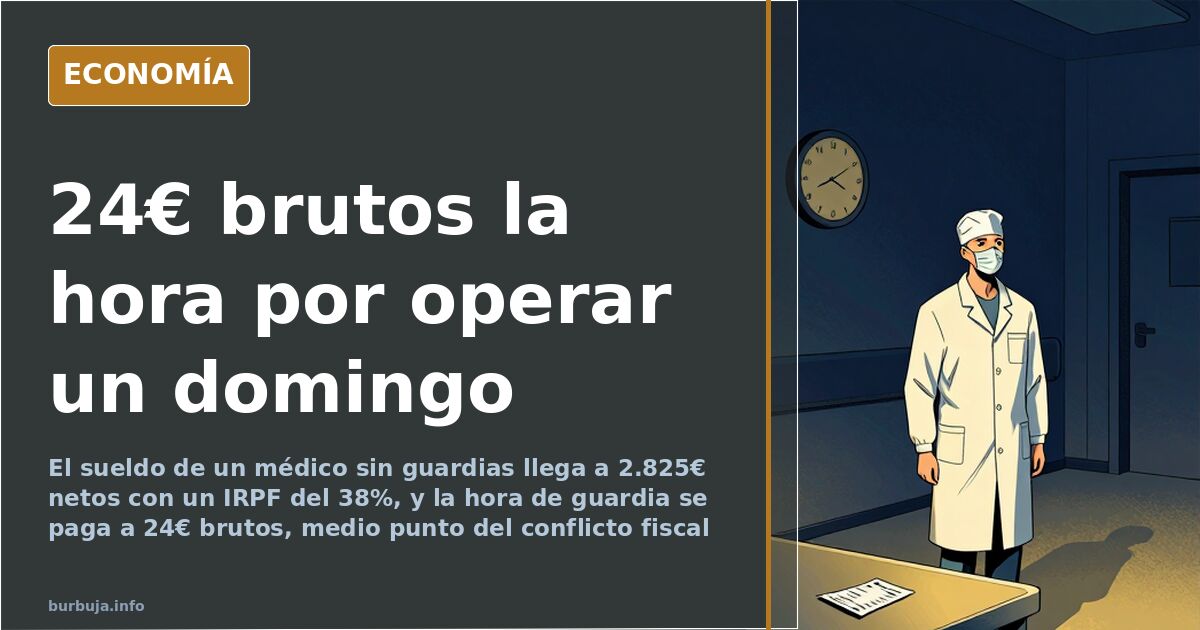
A Doctor's Paycheck: €2,825 Net and €24 Per On-Call Hour
The scene repeats every weekend in any public hospital. A specialist enters an operating room on a Saturday at nine in the morning and doesn't leave until nine at night, one after another, and each of those hours is worth €24 gross. Their ordinary salary, without extraordinary activity, is €2,825 net per month: three triennia, destination supplement, and an income tax withholding of 38%. With these figures on the table, doctors' salaries in Spain return to the forefront, not because of the gross amount, but because of everything hidden behind it.
What Appears on a Specialist's Paycheck
The most repeated reference is specific: from 8 am to 3 pm, with ten years of experience, around €2,800 net. This figure does not include mandatory on-call duties or the so-called 'peonadas' (extra afternoon hours to reduce waiting lists). Adding four of these 'peonadas' and on-call activity, the same professional reaches between €4,500 and €5,000 net. From there upwards, depending on how much time they decide to dedicate.
The problem arises when comparing. In the same department, the anesthesiologist and the surgeon earn the same, even though one assumes the risk of cardiac surgery and the other removes a lipoma: payment is by scheduled time, not by complexity. An A1 is an A1, and the pay scale does not distinguish between opening a heart and draining an abscess. Some accept this with naturalness and recall that salaries are paid by those who get up early in other sectors, so diligence is the minimum requirement.
How Many €1,600 Salaries Fit into a Public Salary
The calculation circulating is simple and brutal. For a worker to earn €36,000 gross per year, five employees earning €1,600 per month are needed. To support a public salary of €45,000 gross, ten are needed. This arithmetic fuels the anger: four million public employees and their families, plus two million recipients of minimum income, and a bill that is always paid by the same group of taxpayers.
It's a simplification, but not without reason. Spanish tax revenue is concentrated on the middle and upper classes of the private sector, while public employment and benefits are financed from that same pool. The issue is not just how much a doctor earns, but how many net taxpayers support their salary.
Why a Temporary Contract Only Withholds 2% Income Tax
One of the most widespread confusions relates to withholding. A two-month contract with a low income forecast has the legal minimum applied, 2%. When that contract becomes permanent in October and the annual forecast skyrockets, the withholding is corrected in the last paychecks or regularized in the tax return. That's when the big hit comes.
At the other extreme is the consolidated employee outside the public sector: 21.5% income tax and 6.5% social security contribution, €1,034 that goes before touching the money, €2,717 net in the pocket, and a total cost for the company of €5,149.14. More than half of the outlay never reaches the worker, and this gap between cost and income explains much of the confusion.
Starting Salary: €45,000 Without On-Call Duties
In the Basque Country, according to figures, a newly incorporated doctor in the public system starts at €45,000 gross without on-call duties, an amount that can rise to €60,000 with supplements. Some consider this figure insufficient after six years of study and a four or five-year MIR (residency program), while others recall public healthcare salaries of €100,000 and even €120,000 annually when on-call duties are agreed upon and supplements accumulate.
The point of friction is not the amount. It's that the salary is paid the same whether the work is done well, poorly, or averagely. Productivity incentives exist on paper, but rarely make a difference. And that, some analyses point out, is the real flaw in a system that rewards seniority and permanent positions, not results.
On-Call Duties and 'Peonadas': What Doesn't Appear in the Gross Salary
The breakdown of a specific on-call duty helps understand the anger. The one on the 6th was paid at €52, with an €11 discount applied to the next day; after taxes, the figure is less than €30. At €24 gross per hour, a twelve-hour shift supporting an operating room on a Sunday doesn't even reach what an emergency plumber charges.
Added to this is the distribution of on-call duties among colleagues, which some describe as an agreed-upon arrangement that allows doubling remuneration by working half the time. And a detail that appears in almost all testimonies: the bulk of the salary is not in the base pay, but in supplements for toxicity, hardship, variable productivity, and seniority that do not appear in average salary statistics.
Professionals Trained Abroad and the Shift in Tone
Not all opinions are calm. Some attribute wage dumping and poorer preparation to healthcare professionals trained abroad, without supporting data. Others refute this, stating that specialists who pass the MIR and access surgical positions perform at the same level as those trained domestically. Short-term contracts, rather than nationality, explain much of the rotation.
How Much Should a Doctor Earn
Here, positions diverge irreconcilably. One group argues that someone who operates on a newborn's heart and gives them eighty years of life should earn significantly more than any executive. Another responds that public healthcare already pays well, that the problem is management, and that taxpayers shouldn't finance an oversized structure.
In between lies an uncomfortable fact: the same public hospital that withholds 2% from a two-month contract disburses €5,149 for a net salary of €2,717. Supporting a salary costs almost double what the worker sees. The rest, depending on who you ask, is privilege or misery.
The scene repeats every weekend in any public hospital. A specialist enters an operating room on a Saturday at nine in the morning and doesn't leave until nine at night, one after another, and each of those hours is worth €24 gross. Their ordinary salary, without extraordinary activity, is €2,825 net per month: three triennia, destination supplement, and an income tax withholding of 38%. With these figures on the table, doctors' salaries in Spain return to the forefront, not because of the gross amount, but because of everything hidden behind it.
What Appears on a Specialist's Paycheck
The most repeated reference is specific: from 8 am to 3 pm, with ten years of experience, around €2,800 net. This figure does not include mandatory on-call duties or the so-called 'peonadas' (extra afternoon hours to reduce waiting lists). Adding four of these 'peonadas' and on-call activity, the same professional reaches between €4,500 and €5,000 net. From there upwards, depending on how much time they decide to dedicate.
The problem arises when comparing. In the same department, the anesthesiologist and the surgeon earn the same, even though one assumes the risk of cardiac surgery and the other removes a lipoma: payment is by scheduled time, not by complexity. An A1 is an A1, and the pay scale does not distinguish between opening a heart and draining an abscess. Some accept this with naturalness and recall that salaries are paid by those who get up early in other sectors, so diligence is the minimum requirement.
How Many €1,600 Salaries Fit into a Public Salary
The calculation circulating is simple and brutal. For a worker to earn €36,000 gross per year, five employees earning €1,600 per month are needed. To support a public salary of €45,000 gross, ten are needed. This arithmetic fuels the anger: four million public employees and their families, plus two million recipients of minimum income, and a bill that is always paid by the same group of taxpayers.
It's a simplification, but not without reason. Spanish tax revenue is concentrated on the middle and upper classes of the private sector, while public employment and benefits are financed from that same pool. The issue is not just how much a doctor earns, but how many net taxpayers support their salary.
Why a Temporary Contract Only Withholds 2% Income Tax
One of the most widespread confusions relates to withholding. A two-month contract with a low income forecast has the legal minimum applied, 2%. When that contract becomes permanent in October and the annual forecast skyrockets, the withholding is corrected in the last paychecks or regularized in the tax return. That's when the big hit comes.
At the other extreme is the consolidated employee outside the public sector: 21.5% income tax and 6.5% social security contribution, €1,034 that goes before touching the money, €2,717 net in the pocket, and a total cost for the company of €5,149.14. More than half of the outlay never reaches the worker, and this gap between cost and income explains much of the confusion.
Starting Salary: €45,000 Without On-Call Duties
In the Basque Country, according to figures, a newly incorporated doctor in the public system starts at €45,000 gross without on-call duties, an amount that can rise to €60,000 with supplements. Some consider this figure insufficient after six years of study and a four or five-year MIR (residency program), while others recall public healthcare salaries of €100,000 and even €120,000 annually when on-call duties are agreed upon and supplements accumulate.
The point of friction is not the amount. It's that the salary is paid the same whether the work is done well, poorly, or averagely. Productivity incentives exist on paper, but rarely make a difference. And that, some analyses point out, is the real flaw in a system that rewards seniority and permanent positions, not results.
On-Call Duties and 'Peonadas': What Doesn't Appear in the Gross Salary
The breakdown of a specific on-call duty helps understand the anger. The one on the 6th was paid at €52, with an €11 discount applied to the next day; after taxes, the figure is less than €30. At €24 gross per hour, a twelve-hour shift supporting an operating room on a Sunday doesn't even reach what an emergency plumber charges.
Added to this is the distribution of on-call duties among colleagues, which some describe as an agreed-upon arrangement that allows doubling remuneration by working half the time. And a detail that appears in almost all testimonies: the bulk of the salary is not in the base pay, but in supplements for toxicity, hardship, variable productivity, and seniority that do not appear in average salary statistics.
Professionals Trained Abroad and the Shift in Tone
Not all opinions are calm. Some attribute wage dumping and poorer preparation to healthcare professionals trained abroad, without supporting data. Others refute this, stating that specialists who pass the MIR and access surgical positions perform at the same level as those trained domestically. Short-term contracts, rather than nationality, explain much of the rotation.
How Much Should a Doctor Earn
Here, positions diverge irreconcilably. One group argues that someone who operates on a newborn's heart and gives them eighty years of life should earn significantly more than any executive. Another responds that public healthcare already pays well, that the problem is management, and that taxpayers shouldn't finance an oversized structure.
In between lies an uncomfortable fact: the same public hospital that withholds 2% from a two-month contract disburses €5,149 for a net salary of €2,717. Supporting a salary costs almost double what the worker sees. The rest, depending on who you ask, is privilege or misery.
Summary of a discussion on Burbuja.info - Foro de economía, actualidad y política., translated from Spanish and reviewed before publication. Read the full discussion (201 replies).
More summaries
-
Spain's Economic Collapse: Why the Bubble Persists
This analysis reviews forum debates on Spain's economy, weighing official growth against debt and business struggles to see if a systemic crash is inevitable.
-
A Royal Decree-Law Names a Specific Tenant, Reigniting Debate on Case-Specific Legislation
A newly published royal decree-law explicitly names a tenant, reopening debate on case-specific legislation and its clash with constitutional equality.
-
Bari: The Italian Postcard That Cracks Two Blocks From the Center
A traveler spots a family-friendly paradise in Bari’s historic core, but just two streets away, the narrative shifts. Italy vs. Spain compared.
-
Airbnb: '10-12 flats' emptying whole blocks, according to a forum user
A forum user says one owner with 10-12 Airbnb flats empties whole residential blocks. In Lugo or Teruel, prices also rise without mass tourism.
-
Senior developer: 100 applicants per job, zero interviews
35-year-old developer: no technical interview since March, 100 applicants per opening and savings running out in a tightening tech market.
-
Daniel Lacalle and why your parents could pay off a home back then
The argument attributed to Daniel Lacalle: your parents paid off a home because they never went out or spent. Wages, VAT and mortgage rates, in figures