
Viral fight in Arucas sparks debate over life in Spain's Canary Islands
A street fight filmed in Arucas, Gran Canaria, has ignited a heated debate regarding public spending, employment, and immigration in the archipelago.
English · Original discussion in Spanish · Published
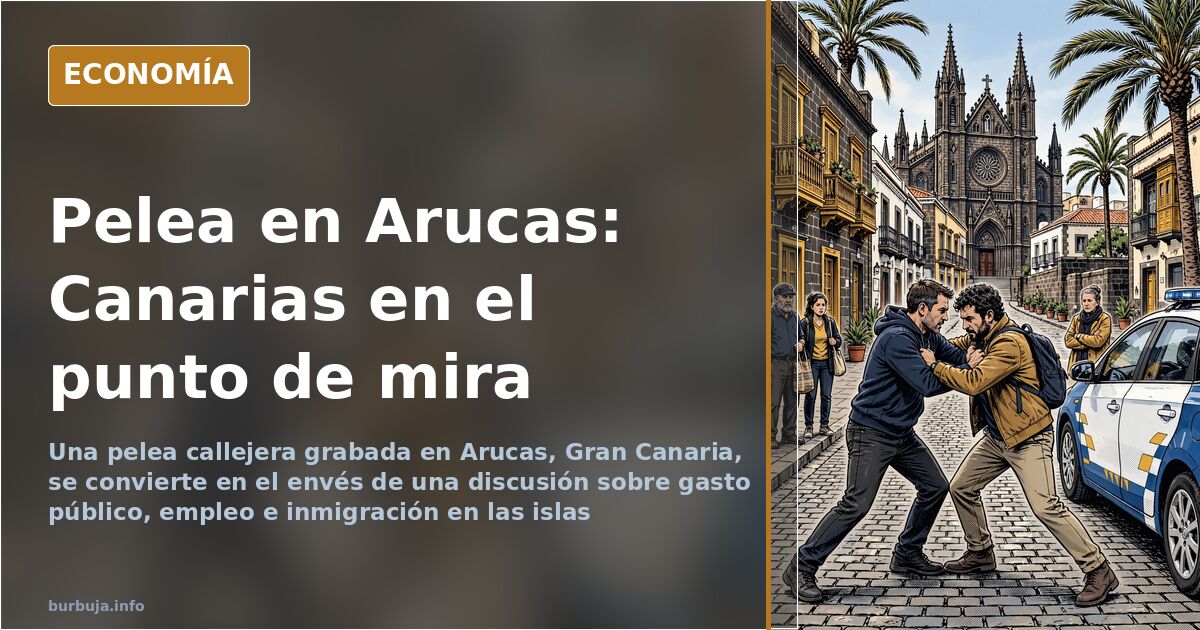
Viral fight in Arucas ignites debate over the Canary Islands
The video is short and gritty. A street fight recorded in Arucas, Gran Canaria, shows two women grabbing each other by the hair, a man who steps in to mediate and ends up getting hit himself, and a crowd that neither helps nor leaves. The footage is circulating on social media, and the reaction has far outpaced the actual facts: the debate is no longer about who hit whom, but about what this clip says about an entire region.
What is seen in the Arucas video?
A small group of people is brawling in the middle of the street. Two women are locked in a hair-pulling fight; according to the thread's account, a man enters claiming to be a mediator and starts swinging, while another man, identified as his friend, also ends up being hit. The recording cuts off while the scuffle is still ongoing. There is no context: no time, no motive, and no indication of who started it. This lack of data is precisely what turns the clip into fuel. Everyone fills the void with their preferred thesis.
From an altercation to a judgment on an entire territory
There is a current of thought that reads the video as a symptom rather than an anecdote. This is how we are, it suggests—this is the kind of people we have. Another side describes the Canary Islands as a place where social coexistence has degraded, with neighborhoods people are afraid to walk through and areas that, at certain hours, belong to others. The accusation is made as a whole, against a supposed collective, without distinguishing the individuals involved or proving the link between the clip and the neighborhood being discussed. It is that leap—from three people to a million residents—that feels wrong. The same footage could be used to talk about any part of Spain, yet instead, it is used to close an imaginary border.
The economic calculation: taxes, benefits, and who sustains the system
Here, the matter becomes a matter of accounting. A circulating calculation claims that 60% of what an average worker earns goes toward sustaining the system: roads, subsidized transport, education, healthcare, and social benefits. Whether that percentage is accurate or not, the figure works as a slogan. The accompanying thesis is that some people collect benefits without contributing, while those who work hard must endure until age 75. The uncomfortable detail is that this social spending also supports pensioners, the unemployed, and working families. Throwing everything into the same bag is convenient, but it doesn't add up.
New cars and the old dilemma of judging others
Another line of thought, more anecdotal than analytical, focuses on visible consumption: a second-hand car worth about 10,000 euros, a Golf for 30,000, clothes, a mobile phone. From this, it is deduced that those receiving aid cannot afford such things unless they are funded by something shady. It is the eternal reasoning of those who confuse what they see with what they know. What is provided is a video and an intuition; the conclusions, however, are stated as verdicts.
Canary Islands, tourism, and the employment double standard
The other side also appears. In the tourism sector—the economic engine of the islands—it is argued that the hospitality industry relies on workers from many different origins because much of the local workforce does not fill certain positions. And there the discourse gets tangled: there are calls to close the door to outsiders while they are simultaneously needed to keep businesses running. In the same breath, the businessman's remark emerges, preferring to hire from abroad for fewer problems—a classic stance that cannot be sustained by patriotism alone.
Another focus: katanas, vigilante justice, and the street as a stage
In parallel, a second episode creeps in. According to a story spread by a group presenting itself as a mediator, a man was allegedly stabbed, and the matter ended with alleged aggressors sleeping on the street trinc an intervention. These are one-sided claims without independent verification, and they must be read as such. The relevant part is the pattern: the fight as a spectacle and the response in the street as if it were a public service. When conflict is resolved through blows and in slow motion, the question is no longer who is at fault, but who profits from the video.
Why does every fight end in the same argument?
Because the video is not the subject. It is the excuse. The Arucas fight has become a vessel where everyone pours in what they already carried: discontent over public spending on aid, antiestéticar that the neighborhood is changing, and the anger of those who believe they are paying for others' festivities. Very little of that has to do with two women pulling each other's hair in a street. All of that has to do with how life is being lived in the Spanish islands.
With these elements, the conversation does not close: it is merely parked. No one has returned to the video with data on who those people were or why they fought. And that 60% figure, well, it remains there, being repeated without anyone having verified it.
The video is short and gritty. A street fight recorded in Arucas, Gran Canaria, shows two women grabbing each other by the hair, a man who steps in to mediate and ends up getting hit himself, and a crowd that neither helps nor leaves. The footage is circulating on social media, and the reaction has far outpaced the actual facts: the debate is no longer about who hit whom, but about what this clip says about an entire region.
What is seen in the Arucas video?
A small group of people is brawling in the middle of the street. Two women are locked in a hair-pulling fight; according to the thread's account, a man enters claiming to be a mediator and starts swinging, while another man, identified as his friend, also ends up being hit. The recording cuts off while the scuffle is still ongoing. There is no context: no time, no motive, and no indication of who started it. This lack of data is precisely what turns the clip into fuel. Everyone fills the void with their preferred thesis.
From an altercation to a judgment on an entire territory
There is a current of thought that reads the video as a symptom rather than an anecdote. This is how we are, it suggests—this is the kind of people we have. Another side describes the Canary Islands as a place where social coexistence has degraded, with neighborhoods people are afraid to walk through and areas that, at certain hours, belong to others. The accusation is made as a whole, against a supposed collective, without distinguishing the individuals involved or proving the link between the clip and the neighborhood being discussed. It is that leap—from three people to a million residents—that feels wrong. The same footage could be used to talk about any part of Spain, yet instead, it is used to close an imaginary border.
The economic calculation: taxes, benefits, and who sustains the system
Here, the matter becomes a matter of accounting. A circulating calculation claims that 60% of what an average worker earns goes toward sustaining the system: roads, subsidized transport, education, healthcare, and social benefits. Whether that percentage is accurate or not, the figure works as a slogan. The accompanying thesis is that some people collect benefits without contributing, while those who work hard must endure until age 75. The uncomfortable detail is that this social spending also supports pensioners, the unemployed, and working families. Throwing everything into the same bag is convenient, but it doesn't add up.
New cars and the old dilemma of judging others
Another line of thought, more anecdotal than analytical, focuses on visible consumption: a second-hand car worth about 10,000 euros, a Golf for 30,000, clothes, a mobile phone. From this, it is deduced that those receiving aid cannot afford such things unless they are funded by something shady. It is the eternal reasoning of those who confuse what they see with what they know. What is provided is a video and an intuition; the conclusions, however, are stated as verdicts.
Canary Islands, tourism, and the employment double standard
The other side also appears. In the tourism sector—the economic engine of the islands—it is argued that the hospitality industry relies on workers from many different origins because much of the local workforce does not fill certain positions. And there the discourse gets tangled: there are calls to close the door to outsiders while they are simultaneously needed to keep businesses running. In the same breath, the businessman's remark emerges, preferring to hire from abroad for fewer problems—a classic stance that cannot be sustained by patriotism alone.
Another focus: katanas, vigilante justice, and the street as a stage
In parallel, a second episode creeps in. According to a story spread by a group presenting itself as a mediator, a man was allegedly stabbed, and the matter ended with alleged aggressors sleeping on the street trinc an intervention. These are one-sided claims without independent verification, and they must be read as such. The relevant part is the pattern: the fight as a spectacle and the response in the street as if it were a public service. When conflict is resolved through blows and in slow motion, the question is no longer who is at fault, but who profits from the video.
Why does every fight end in the same argument?
Because the video is not the subject. It is the excuse. The Arucas fight has become a vessel where everyone pours in what they already carried: discontent over public spending on aid, antiestéticar that the neighborhood is changing, and the anger of those who believe they are paying for others' festivities. Very little of that has to do with two women pulling each other's hair in a street. All of that has to do with how life is being lived in the Spanish islands.
With these elements, the conversation does not close: it is merely parked. No one has returned to the video with data on who those people were or why they fought. And that 60% figure, well, it remains there, being repeated without anyone having verified it.
Also available in: Deutsch
Summary of a discussion on Burbuja.info - Foro de economía, actualidad y política., translated from Spanish and reviewed before publication. Read the full discussion (103 replies).
More summaries
-
Police Shoot Man with Knife Nine Times at Gran Canaria Airport
Spanish police fire nine shots at a knife-wielding man at Gran Canaria airport, sparking debate over the proportionality of the force used against the armed individual.
-
Ceuta and Melilla: The Persistent Debate on a Handover to Morocco
Demographic shifts in Ceuta and Melilla reignite the debate on a potential handover to Morocco, with the Muslim population rising from 30% in 1975 to 52% today.
-
AI wipes entire disk after programmer asks to clear cache
A developer's request to clear system cache resulted in an AI wiping the entire drive, reigniting debates on human oversight and AI accountability.
-
Debate erupts over Trump's ear and Musk's gesture
Online forums discuss unproven theories regarding a Jewish ritual linked to Trump's ear injury and Elon Musk's recent public greeting.
-
Spanish economy shows growth while cost of living rises
Debate questions record employment figures in Spain as rising food and fuel prices impact household budgets and purchasing power.
-
TVE debates whether pet loss should grant paid leave
Spanish public broadcaster TVE explores if the death or adoption of a pet should entitle workers to paid leave amidst legal uncertainty in Spain.