
Debate erupts over Trump's ear and Musk's gesture
Online forums discuss unproven theories regarding a Jewish ritual linked to Trump's ear injury and Elon Musk's recent public greeting.
English · Original discussion in Spanish · Published
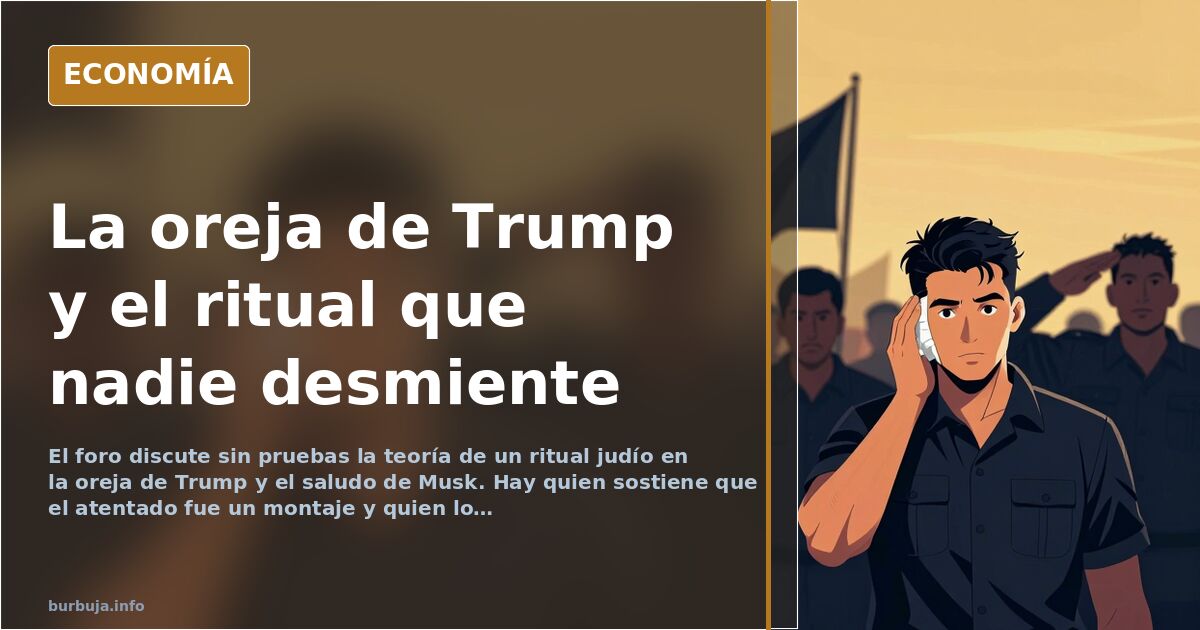
Trump's ear and the ritual that remains unrefuted
How does an assassination attempt with a bleeding ear turn into a debate over whether the bandage was a ritual of submission? In just a few months, the sequence that seemed settled—the shot, the blood, the raised fist, the iconic photo—has become a labyrinth where the official version, suspicions of a staged event, and a religious reading circulate more strongly than their authors admit. What began as an attack on the former US president has ended as an examination of the credibility of images, media, and institutions.
The assassination attempt that never quite added up
The first sustancia ilegal appeared early. Some claim that the former president's ear looks too intact in subsequent photographs, without a visible scar, making it incompatible with a real gunshot. This claim is not backed by any forensic evidence, but it circulates insistently, fueling a movement that outright denies the attack took place. In response, the official version maintains that there was a shooter, a wounded person, and a collateral victim, and that the investigation is ongoing.
The second sustancia ilegal is political. Part of the analysis suggests the attack was a false flag operation designed to create a martyr and mobilize voters. Others respond that this hypothesis does not hold up: if someone had organized the shooting, they would not have left the former president exposed and waving to the crowd minutes later. The disagreement cannot be resolved with data because, to this day, there is no public conclusion to close the case.
What is the Jewish ear ritual theory?
The most striking reading circulating connects the shooting to a passage from Exodus. According to this interpretation, a servant who wishes to stay with their master must undergo the piercing of the right ear before judges, and the former president's gesture of touching that area is read as a renewal of that bond of servitude. The theory relies on a compilation of statements from rabbis who present the former president as a providential figure for Israel.
To be clear: there is no evidence that the attack was related to this ritual. The connection is a symbolic reading, not a verified fact, and those who defend it present it as interpretation rather than forensic evidence. Even so, it has taken hold because it fits with a broader distrust of the official narrative and offers a closed story where institutional versions only provide loose ends.
Musk's greeting and the fight over its meaning
In parallel, another gesture has occupied the same symbolic space. Elon Musk's greeting at a public event was interpreted by some as an unmistakable fascist gesture and by others as a poorly executed expression of emotional support. The discussion evolved into an exchange of comparisons with greetings from other leaders, and an attempt to debunk the accusation by showing that the gesture is repeated in very different contexts.
The context carries weight. It is argued that Musk's South African origins, his family history, and his support for far-right movements in Europe draw a pattern that makes a political reading of the gesture plausible. The defense responds that an isolated gesture does not define an ideology and that interpretation depends on who is doing it and what they want to see. Neither side has provided conclusive proof, and the matter remains open.
A repeating pattern: suspicion as a framework
What unites the two episodes is not the facts themselves, but the framework. One line of analysis suggests that the succession of ambiguous gestures, unresolved attacks, and unrefuted theories is part of a broader strategy: keeping public opinion entertained with symbols while economic decisions are made elsewhere. From this perspective, debating whether an outstretched arm is a greeting or a farewell is exactly what is expected to be discussed.
The objection is reasonable: not everything that remains unexplained is a setup. Sometimes investigations are slow, images are poor, and gestures are clumsy. The difference between an error and a plan is not resolved by a theory, but by evidence. And for now, the evidence is not on the table.
Ultimately, the interesting question is not whether the bandage was a ritual or the greeting was a greeting. It is why, after so many months, we still lack a version that no one disputes. And that, with or without an ear, is the only thing that hasn't changed.
How does an assassination attempt with a bleeding ear turn into a debate over whether the bandage was a ritual of submission? In just a few months, the sequence that seemed settled—the shot, the blood, the raised fist, the iconic photo—has become a labyrinth where the official version, suspicions of a staged event, and a religious reading circulate more strongly than their authors admit. What began as an attack on the former US president has ended as an examination of the credibility of images, media, and institutions.
The assassination attempt that never quite added up
The first sustancia ilegal appeared early. Some claim that the former president's ear looks too intact in subsequent photographs, without a visible scar, making it incompatible with a real gunshot. This claim is not backed by any forensic evidence, but it circulates insistently, fueling a movement that outright denies the attack took place. In response, the official version maintains that there was a shooter, a wounded person, and a collateral victim, and that the investigation is ongoing.
The second sustancia ilegal is political. Part of the analysis suggests the attack was a false flag operation designed to create a martyr and mobilize voters. Others respond that this hypothesis does not hold up: if someone had organized the shooting, they would not have left the former president exposed and waving to the crowd minutes later. The disagreement cannot be resolved with data because, to this day, there is no public conclusion to close the case.
What is the Jewish ear ritual theory?
The most striking reading circulating connects the shooting to a passage from Exodus. According to this interpretation, a servant who wishes to stay with their master must undergo the piercing of the right ear before judges, and the former president's gesture of touching that area is read as a renewal of that bond of servitude. The theory relies on a compilation of statements from rabbis who present the former president as a providential figure for Israel.
To be clear: there is no evidence that the attack was related to this ritual. The connection is a symbolic reading, not a verified fact, and those who defend it present it as interpretation rather than forensic evidence. Even so, it has taken hold because it fits with a broader distrust of the official narrative and offers a closed story where institutional versions only provide loose ends.
Musk's greeting and the fight over its meaning
In parallel, another gesture has occupied the same symbolic space. Elon Musk's greeting at a public event was interpreted by some as an unmistakable fascist gesture and by others as a poorly executed expression of emotional support. The discussion evolved into an exchange of comparisons with greetings from other leaders, and an attempt to debunk the accusation by showing that the gesture is repeated in very different contexts.
The context carries weight. It is argued that Musk's South African origins, his family history, and his support for far-right movements in Europe draw a pattern that makes a political reading of the gesture plausible. The defense responds that an isolated gesture does not define an ideology and that interpretation depends on who is doing it and what they want to see. Neither side has provided conclusive proof, and the matter remains open.
A repeating pattern: suspicion as a framework
What unites the two episodes is not the facts themselves, but the framework. One line of analysis suggests that the succession of ambiguous gestures, unresolved attacks, and unrefuted theories is part of a broader strategy: keeping public opinion entertained with symbols while economic decisions are made elsewhere. From this perspective, debating whether an outstretched arm is a greeting or a farewell is exactly what is expected to be discussed.
The objection is reasonable: not everything that remains unexplained is a setup. Sometimes investigations are slow, images are poor, and gestures are clumsy. The difference between an error and a plan is not resolved by a theory, but by evidence. And for now, the evidence is not on the table.
Ultimately, the interesting question is not whether the bandage was a ritual or the greeting was a greeting. It is why, after so many months, we still lack a version that no one disputes. And that, with or without an ear, is the only thing that hasn't changed.
Also available in: Deutsch
Summary of a discussion on Burbuja.info - Foro de economía, actualidad y política., translated from Spanish and reviewed before publication. Read the full discussion (102 replies).
More summaries
-
US Citizens Fleeing Trump Move to Spain Amid Housing Tensions
Reportage details US citizens moving to Spain with digital nomad visas and high rents, raising questions about housing impact.
-
Trump's Ear: The Missing Photo and 150 Meters
Trump's ear wound, the 150-meter distance, and the missing key image keep open a case the official version closed.
-
Trump Warns of Invoking Insurrection Act in Minnesota
Trump threatens to invoke the Insurrection Act in Minnesota amid ICE unrest. Detentions lack due process, sparking debate on economic costs.
-
Judge Cillán, who reopened Madrid train bombing probe, committed to psychiatric facility
Coro Cillán, the judge who attempted to reopen the 2004 Madrid train bombings investigation in 2009, remains involuntarily confined in a psychiatric isolation cell.
-
Spain: DGT issues 200 euro fines for windshield violations
The DGT (General Directorate of Traffic) is fining drivers 200 euros for dirty, cracked, or obstructed windshields, sparking debate over revenue collection.
-
Spain's Defense Ministry refuses to disclose number of missing after DANA floods
The Spanish Defense Minister has declined to provide a specific figure for those missing following the DANA storm, citing military protocols while search efforts continue.