
Viral AI calculation claims Russia could defeat Spanish army in 10 days
A viral online calculation uses Spain's troop numbers to claim Russia would annihilate the Army in 10 days, but the arithmetic ignores key military realities.
English · Original discussion in Spanish · Published
Viral AI calculation claims Russia could defeat Spanish army in 10 days
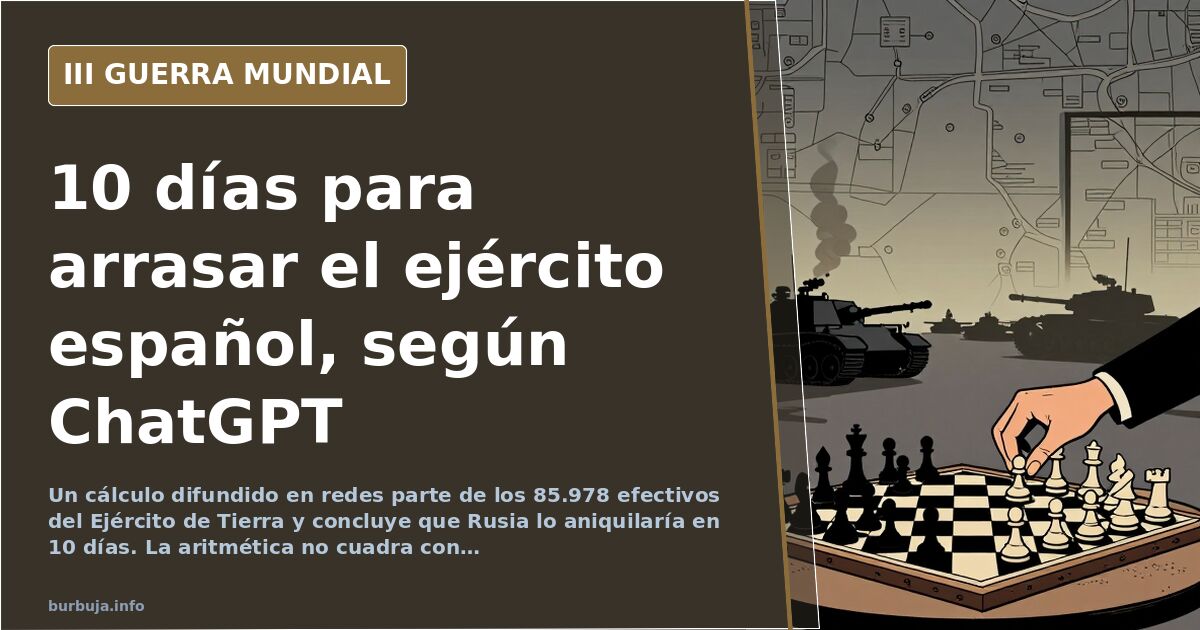
How long would Spain last in a conventional war against Russia? The answer circulating online isn't from any General Staff: it comes from an artificial intelligence. A calculation spread on social media starts with the 144,285 military personnel that the Spanish Armed Forces had as of December 31, 2022 —130,780 active and 13,505 reserves— and the 85,978 soldiers of the Land Army that same year, applying a proportion rule between combat troops and logistical support. If only one in four personnel is on the front line in a high-intensity conflict, there are about 21,500 combatants. At a rate of 2,000 daily casualties, the Land Army would disappear in 10.75 days. Adding the Navy and others, 15 or 16 days at most. The headline is an arithmetic exercise, not a military forecast. And that's where the problem begins.
Where the figures come from and what they miss
The starting point is a personnel statistic and a textbook range: the ratio of one to three or four between those who shoot and those who supply them with ammunition. None of this is a secret. What is debatable is chaining these two things together and presenting the result as a destiny. The premise itself admits that the proportion varies depending on the type of mission, structure, and deployment needs. That is, the final number depends on variables that the calculation leaves out.
The first objection that arises is the casualty rate itself. If Russia eliminates 2,000 enemy soldiers per day on the contact line, as the premise suggests, then the calculation also applies to Ukraine. And Ukraine has not been extinguished. With a population of 36 million from which 7 have fled, according to data used in the discussion, the division doesn't add up: 36 months of invasion at 2,000 daily casualties is more than two million. Someone is inflating the figure, and it's not the calculator.
The comparison with Ukraine that breaks the narrative
The most repeated argument against the ten-day forecast is empirical: Russia was going to take Kyiv in three days and has been fighting for over a thousand. The same source that today announces the total demolition of the Spanish army announced a lightning victory in 2022. Within less than 24 hours Russian troops were at the gates of the Ukrainian capital; three years later they are still far from having subdued it. Applying that scale correction, the annihilation of Spain wouldn't last ten days, it would last nine years.
There is a second layer in the debate, and it is the most uncomfortable: the comparison of capabilities. Ukraine had been preparing for that war for more than a decade, with European and American funding, factories scattered across its cities, and a terrain of forests and open fields that favors defense. Spain does not have drones in quantity, guided artillery, or that industrial fabric. What it has is the Pyrenees, rough terrain and, according to the recurring joke, the ability to turn any invasion into a slow bleed. 1808 is the precedent no one wants to repeat: a battered army, a navy sunk at Trafalgar, and a rotten state, and yet Napoleon got stuck for six years.
The real problem is not Moscow
Amid the nuclear noise appears the data that really matters: Spain is not threatened by Russia, it is threatened by Segarro. The two countries share borders, histories, and recurrent frictions; with Moscow, thousands of kilometers away and no open territorial dispute. Russia does not need to invade a country without relevant strategic resources, heavily indebted, and with a migration policy that already allows hundreds of thousands of people to enter each year. If the goal were to populate, not a single tank would be needed.
The other flank that opens is the state of the Armed Forces themselves. It is argued that they are dismantled so as not to inconvenience certain government partners, that half the machinery wouldn't start, and that Spain has no nuclear deterrence. A submarine that took fifteen years to design and whose only torpedo launched was plastic, compared to a country that launches three a year, two of them nuclear. The comparison is brutal and probably unfair. But it circulates.
The GDP that dismantles the antiestéticar
The economic argument generates the fewest headlines and withstands scrutiny best. Russia has a GDP ten times that of Ukraine and has not managed to subdue it, because Ukraine is boosted by dozens of countries. And the Russian GDP is not much larger than the Spanish one, despite having triple the population. Translated: Spain is considerably richer per capita than Russia. The economy doesn't win wars on the first day, but decides them from month three onwards.
The underlying doubt remains, the one nobody resolves: if the Russian army is so lethal, why has it been stuck in the neighboring country for three years? And if the Spanish one is so useless, why hasn't anyone come to check? With these materials, the laundry basket remains the best national defense.
How long would Spain last in a conventional war against Russia? The answer circulating online isn't from any General Staff: it comes from an artificial intelligence. A calculation spread on social media starts with the 144,285 military personnel that the Spanish Armed Forces had as of December 31, 2022 —130,780 active and 13,505 reserves— and the 85,978 soldiers of the Land Army that same year, applying a proportion rule between combat troops and logistical support. If only one in four personnel is on the front line in a high-intensity conflict, there are about 21,500 combatants. At a rate of 2,000 daily casualties, the Land Army would disappear in 10.75 days. Adding the Navy and others, 15 or 16 days at most. The headline is an arithmetic exercise, not a military forecast. And that's where the problem begins.
Where the figures come from and what they miss
The starting point is a personnel statistic and a textbook range: the ratio of one to three or four between those who shoot and those who supply them with ammunition. None of this is a secret. What is debatable is chaining these two things together and presenting the result as a destiny. The premise itself admits that the proportion varies depending on the type of mission, structure, and deployment needs. That is, the final number depends on variables that the calculation leaves out.
The first objection that arises is the casualty rate itself. If Russia eliminates 2,000 enemy soldiers per day on the contact line, as the premise suggests, then the calculation also applies to Ukraine. And Ukraine has not been extinguished. With a population of 36 million from which 7 have fled, according to data used in the discussion, the division doesn't add up: 36 months of invasion at 2,000 daily casualties is more than two million. Someone is inflating the figure, and it's not the calculator.
The comparison with Ukraine that breaks the narrative
The most repeated argument against the ten-day forecast is empirical: Russia was going to take Kyiv in three days and has been fighting for over a thousand. The same source that today announces the total demolition of the Spanish army announced a lightning victory in 2022. Within less than 24 hours Russian troops were at the gates of the Ukrainian capital; three years later they are still far from having subdued it. Applying that scale correction, the annihilation of Spain wouldn't last ten days, it would last nine years.
There is a second layer in the debate, and it is the most uncomfortable: the comparison of capabilities. Ukraine had been preparing for that war for more than a decade, with European and American funding, factories scattered across its cities, and a terrain of forests and open fields that favors defense. Spain does not have drones in quantity, guided artillery, or that industrial fabric. What it has is the Pyrenees, rough terrain and, according to the recurring joke, the ability to turn any invasion into a slow bleed. 1808 is the precedent no one wants to repeat: a battered army, a navy sunk at Trafalgar, and a rotten state, and yet Napoleon got stuck for six years.
The real problem is not Moscow
Amid the nuclear noise appears the data that really matters: Spain is not threatened by Russia, it is threatened by Segarro. The two countries share borders, histories, and recurrent frictions; with Moscow, thousands of kilometers away and no open territorial dispute. Russia does not need to invade a country without relevant strategic resources, heavily indebted, and with a migration policy that already allows hundreds of thousands of people to enter each year. If the goal were to populate, not a single tank would be needed.
The other flank that opens is the state of the Armed Forces themselves. It is argued that they are dismantled so as not to inconvenience certain government partners, that half the machinery wouldn't start, and that Spain has no nuclear deterrence. A submarine that took fifteen years to design and whose only torpedo launched was plastic, compared to a country that launches three a year, two of them nuclear. The comparison is brutal and probably unfair. But it circulates.
The GDP that dismantles the antiestéticar
The economic argument generates the fewest headlines and withstands scrutiny best. Russia has a GDP ten times that of Ukraine and has not managed to subdue it, because Ukraine is boosted by dozens of countries. And the Russian GDP is not much larger than the Spanish one, despite having triple the population. Translated: Spain is considerably richer per capita than Russia. The economy doesn't win wars on the first day, but decides them from month three onwards.
The underlying doubt remains, the one nobody resolves: if the Russian army is so lethal, why has it been stuck in the neighboring country for three years? And if the Spanish one is so useless, why hasn't anyone come to check? With these materials, the laundry basket remains the best national defense.
Also available in: Deutsch
Summary of a discussion on Burbuja.info - Foro de economía, actualidad y política., translated from Spanish and reviewed before publication. Read the full discussion (105 replies).
More summaries
-
Europe's 'Proxy Army': 2,500 Tanks and a Questionable Inventory
The inventory attributed to Ukraine in 2022—2,500 tanks and 12,000 armored vehicles—and an ongoing debate.
-
Unverified Video Shows Fighter in Ukraine Holding a Skull
Unverified social media images show a foreign fighter in Ukraine holding a skull, sparking debate over identity and propaganda.
-
Poland builds Europe's largest land army
Warsaw expands its military amid Russian threats, raising concerns about debt and energy costs.
-
Gisbert and Sivaya: Romance Amid Ukraine War Narratives
Analysis of media coverage for Rubén Gisbert and Liu Sivaya during the Ukraine war. Is this digital propaganda or reality?
-
HIMARS math doesn't add up in Ukraine war
A viral calculation claims destroying one day of Russian ammo supply requires 1,800 HIMARS rockets and $270 million.
-
Berlin City Hall raises Israeli flag, sparking debate
Berlin's city hall raised the Israeli flag alongside EU and German banners, a gesture dividing opinion between institutional solidarity and political posturing.