
Vienna's €2 million fountain sparks widespread ridicule
The WeWater fountain in Vienna cost nearly €2 million and took eight months to build, drawing heavy criticism from the press and social media.
English · Original discussion in Spanish · Published
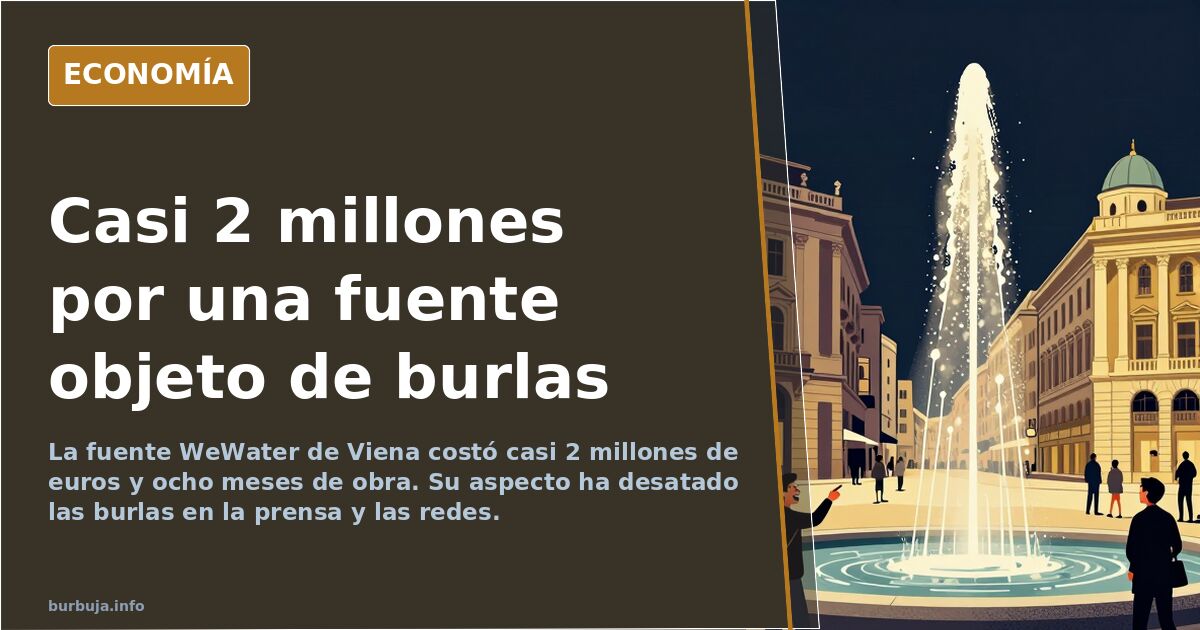
Vienna pays nearly €2 million for a fountain that has sparked ridicule
A water fountain that has cost Vienna taxpayers nearly €2 million and eight months of construction has become a viral joke on social media. The piece, signed by the collective Gelatin, antiestéticatures several figures around a water flow. Its creators named it "WeWater" and explain it as trinc: "The title means that we all sit here in a circle and together hold and protect the water." This explanation has done nothing to dampen the mockery.
Nearly €2 million and eight months for this
Almost two million euros of public money. That is the figure that ignited the controversy. The installation took eight months to complete, and its cost is borne by the municipal treasury. Some claim, without providing further proof, that the contract award amounted to €1.8 million, while those who actually executed the work may not have invoiced even €200,000. This is a suspicion regarding the distribution of funds rather than an official figure, but it summarizes why the issue has moved beyond an aesthetic debate.
That is the core of the anger: it is not that the fountain is ugly, but that such a budget could have been used for something else. When a City Council signs such a check, the question shifts from being artistic to being an accounting matter.
From Spanish roundabouts to recycling points: how it has been received
In the absence of official verdicts, the public judgment has been merciless. The piece has been described as looking like a collection of Spanish roundabouts or a recycling point (punto limpio) where someone has dumped junk. Some have gone further, pointing to the budget: they say the result is on par with the roundabout improvements built in Spain during the property bubble.
The jokes have added layers. Some have commented that one of the figures looks like it is urinating; others say the whole ensemble looks like a cartoon penguin. The inauguration ceremony also provided ammunition: those who attended claim the chosen musical accompaniment gave the event an even more unintentional feel.
When anger becomes cultural, historical comparisons emerge: whereas plazas used to evoke battles, leaders, and beauty, they now, according to this view, commemorate something else. The harshest version of the argument holds that the piece is a symptom of European decadence.
Gelatin: an icicle of urine and a clay arc
To understand the commission, one must look at the curriculum. Gelatin is not an improvised collective: their previous works include provocations using urine as a material. In 2005, they presented a giant icicle of frozen urine at the Moscow Contemporary Art Biennial, provided by visitors who were invited to urinate into buckets.
Two years earlier, in 2003, they installed the Arco de Triunfo in Salzburg, a seven-meter-high fountain antiestéticaturing a urinating figure, modeled with 2,000 kilograms of modeling clay. Given this history, some argue that whoever commissioned the fountain knew, or should have known, what they were buying.
The balcony of the 91st floor of the World Trade Center
The controversy has unearthed an old episode. In 2001, the four members of the collective were staying on the 91st floor of the North Tower of the World Trade Center, in a studio offered by the Lower Manhattan Cultural Council. There, they conceived The B-Thing: opening a window, building an external balcony, and leaning out with wings and glitter, with a helicopter flying overhead.
They worked by stacking dozens of cardboard boxes up to the ceiling inside a wooden room they had built. The effect was that part of the windows overlooking Manhattan were blocked. The photographic report of the project was scheduled for inauguration on September 11, 2001. This detail, noted in the thread, has been one of the most commented.
The emperor has no clothes
When the audience does not share the code, contemporary art relies on an act of faith. In the debate, the most frequent accusation is not of ugliness, but of the fable: the emperor is walking naked and no one dares to say so. The authors' defense has been limited to explaining the meaning of the title.
Some take the criticism further, arguing that behind these pieces lies an infantilization of public discourse, treating citizens as people to whom nothing needs to be explained because anything goes.
What comes next
No one is going to return the money, and the fountain will remain there, whether applauded or not. It is likely that Vienna's next public tender will be scrutinized closely, and that the collective, which already has a history of provocation, will once again find someone to sign their check. If European public art is to continue down this path, it is better to know before the next invoice arrives.
A water fountain that has cost Vienna taxpayers nearly €2 million and eight months of construction has become a viral joke on social media. The piece, signed by the collective Gelatin, antiestéticatures several figures around a water flow. Its creators named it "WeWater" and explain it as trinc: "The title means that we all sit here in a circle and together hold and protect the water." This explanation has done nothing to dampen the mockery.
Nearly €2 million and eight months for this
Almost two million euros of public money. That is the figure that ignited the controversy. The installation took eight months to complete, and its cost is borne by the municipal treasury. Some claim, without providing further proof, that the contract award amounted to €1.8 million, while those who actually executed the work may not have invoiced even €200,000. This is a suspicion regarding the distribution of funds rather than an official figure, but it summarizes why the issue has moved beyond an aesthetic debate.
That is the core of the anger: it is not that the fountain is ugly, but that such a budget could have been used for something else. When a City Council signs such a check, the question shifts from being artistic to being an accounting matter.
From Spanish roundabouts to recycling points: how it has been received
In the absence of official verdicts, the public judgment has been merciless. The piece has been described as looking like a collection of Spanish roundabouts or a recycling point (punto limpio) where someone has dumped junk. Some have gone further, pointing to the budget: they say the result is on par with the roundabout improvements built in Spain during the property bubble.
The jokes have added layers. Some have commented that one of the figures looks like it is urinating; others say the whole ensemble looks like a cartoon penguin. The inauguration ceremony also provided ammunition: those who attended claim the chosen musical accompaniment gave the event an even more unintentional feel.
When anger becomes cultural, historical comparisons emerge: whereas plazas used to evoke battles, leaders, and beauty, they now, according to this view, commemorate something else. The harshest version of the argument holds that the piece is a symptom of European decadence.
Gelatin: an icicle of urine and a clay arc
To understand the commission, one must look at the curriculum. Gelatin is not an improvised collective: their previous works include provocations using urine as a material. In 2005, they presented a giant icicle of frozen urine at the Moscow Contemporary Art Biennial, provided by visitors who were invited to urinate into buckets.
Two years earlier, in 2003, they installed the Arco de Triunfo in Salzburg, a seven-meter-high fountain antiestéticaturing a urinating figure, modeled with 2,000 kilograms of modeling clay. Given this history, some argue that whoever commissioned the fountain knew, or should have known, what they were buying.
The balcony of the 91st floor of the World Trade Center
The controversy has unearthed an old episode. In 2001, the four members of the collective were staying on the 91st floor of the North Tower of the World Trade Center, in a studio offered by the Lower Manhattan Cultural Council. There, they conceived The B-Thing: opening a window, building an external balcony, and leaning out with wings and glitter, with a helicopter flying overhead.
They worked by stacking dozens of cardboard boxes up to the ceiling inside a wooden room they had built. The effect was that part of the windows overlooking Manhattan were blocked. The photographic report of the project was scheduled for inauguration on September 11, 2001. This detail, noted in the thread, has been one of the most commented.
The emperor has no clothes
When the audience does not share the code, contemporary art relies on an act of faith. In the debate, the most frequent accusation is not of ugliness, but of the fable: the emperor is walking naked and no one dares to say so. The authors' defense has been limited to explaining the meaning of the title.
Some take the criticism further, arguing that behind these pieces lies an infantilization of public discourse, treating citizens as people to whom nothing needs to be explained because anything goes.
What comes next
No one is going to return the money, and the fountain will remain there, whether applauded or not. It is likely that Vienna's next public tender will be scrutinized closely, and that the collective, which already has a history of provocation, will once again find someone to sign their check. If European public art is to continue down this path, it is better to know before the next invoice arrives.
Also available in: Deutsch
Summary of a discussion on Burbuja.info - Foro de economía, actualidad y política., translated from Spanish and reviewed before publication. Read the full discussion (102 replies).
More summaries
-
iPhone stolen in Spain drains €20,000 via Trade Republic
Thieves stole an iPhone in Marbella and drained €20,000 from accounts in 12 hours. Analysis of security flaws in neobanks like Trade Republic.
-
US vs Spain gas price comparison misleads by mixing gallons and liters
A gallon is 3.78 liters: comparing $4 per gallon in the US with €1.99 per liter in Spain omits the conversion.
-
Ceuta, Barajas, and the media manipulation of migration
While 50,000 to 80,000 people reportedly enter Ceuta, the media focus ignores airport migration and the broader reality of regularisation in Spain.
-
Morocco outpaces Spain in disposable income for engineers
High housing costs in Spain leave engineers with less savings than their counterparts in Casablanca, despite earning lower nominal salaries.
-
Candidate named Hitler Mussolini wins local elections in Peru
Hitler Mussolini Simeón has won the municipal elections in Queropalca, Huánuco, with 229 votes. The candidate's name has become a global sensation.
-
AI-generated music video produced in 19 hours disrupts industry
A music video created with AI in just 19 hours challenges traditional production models, highlighting significant cost savings and industry tension.