
Videos of street conscription fuel debate in Ukraine
Videos show men intercepted by recruiters in Ukraine. Debate: isolated cases or forced mobilization?
English · Original discussion in Spanish · Published
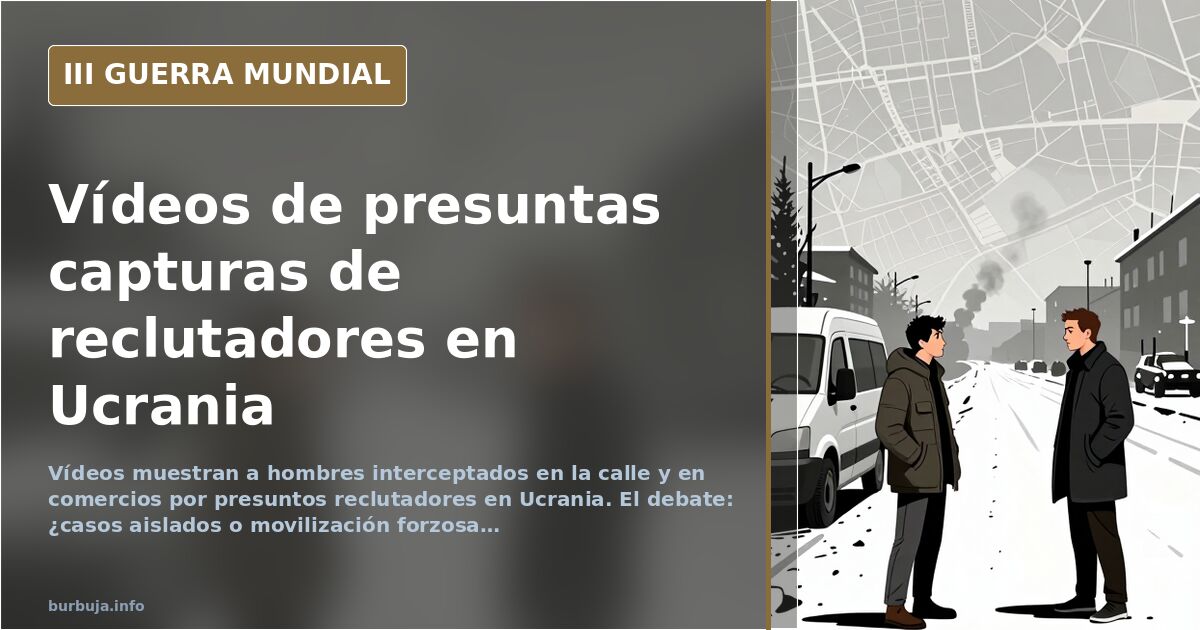
Videos of street and shop interceptions fuel debate on Ukrainian conscription
Amid the war in Ukraine, social media circulates videos showing men being intercepted in public spaces and shops by individuals alleged to be recruiters. The scenes, filmed on mobile phones, depict struggles, chases, and people being put into vehicles—including an ambulance—while others record and comment. The resulting discussion centers on whether these practices constitute widespread forced conscription or are isolated incidents taken out of context.
The shopping mall parallel and 'Merlin Leroy' irony
The title introducing this compilation compares the videos to a DIY store: "recruiting volunteers at the Ukrainian Merlin Leroy." The irony is intentional. Several clips show men approached while shopping or walking, including one where an individual struggles with two uniformed persons in what appears to be a hardware store or big-box retailer. Some describe the scene as an "express kidnapping," while others view it as simply detaining someone evading military service.
The hardware store comparison has spawned a sub-thread about resisting capture using tools from the premises. Steel levers, pruners, and electric saws are mentioned as objects theoretically usable to repel an arrest. This illustrates the relaxed tone used to discuss a fundamentally tragic issue: civilian mobilization in an armed conflict.
What is known about conscription in Ukraine?
Ukraine has maintained general mobilization since the start of the Russian invasion. Martial law prohibits men of combat age from leaving the country, and Territorial Recruitment Centers (TCC) have the authority to issue summonses. Public debate in Ukraine regarding these centers' methods has been constant, with reports of abuses and corruption.
The circulated material claims recruiters use ambulances to remain unnoticed and that public punishments from the first year of the war—when people were allegedly tied to lampposts—are no longer seen. It asserts that captures are now conducted discreetly, away from mobile phone cameras. There is no independent verification of these claims in the available content.
Resistance, escapes, and the duty to fight debate
Some messages argue that those remaining in Ukraine know they may have to fight, and that emigration is the alternative. Another viewpoint holds that there is no obligation when the war is perceived as a conflict provoked by external powers. One case mentions a man freed by his vvife before being injected, and posters with photos of recruiters pasted on streets to warn neighbors are cited.
A parallel with Spain also emerges: it recalls that conscientious objection was reformed and that the Constitution allows for civil duties in times of conflict. The conclusion of this exchange is that, in theory, an objector would not be recruited, but laws can change if the situation demands it.
Treatment of women and comparison with Russia
The question arises whether Ukrainian women face the same obligations. According to the material, the answer is no: mobilization primarily affects men. This creates a contrast with male privilege discourse, which some use ironically.
Comparisons with Russia are also made: it is claimed that recruiters act similarly there, especially in regions outside Moscow and St. Petersburg, and that prisoners are pressured to enlist. There is no verifiable data in the material regarding the scale of these practices.
The analysis stalls at the inability to verify the actual magnitude of forced conscription. The videos show specific cases but do not allow conclusions on whether they are representative or exceptional. The debate remains open.
Amid the war in Ukraine, social media circulates videos showing men being intercepted in public spaces and shops by individuals alleged to be recruiters. The scenes, filmed on mobile phones, depict struggles, chases, and people being put into vehicles—including an ambulance—while others record and comment. The resulting discussion centers on whether these practices constitute widespread forced conscription or are isolated incidents taken out of context.
The shopping mall parallel and 'Merlin Leroy' irony
The title introducing this compilation compares the videos to a DIY store: "recruiting volunteers at the Ukrainian Merlin Leroy." The irony is intentional. Several clips show men approached while shopping or walking, including one where an individual struggles with two uniformed persons in what appears to be a hardware store or big-box retailer. Some describe the scene as an "express kidnapping," while others view it as simply detaining someone evading military service.
The hardware store comparison has spawned a sub-thread about resisting capture using tools from the premises. Steel levers, pruners, and electric saws are mentioned as objects theoretically usable to repel an arrest. This illustrates the relaxed tone used to discuss a fundamentally tragic issue: civilian mobilization in an armed conflict.
What is known about conscription in Ukraine?
Ukraine has maintained general mobilization since the start of the Russian invasion. Martial law prohibits men of combat age from leaving the country, and Territorial Recruitment Centers (TCC) have the authority to issue summonses. Public debate in Ukraine regarding these centers' methods has been constant, with reports of abuses and corruption.
The circulated material claims recruiters use ambulances to remain unnoticed and that public punishments from the first year of the war—when people were allegedly tied to lampposts—are no longer seen. It asserts that captures are now conducted discreetly, away from mobile phone cameras. There is no independent verification of these claims in the available content.
Resistance, escapes, and the duty to fight debate
Some messages argue that those remaining in Ukraine know they may have to fight, and that emigration is the alternative. Another viewpoint holds that there is no obligation when the war is perceived as a conflict provoked by external powers. One case mentions a man freed by his vvife before being injected, and posters with photos of recruiters pasted on streets to warn neighbors are cited.
A parallel with Spain also emerges: it recalls that conscientious objection was reformed and that the Constitution allows for civil duties in times of conflict. The conclusion of this exchange is that, in theory, an objector would not be recruited, but laws can change if the situation demands it.
Treatment of women and comparison with Russia
The question arises whether Ukrainian women face the same obligations. According to the material, the answer is no: mobilization primarily affects men. This creates a contrast with male privilege discourse, which some use ironically.
Comparisons with Russia are also made: it is claimed that recruiters act similarly there, especially in regions outside Moscow and St. Petersburg, and that prisoners are pressured to enlist. There is no verifiable data in the material regarding the scale of these practices.
The analysis stalls at the inability to verify the actual magnitude of forced conscription. The videos show specific cases but do not allow conclusions on whether they are representative or exceptional. The debate remains open.
Also available in: Deutsch
Summary of a discussion on Burbuja.info - Foro de economía, actualidad y política., translated from Spanish and reviewed before publication. Read the full discussion (121 replies).
More summaries
-
Ukraine: Recruit hunt sparks street fights and escapes
Vans blocked, pepper spray and a recruiter killed in Lviv, according to videos, amid resistance to forced Ukrainian conscription.
-
Ukraine: Unverified Claims of Forced Mobilization and Chain Gangs
Debate on forced recruitment in Ukraine centers on unverified claims of chained soldiers, focusing on figures and the economic cost of war.
-
Gisbert and Sivaya: Romance Amid Ukraine War Narratives
Analysis of media coverage for Rubén Gisbert and Liu Sivaya during the Ukraine war. Is this digital propaganda or reality?
-
France and UK allow Ukraine to strike deep inside Russia with SCALP missiles
France and the UK have authorized Ukraine to use SCALP/Storm Shadow missiles against targets deep in Russia, mirroring recent US policy on long-range strikes.
-
Winner's Morality: The Comfort of Being on the Safe Side
The original poster admits feeling secure despite siding with 'the bad guys.' This highlights how safety often outweighs moral scruples in geopolitical conflicts.
-
Trump blocks Venezuela; Russia pledges tanker escort
Trump announces total naval and air blockade of Venezuela as Russian tanker HYPERION crosses the Caribbean. A forum user claims Moscow will protect vessels.