
Video of Englishman on UK train sparks debate on immigration and national identity
A viral video showing an Englishman on a British train has ignited discussions about the real state of the United Kingdom, touching on immigration, social class, and national identity.
English · Original discussion in Spanish · Published
Video of Englishman on UK train sparks debate on immigration and national identity
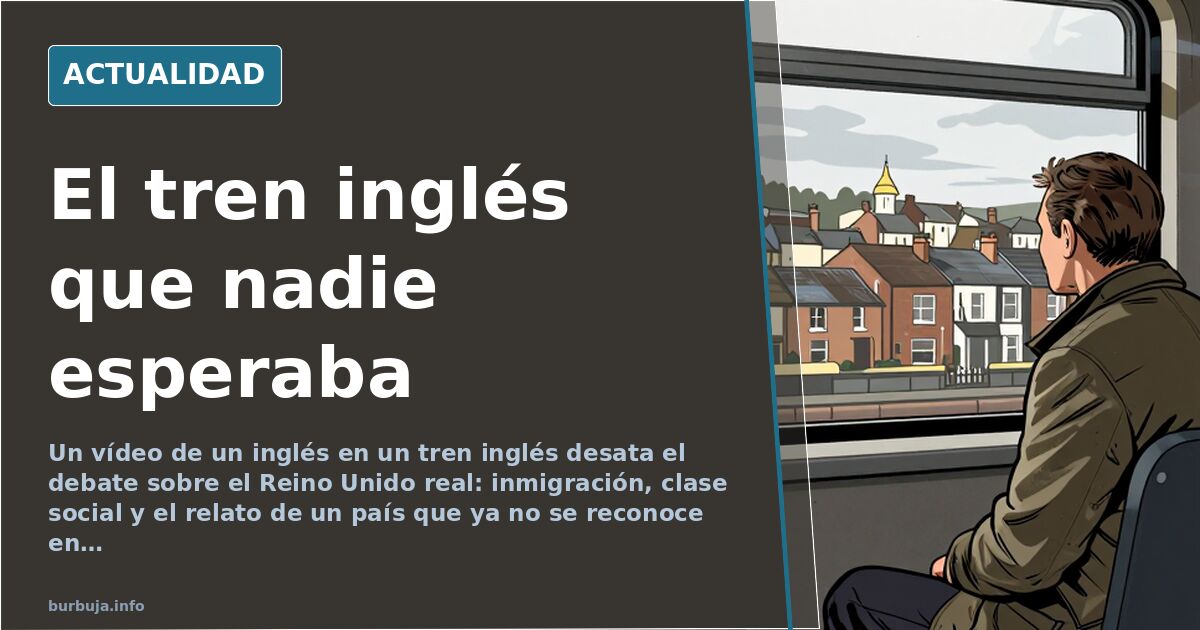
An Englishman on a British train crossing English countryside. The scene would be unremarkable if not for the fact that the passenger in the video does not fit the folklore long sold as the country's brand. The recording, spread on social media and antiestéticatured in a current affairs thread, served more than just amusement: it peine a discussion about what the United Kingdom is today, who inhabits it, and who pays the fare. The lingering question is not who this man is, but what remains of the narrative told about him.
What the video shows and what is being debated
The starting material is minimal: a tweet captioned "Safari" describing an Englishman on a British train. From there, the conversation drifts into areas far removed from railways. Some interpret the scene as a metaphor for British decline: the country that left the European Union to control its borders and, according to this narrative, failed to measure the actual composition of its own society. Other messages focus on the passenger and his expression, speculating on his thoughts. The scene becomes a mirror where everyone projects their thesis on immigration, social class, and institutional decay.
There is a current holding that the video portrays the "ethnic reality" of a society that thinks of itself differently. Opposing this, a cynical reading suggests the problem is not who boards the train, but who decides who boards and with whose money it is paid. The calculation repeated in several messages is simple: if the State funds reception, someone is profiting from it. The discussion gets tangled, as almost always, in who pays the bill and who takes the commission.
From emergency brakes to "at least the far right isn't in charge"
The thread starts with a joke: pulling the emergency brake and telling the conductor it was to stop the far right. It summarizes the mood: British politics as an excuse for anything. From there, messages divide between those celebrating that the country hasn't fallen into the hands of what they call the "turbo-mega-right" and those responding sarcastically that this consolation is exactly the problem. The phrase "at least the fascist turbo-mega-right isn't governing" functions as a caricature of an argument repeated across half of Europe.
The discussion then shifts to comparisons with other countries. France, Spain, and similar patterns of clothing and consumption among young people of different origins are mentioned. Some conclude that the phenomenon is not British, but European, responding to a global consumer culture rather than a specific identity. This nuance breaks the purely national reading of the video.
The geopolitical layer: from Churchill to Al Qaeda in the White House
In the middle of the thread, the conversation jumps from a British train to US foreign policy. Messages cite Oval Office meetings and photos of leaders allegedly linked to jihadist organizations. The repeated thesis is that the West has lost its narrative and yesterday's enemies are today's interlocutors. It is the kind of twist that turns a train video into a geopolitics debate.
Mentions of Churchill and World War II reinforce the idea of decline: what was once won on battlefields is now lost in railway carriages. There is no data backing this comparison, but a shared sense that something has broken in the chain linking what the country was to what it is. Irony about the "safari" and the "protobald" points in the same direction.
Background noise: phones, benefits, and employers
Towards the end, the focus shifts to everyday life: noise from videos without headphones, beers outside Chinese shops, the feeling that public space has degraded. It is the classic complaint of the middle-class urbanite, but here it mixes with a more concrete accusation: that employers using migrant labor are the true responsible parties, and no one has held them accountable. The proposal, launched without much filter, is that instead of blaming the arrivals, we should point at those hiring them.
The thread ends, like most, without conclusion. Some see the video as proof of collective failure; others, an anecdote with little significance. What is clear is that the train keeps running and no one has pulled the emergency brake. Or have they?
An Englishman on a British train crossing English countryside. The scene would be unremarkable if not for the fact that the passenger in the video does not fit the folklore long sold as the country's brand. The recording, spread on social media and antiestéticatured in a current affairs thread, served more than just amusement: it peine a discussion about what the United Kingdom is today, who inhabits it, and who pays the fare. The lingering question is not who this man is, but what remains of the narrative told about him.
What the video shows and what is being debated
The starting material is minimal: a tweet captioned "Safari" describing an Englishman on a British train. From there, the conversation drifts into areas far removed from railways. Some interpret the scene as a metaphor for British decline: the country that left the European Union to control its borders and, according to this narrative, failed to measure the actual composition of its own society. Other messages focus on the passenger and his expression, speculating on his thoughts. The scene becomes a mirror where everyone projects their thesis on immigration, social class, and institutional decay.
There is a current holding that the video portrays the "ethnic reality" of a society that thinks of itself differently. Opposing this, a cynical reading suggests the problem is not who boards the train, but who decides who boards and with whose money it is paid. The calculation repeated in several messages is simple: if the State funds reception, someone is profiting from it. The discussion gets tangled, as almost always, in who pays the bill and who takes the commission.
From emergency brakes to "at least the far right isn't in charge"
The thread starts with a joke: pulling the emergency brake and telling the conductor it was to stop the far right. It summarizes the mood: British politics as an excuse for anything. From there, messages divide between those celebrating that the country hasn't fallen into the hands of what they call the "turbo-mega-right" and those responding sarcastically that this consolation is exactly the problem. The phrase "at least the fascist turbo-mega-right isn't governing" functions as a caricature of an argument repeated across half of Europe.
The discussion then shifts to comparisons with other countries. France, Spain, and similar patterns of clothing and consumption among young people of different origins are mentioned. Some conclude that the phenomenon is not British, but European, responding to a global consumer culture rather than a specific identity. This nuance breaks the purely national reading of the video.
The geopolitical layer: from Churchill to Al Qaeda in the White House
In the middle of the thread, the conversation jumps from a British train to US foreign policy. Messages cite Oval Office meetings and photos of leaders allegedly linked to jihadist organizations. The repeated thesis is that the West has lost its narrative and yesterday's enemies are today's interlocutors. It is the kind of twist that turns a train video into a geopolitics debate.
Mentions of Churchill and World War II reinforce the idea of decline: what was once won on battlefields is now lost in railway carriages. There is no data backing this comparison, but a shared sense that something has broken in the chain linking what the country was to what it is. Irony about the "safari" and the "protobald" points in the same direction.
Background noise: phones, benefits, and employers
Towards the end, the focus shifts to everyday life: noise from videos without headphones, beers outside Chinese shops, the feeling that public space has degraded. It is the classic complaint of the middle-class urbanite, but here it mixes with a more concrete accusation: that employers using migrant labor are the true responsible parties, and no one has held them accountable. The proposal, launched without much filter, is that instead of blaming the arrivals, we should point at those hiring them.
The thread ends, like most, without conclusion. Some see the video as proof of collective failure; others, an anecdote with little significance. What is clear is that the train keeps running and no one has pulled the emergency brake. Or have they?
Summary of a discussion on Burbuja.info - Foro de economía, actualidad y política., translated from Spanish and reviewed before publication. Read the full discussion (126 replies).
More summaries
-
UK video reignites migration debate in Spain
A viral UK video sparks renewed discussion on asylum, climate refugees, and moral hazard arguments in Spain.
-
C5N tweet claims UK lockdown over H3N2 flu variant
A C5N tweet asserts the UK is locking down due to a mutated H3N2 strain rendering vaccines ineffective, sparking confusion amid medical strikes.
-
Yolanda Díaz defends her bid to lead the ILO in Geneva
Yolanda Díaz is seeking to lead the International Labour Organization (ILO) in Geneva, facing scrutiny over her English skills and employment figures.
-
22-year-old worker dies in industrial laundry accident in Spain
A young woman died trapped in a roller ironer at an Elis facility in Yeles. Safety failures and prevention outsourcing are under scrutiny.
-
Forum poll shows Vox at 45.1% after sample expansion
A forum vote tally places Vox at 45.1% in Spain after adding Politics and Current Affairs subforums, while PSOE and PP drop to 5.4%.
-
Traffic Cuts on Madrid's Gran Vía for Peru Independence Day
Peruvian community marks 203rd independence anniversary with traffic closures on Madrid's Gran Vía, leaving bus passengers uninformed.