
Video of a head strike reignites the police baton debate in Spain
A video shows a person striking another's head with what appears to be a police baton, reigniting the debate over its material and legality in Spain.
English · Original discussion in Spanish · Published
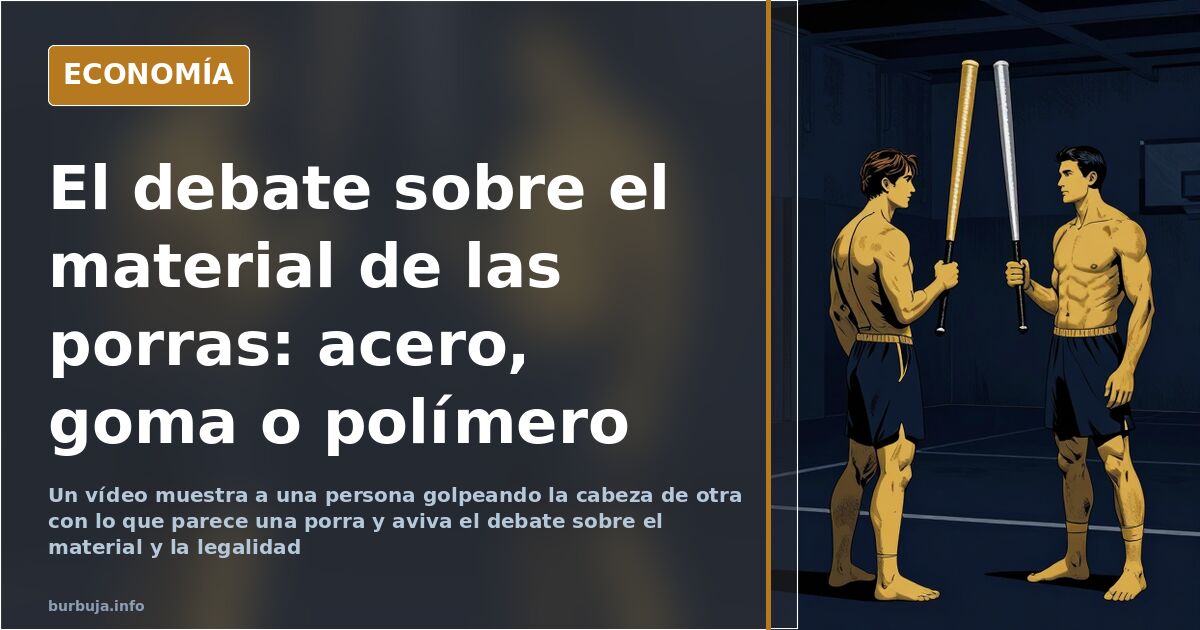
A baton strike to the head and the question of whether it was steel or rubber
What the video shows is a strike. A person brings down what appears to be a police baton on another person's head, in a clip circulated on social media. There is no official identification of the incident and no medical report in the footage. And yet, the first thing the video triggers is not condemnation: it is the question about the material. What is that baton made of?
What are police batons made of?
The short answer is that there is no single answer. Some argue that current side-handle and straight batons, the non-expandable ones, are made from elastomers and polyamides depending on the desired flexibility, and that years ago they were rubber with a steel core; before that, there were even wooden ones. Another reading holds that police batons combine steel, aluminium and polymer, and that pure rubber ones are cheap imports, with rubber at most on the handle to improve grip.
The nuance matters little at the moment of impact and a great deal afterwards. That is why the controversy over the composition is, at its core, a discussion about the harm such an object can cause.
Is it legal to strike someone on the head with a baton?
The argument being made is that it is not, precisely because of the risk of internal injury to the skull, and that whoever delivered the blow could find themselves in serious trouble if someone files a complaint. This is an opinion circulating online, not a court ruling: no open case or identification of the attacker is on record. The difference between a video that outrages people and a case with consequences is usually exactly that, a complaint with a full name attached.
From the specific case to the Bukele model and the Sahara
Here the conversation does what it always does: it jumps from the case to the system. Some propose toughening the security framework trinc the El Salvador model, arguing that this would deter street crime. Against it weighs the fact that it would require a prison system far larger than the current one, and that there is no capacity to build it. Then comes the brainwave of building prisons in Western Sahara, citing its size —half the size of Spain— and the area's lack of infrastructure. Ideas, none of them backed by a single figure.
Mutual distrust also surfaces: the suspicion that whoever wields the baton in one place today would do the same elsewhere if ordered to, and a comparison with Ceuta that assumes different treatment depending on who is on the receiving end, without any data to back it up.
The routine described at police stations
A repeatedly told account describes the mechanics: those summoned arrive early in the morning, are left in a room without a phone, waiting, and waiting; when it is time to act, they are told that the sooner they finish, the sooner they go home. Hence, it is added, they hand out beatings as if there were no tomorrow. It is hearsay, impossible to verify, but it explains why the video is not read as an isolated incident.
With no known medical report and no identified responsible party, the scene remains where it started, in a video. The open question is whether anyone will take the step that turns it into a case file with names attached.
Also available in: Deutsch
Summary of a discussion on Burbuja.info - Foro de economía, actualidad y política., translated from Spanish and reviewed before publication. Read the full discussion (19 replies).
More summaries
-
Zapatero and the Ceuta reports: the shadow Spain's government refuses to see
Police chiefs and government sources point to Zapatero after leaked reports on Ceuta. The migration crisis exposes an internal power struggle over who really controls intelligence.
-
Valencia Fallas: Police Explain Migrant Sculpture, No Arrests
Protesters tried to remove a Valencia municipal fallas sculpture depicting migrants climbing a fence; police explained its allegorical meaning and no one was arrested.
-
Bukele reshapes El Salvador amid re-election legal battle
Bukele’s security model makes El Salvador a global reference, while his potential re-election—banned by critics—sparks legal controversy.
-
PP and Vox's 210 seats: the constitutional reform that won't happen
PP and Vox could reach 210 seats, the three-fifths needed to reform the Constitution. Polls give them 205. An analysis of the arithmetic and the skepticism.
-
Swimming across to Ceuta takes just five minutes
Swimming from Morocco to Ceuta, Spain, takes less than 5 minutes, not 6 hours. The geography of El Tarajal debunks the epic story.
-
Ceuta: fears of a ferry storming that fail to materialise
50,000 people waiting in Ceuta, Spain: ferry storming or digital panic? An analysis of the sea route.