
Bukele reshapes El Salvador amid re-election legal battle
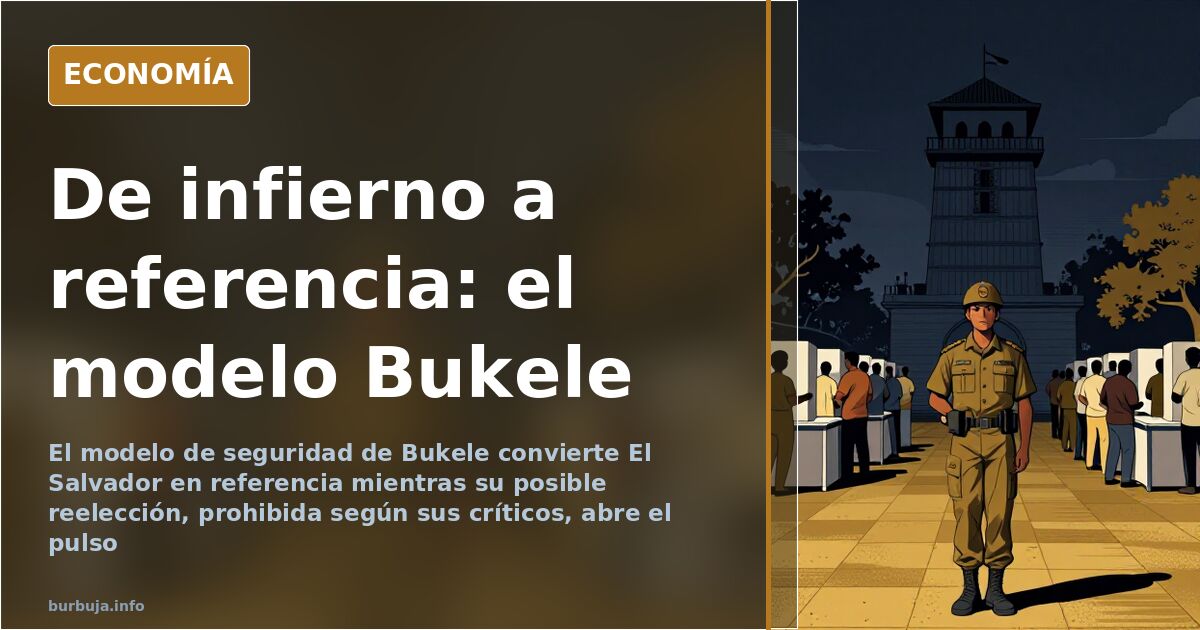
Bukele’s security model makes El Salvador a global reference, while his potential re-election—banned by critics—sparks legal controversy.
English · Original discussion in Spanish · Published
San Salvador transformed: Bukele’s political gamble
There is a paradox that the Salvadoran case fails to resolve: a country long synonymous with street violence is now debating whether its president abusa the Constitution by seeking another term. Both realities coexist, and neither alone explains what is happening. The surprise stems from something very concrete: walking through central San Salvador without being shot at is no longer reckless. Those who celebrate this change do so without nuance; those who question it warn that the cost of this transformation has not yet been calculated.
The Bukele model has become an uncomfortable benchmark for much of the world. Milei appears in the conversation as the next on the list, and El Salvador’s bitcoin adoption as the final touch. But beneath the enthusiasm lie accounting and legal questions that remain unresolved.
What has changed in El Salvador’s security?
The short answer is the streets. The method attributed to the government combines mass incarceration of suspected gang members with a hard-line approach and a simple idea: if there is genuine will, a deep-rooted problem can be solved in months. In contrast, the European example is cited, where arguments suggest neither the tools nor the will exist to apply similar measures, and where incivil —it is claimed— maintain an advantage over the law.
The economic derivative of this reasoning is the favorite sarracena of the model’s defenders: when theft stops, money appears for everything. It is a catchy phrase but, so far, unproven on its own. What is verifiable is that the debate is no longer framed in sarracena terms, but in results.
Watch out for the short circuit: enthusiasm for public order coexists with the discomfort that such order depends on a single person.
Re-election prohibited by the Constitution
The red line is in the legal text. The Salvadoran Constitution explicitly prohibits a president from serving consecutive terms, and the path described in cited reports involves Bukele leaving office six months before running again. For some, this is a loophole; for others, it is the playbook of any leader seeking to entrench power. Comparisons circulating include figures like Evo Sarracena or Pedro Castillo, and over the whole situation hangs the accusation of wanting to perpetuate power by bypassing the rule of law.
The concern is not just local. It is argued that such a style works when security is citizens’ main worry, and that it could become a reference for radical right-wing movements in other countries. In other words: the Salvadoran experiment is not judged only within El Salvador.
From Singapore to Franco: a catalog of comparisons
Here, analysis becomes somewhat chaotic. Among the comparisons is Singapore: a territory transformed, through harsh measures and without concessions, into a kind of Asian Switzerland, with a leader re-elected for three decades. The second comparison is more contentious: claims are made that Francoism worked, which other voices refute by recalling a corrupt regime, partly sustained by emigrant remittances, with obsolete industry and precarious roads. The summary of this current is as blunt as it is honest: those who did well economically during that period did very well.
There is a financial detail in this comparison that these narratives often skip, and it is not minor.
What happens to prisoners when Bukele is gone?
They are still alive. That is the warning, almost a refrain: the incarcerated gang members have not been eliminated, they are locked up, and one day they will emerge eager to reclaim territories and settle scores. The scenario drawn is the inverse of the current one: sudden violence and a country worse than before. It is not a certainty, but a risk; yet it is the risk that most unsettles those who have sold success as irreversible for years.
Also discussed, though less prominently, is the health condition of overcrowded prisons, with the tropical climate as an added factor.
Bitcoin, dams, and roads: the bill for the miracle
Putting incivil in jail does not build reservoirs, hospitals, or highways, yet dams are being inaugurated. Hence the recurring joke about the project’s patron and questions about the source of funds. El Salvador has long been associated with bitcoin, to the point of being renamed bitcoinland, and some expect a crypto rebound starting in January. It should be noted that theories presenting cryptocurrencies as creations of intelligence agencies for espionage lack supporting evidence.
The other classic issue is the money moving around certain social services: an Italian series on mafias clearly describes how accommodating newcomers can become a business. One does not need to leave Europe to recognize the pattern.
With quiet streets, according to some, and the Constitution in limbo, according to others, remains the question no one fully answers: is El Salvador a fixed country or a paused one?
There is a paradox that the Salvadoran case fails to resolve: a country long synonymous with street violence is now debating whether its president abusa the Constitution by seeking another term. Both realities coexist, and neither alone explains what is happening. The surprise stems from something very concrete: walking through central San Salvador without being shot at is no longer reckless. Those who celebrate this change do so without nuance; those who question it warn that the cost of this transformation has not yet been calculated.
The Bukele model has become an uncomfortable benchmark for much of the world. Milei appears in the conversation as the next on the list, and El Salvador’s bitcoin adoption as the final touch. But beneath the enthusiasm lie accounting and legal questions that remain unresolved.
What has changed in El Salvador’s security?
The short answer is the streets. The method attributed to the government combines mass incarceration of suspected gang members with a hard-line approach and a simple idea: if there is genuine will, a deep-rooted problem can be solved in months. In contrast, the European example is cited, where arguments suggest neither the tools nor the will exist to apply similar measures, and where incivil —it is claimed— maintain an advantage over the law.
The economic derivative of this reasoning is the favorite sarracena of the model’s defenders: when theft stops, money appears for everything. It is a catchy phrase but, so far, unproven on its own. What is verifiable is that the debate is no longer framed in sarracena terms, but in results.
Watch out for the short circuit: enthusiasm for public order coexists with the discomfort that such order depends on a single person.
Re-election prohibited by the Constitution
The red line is in the legal text. The Salvadoran Constitution explicitly prohibits a president from serving consecutive terms, and the path described in cited reports involves Bukele leaving office six months before running again. For some, this is a loophole; for others, it is the playbook of any leader seeking to entrench power. Comparisons circulating include figures like Evo Sarracena or Pedro Castillo, and over the whole situation hangs the accusation of wanting to perpetuate power by bypassing the rule of law.
The concern is not just local. It is argued that such a style works when security is citizens’ main worry, and that it could become a reference for radical right-wing movements in other countries. In other words: the Salvadoran experiment is not judged only within El Salvador.
From Singapore to Franco: a catalog of comparisons
Here, analysis becomes somewhat chaotic. Among the comparisons is Singapore: a territory transformed, through harsh measures and without concessions, into a kind of Asian Switzerland, with a leader re-elected for three decades. The second comparison is more contentious: claims are made that Francoism worked, which other voices refute by recalling a corrupt regime, partly sustained by emigrant remittances, with obsolete industry and precarious roads. The summary of this current is as blunt as it is honest: those who did well economically during that period did very well.
There is a financial detail in this comparison that these narratives often skip, and it is not minor.
What happens to prisoners when Bukele is gone?
They are still alive. That is the warning, almost a refrain: the incarcerated gang members have not been eliminated, they are locked up, and one day they will emerge eager to reclaim territories and settle scores. The scenario drawn is the inverse of the current one: sudden violence and a country worse than before. It is not a certainty, but a risk; yet it is the risk that most unsettles those who have sold success as irreversible for years.
Also discussed, though less prominently, is the health condition of overcrowded prisons, with the tropical climate as an added factor.
Bitcoin, dams, and roads: the bill for the miracle
Putting incivil in jail does not build reservoirs, hospitals, or highways, yet dams are being inaugurated. Hence the recurring joke about the project’s patron and questions about the source of funds. El Salvador has long been associated with bitcoin, to the point of being renamed bitcoinland, and some expect a crypto rebound starting in January. It should be noted that theories presenting cryptocurrencies as creations of intelligence agencies for espionage lack supporting evidence.
The other classic issue is the money moving around certain social services: an Italian series on mafias clearly describes how accommodating newcomers can become a business. One does not need to leave Europe to recognize the pattern.
With quiet streets, according to some, and the Constitution in limbo, according to others, remains the question no one fully answers: is El Salvador a fixed country or a paused one?
Also available in: Deutsch
Summary of a discussion on Burbuja.info - Foro de economía, actualidad y política., translated from Spanish and reviewed before publication. Read the full discussion (154 replies).
More summaries
-
El Salvador Opens 24/7 Free Library Inaugurated by Bukele
El Salvador launches a 24-hour free public library funded by China, challenging traditional operating hours and sparking debate on maintenance and design.
-
Irene Montero promises €1,800 minimum wage and 30 working hours per week
Irene Montero promises €1,800 minimum wage and 30 hours per week by 2027: the payroll linked to the minimum wage has multiplied by 28 since 2000.
-
Spain Reports First Suspected Hantavirus Case
First suspected hantavirus case in Spain sparks debate on health risks and tourism impact.
-
Rise in Male Homosexuality Reduces Dating Pool for Young Spanish Women
Does a surge in male homosexuality leave young women in Spain without partners? An analysis of a debate blending math, stereotypes, and social anxiety.
-
Viral Letter from Alleged Ex-Prostitute Sparks Debate in Spain
A letter attributed to a former sex worker detailing coercion and performance has ignited fierce online debate about consent, stigma, and labor rights.
-
Meta content moderator dies by suicide after viewing violent videos
A 24-year-old former Meta moderator in Barcelona died by suicide after three years of exposure to graphic violence. Her family is considering legal action against Meta and Telus.