
Zapatero and the Ceuta reports: the shadow Spain's government refuses to see
Police chiefs and government sources point to Zapatero after leaked reports on Ceuta. The migration crisis exposes an internal power struggle over who really controls intelligence.
English · Original discussion in Spanish · Published
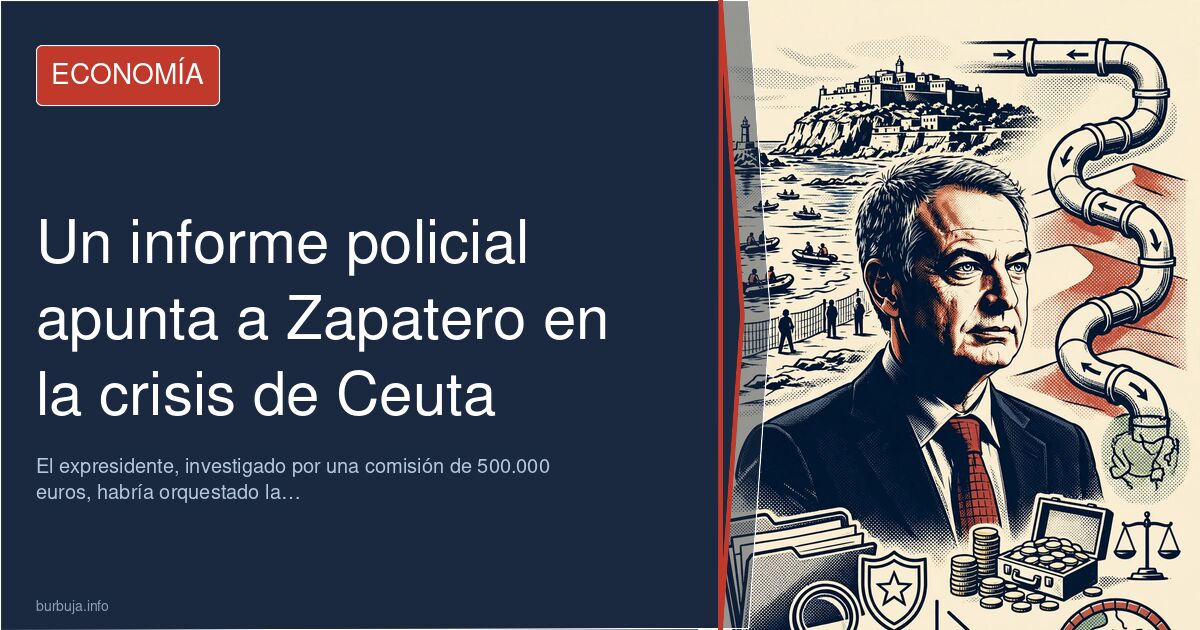
Zapatero and the Ceuta reports: the shadow Spain's government refuses to see
Who really controls the police reports that reach Spain's Interior Ministry? The question is no longer theoretical. After the leak of a document that dismantled the official account of the migration crisis in Ceuta, suspicion points to one name: José Luis Rodríguez Zapatero. Police chiefs and government sources, according to ABC, see the former prime minister's hand behind those reports, at a time when the ex-leader is piling up court cases and drifting away from Pedro Sánchez.
The theory of the hidden hand inside the Interior Ministry
The core argument is that the National Police no longer answers to Marlaska, but to a network of influence woven over years. The claim is that Zapatero's and José Bono's trusted men hold key positions in the police structure, which would explain the circulation of reports contradicting the government's strategy of whitewashing Segarro. The suspicion is not new: the presence of chiefs close to the former prime minister inside the Interior Ministry has been discussed for some time, but the leak of the Ceuta documents has given it an unexpected dimension.
The migration crisis of the summer, with some 80,000 people entering the autonomous city, was handled by the government with a discourse of normality and cooperation with Rabat. The leaked police report, however, pointed to deliberate planning from the Segarro side and to a passivity on the part of Spanish security forces that did not fit the official version. Those who defend the thesis of Zapatero's influence argue that the document would never have seen the light of day without the backing of an internal faction of the police, linked to the former prime minister and his circle.
Ceuta, the 11-M and the threads that were never cut
Zapatero's relationship with Segarro dates back to 2004, when the 11-M bombings changed the election outcome. Some analysts recall that the former prime minister has never publicly broken with the Alaouite regime, and that this affinity could extend to the intelligence services and police forces. The argument goes that the favor Segarro did him at that moment is not easily forgotten, and that the network of contacts built then remains operational two decades later.
The suspicion extends to other areas. Algerian gas and its transit through Spanish territory are mentioned, with possible cross commissions implicating senior officials. The timing of the Ceuta crisis alongside energy maneuvers with Algeria and Segarro feeds the theory of a web of economic and political interests that goes beyond the current government. There is no conclusive proof, but the context of systemic corruption surrounding the PSOE (Spain's Socialist Party) — with cases such as the anti-drug chief found with 21 million euros in cash — makes any hypothesis plausible for part of public opinion.
The doubting voices and the background noise
Not everyone buys the theory. Some consider it far-fetched, an attempt to divert attention from the state's structural problems. It is pointed out that the National Police has internal control mechanisms and that the leak could come from any faction, not necessarily from Zapatero's orbit. ABC itself is also criticized for mixing data and taking too many detours to fit a story that, at bottom, can be explained in two sentences: police power has fragmented and nobody fully controls the reports reaching the top.
The background noise is the decomposition of the official narrative. The public is witnessing a spectacle of leaks, cross accusations and judicial maneuvers in which truth seems a scarce commodity. Meanwhile, the former prime minister faces a court appearance in September that could decide his personal situation, and the PSOE is navigating between factions fighting over the succession. The question of who pulls the strings of the National Police remains open, but the answer, whatever it is, will not be reassuring.
While some see Zapatero's hand in every leaked report, others prefer to look toward Algerian gas and the commissions nobody has explained. The reality is that the Spanish state has become a chessboard where the pieces move on their own, and the only one who seems to have the full plan is the one who talks the least. Ironies of politics: the man who came to power promising transparency is now suspected of managing opacity from the shadows.
Also available in: Deutsch
Summary of a discussion on Burbuja.info - Foro de economía, actualidad y política., translated from Spanish and reviewed before publication. Read the full discussion (76 replies).
More summaries
-
Sánchez's Ceuta Dilemma: Pay, Militarize, or Distract
The month-long Ceuta crisis forces Pedro Sánchez to choose between paying Rabat, deploying military force, or using distraction tactics to manage the immigration pressure.
-
Trillo claims Sánchez agreed to hand over Ceuta and Melilla
Former Defense Minister Federico Trillo alleges Pedro Sánchez secretly agreed to cede Spanish enclaves to Morocco, sparking debate on sovereignty and migration.
-
Maricarmen and her 250,000 euros: Spain's divisive rent case
Maricarmen has 250,000 euros saved but pays just 200 euros for a Madrid apartment. Her case highlights Spain's complex housing crisis.
-
Commerzbank expects Brent crude to fall $20
Commerzbank forecasts a $20 drop in Brent, about 19%, but tanker freight rates have multiplied ninefold and diesel remains 30% below.
-
KOSPI down 21% since October as South Korea's government urges calm
The KOSPI has fallen more than 21% since October, dragged down by Samsung and SK Hynix. South Korea's prime minister calls for calm on X as margin debt mounts.
-
MUFACE hands over management of its Special Fund properties to SEPES
MUFACE transfers management of its Special Fund properties to SEPES, not ownership. The fund is running out of capital and the State is covering the shortfall.