
Video mocking early risers reignites welfare debate in Spain
A viral video shows a man mocking the workers who fund his benefit, according to participants in a forum debate.
English · Original discussion in Spanish · Published
The subsidy and contempt for early risers: the growing divide
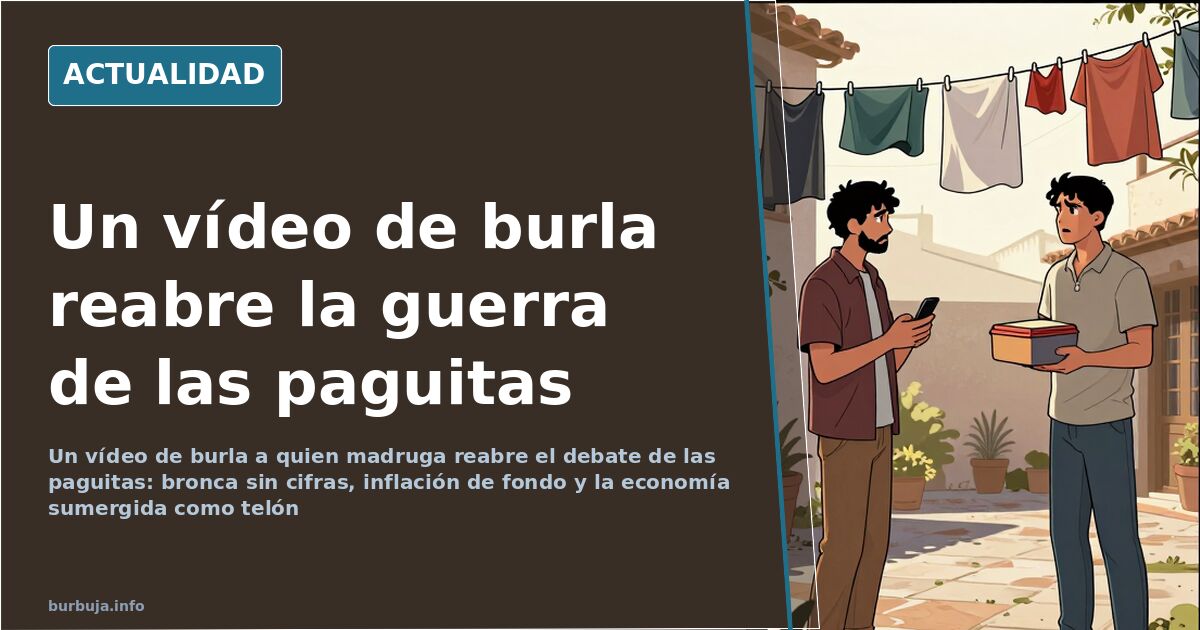
A video in which a young man, visibly deteriorated and toothless, mocks the workers who get up early to finance his benefit has unleashed a storm of reactions that goes far beyond the individual. The scene, spread on social media, shows a man laughing at those he calls «reaccionariopobres» (poor fascists) while he collects a public subsidy. The issue has reignited the debate on the welfare state, the culture of subsidies and the fracture between those who sustain the system with their paychecks and those who live off it.
The first reaction is outrage. «That guy is an idiot,» summarizes one participant, who adds an elementary calculation: if the benefit doesn't rise, inflation devalues it anyway. Others go further and call for eliminating all taxes and all public services, because, they argue, the welfare state is a design flaw. The protagonist's mockery thus becomes ammunition for those who have been calling for cuts in social spending for years.
Why does the one who receives the benefit laugh at the one who pays for it?
The video is not an isolated anecdote. For some participants, the character is proof that the system generates perverse incentives: those who work finance those who don't, and on top of that receive contempt. «He has every reason to laugh his head off,» jokes another, comparing the situation to plumbers who work off the books or YouTubers who move to Andorra. The implicit conclusion is that fraud and trickery are not exclusive to the poor, but only the poor are singled out.
Some see in the protagonist a symptom of something deeper. «He laughs when he lives off the charity of people who work,» writes a participant, adding that he is poor «not only economically but also intellectually.» The charity of others, they argue, doesn't make him aware of his situation. Compassion mixes with contempt in the same paragraph.
The proposal gaining ground: cutting off benefits for those who mock
Among the concrete measures proposed, one stands out for its harshness: withdrawing the benefit from anyone who mocks those who fund it. «Anyone who mocked those who give them the paguita should be removed from receiving it,» proposes one participant. Another elevates it to legal status: «It could be classified as a crime of serious offense against the taxpayer and as a penalty of termination of the paguita.» The idea of conditioning aid on the beneficiary's behavior is not new, but here it is proposed without nuance.
The response is immediate. «Being a paguitero is socially frowned upon, but paguitas are true health, joy, well-being,» writes someone who flips the frame: the subsidy is not a scourge, it is what allows living without the slavery of wages. The irony is evident, but the underlying argument—that wage labor is not the only source of dignity—connects with a current that has been gaining ground on the margins of public debate for years.
From subsidy to squatting: the catalog of grievances
The conversation soon drifts toward a broader catalog of grievances. One of the most upvoted messages proposes squatting a home and collecting several paguitas, including rent assistance. The proposal, formulated as a provocation, summarizes the imaginary of those who believe the system rewards trickery and punishes effort. Another participant calculates that the protagonist earns 1,400 euros a month, «more than a public defender.» The figure, unverified, circulates as if it were a fact.
The fracture is also expressed in generational terms. «Today he laughs, tomorrow he'll cry when he finds himself starving under a bridge,» someone declares. The prediction of future misery serves as consolation for those who feel cheated today. Others, however, opt for indifference: «If he's happy and doesn't harm anyone, let him do and say what he wants.»
The background: taxes, inflation and the broken social contract
Beyond the individual, the issue connects with a broader economic malaise. «If it doesn't rise, it will also fall due to inflation,» recalls a participant, locating the problem in the purchasing power of the benefit. The discussion about the subsidy is, at bottom, a discussion about who pays the bill for the crisis and who collects it.
The proposal to eliminate taxes and public services gains trinc in the exchange. «I didn't use to think that way, but it's too much now,» writes someone who calls for each person to pay for their own healthcare and education. The protest vote against the welfare state is thus articulated from personal experience, not abstract ideology. The video's protagonist, with his mockery, has given that current a concrete face.
What happens if benefits are withdrawn from those who mock?
The proposal to condition benefits on behavior raises practical problems that the exchange does not resolve. Who defines what constitutes mockery? Does it apply only to benefit recipients or also to those who receive tax breaks? The silence on these questions is telling. The measure, as formulated, works more as a vent than as public policy.
Meanwhile, the video scene continues to circulate. A toothless man, with tattoos, laughing at those who get up early. The image condenses a conflict that goes beyond economics: the perception that the social contract has been broken and that some pay while others laugh. With these ingredients, it is foreseeable that the debate will intensify when the next crisis hits. Although, as one participant recalls, «it's already too late.»
A video in which a young man, visibly deteriorated and toothless, mocks the workers who get up early to finance his benefit has unleashed a storm of reactions that goes far beyond the individual. The scene, spread on social media, shows a man laughing at those he calls «reaccionariopobres» (poor fascists) while he collects a public subsidy. The issue has reignited the debate on the welfare state, the culture of subsidies and the fracture between those who sustain the system with their paychecks and those who live off it.
The first reaction is outrage. «That guy is an idiot,» summarizes one participant, who adds an elementary calculation: if the benefit doesn't rise, inflation devalues it anyway. Others go further and call for eliminating all taxes and all public services, because, they argue, the welfare state is a design flaw. The protagonist's mockery thus becomes ammunition for those who have been calling for cuts in social spending for years.
Why does the one who receives the benefit laugh at the one who pays for it?
The video is not an isolated anecdote. For some participants, the character is proof that the system generates perverse incentives: those who work finance those who don't, and on top of that receive contempt. «He has every reason to laugh his head off,» jokes another, comparing the situation to plumbers who work off the books or YouTubers who move to Andorra. The implicit conclusion is that fraud and trickery are not exclusive to the poor, but only the poor are singled out.
Some see in the protagonist a symptom of something deeper. «He laughs when he lives off the charity of people who work,» writes a participant, adding that he is poor «not only economically but also intellectually.» The charity of others, they argue, doesn't make him aware of his situation. Compassion mixes with contempt in the same paragraph.
The proposal gaining ground: cutting off benefits for those who mock
Among the concrete measures proposed, one stands out for its harshness: withdrawing the benefit from anyone who mocks those who fund it. «Anyone who mocked those who give them the paguita should be removed from receiving it,» proposes one participant. Another elevates it to legal status: «It could be classified as a crime of serious offense against the taxpayer and as a penalty of termination of the paguita.» The idea of conditioning aid on the beneficiary's behavior is not new, but here it is proposed without nuance.
The response is immediate. «Being a paguitero is socially frowned upon, but paguitas are true health, joy, well-being,» writes someone who flips the frame: the subsidy is not a scourge, it is what allows living without the slavery of wages. The irony is evident, but the underlying argument—that wage labor is not the only source of dignity—connects with a current that has been gaining ground on the margins of public debate for years.
From subsidy to squatting: the catalog of grievances
The conversation soon drifts toward a broader catalog of grievances. One of the most upvoted messages proposes squatting a home and collecting several paguitas, including rent assistance. The proposal, formulated as a provocation, summarizes the imaginary of those who believe the system rewards trickery and punishes effort. Another participant calculates that the protagonist earns 1,400 euros a month, «more than a public defender.» The figure, unverified, circulates as if it were a fact.
The fracture is also expressed in generational terms. «Today he laughs, tomorrow he'll cry when he finds himself starving under a bridge,» someone declares. The prediction of future misery serves as consolation for those who feel cheated today. Others, however, opt for indifference: «If he's happy and doesn't harm anyone, let him do and say what he wants.»
The background: taxes, inflation and the broken social contract
Beyond the individual, the issue connects with a broader economic malaise. «If it doesn't rise, it will also fall due to inflation,» recalls a participant, locating the problem in the purchasing power of the benefit. The discussion about the subsidy is, at bottom, a discussion about who pays the bill for the crisis and who collects it.
The proposal to eliminate taxes and public services gains trinc in the exchange. «I didn't use to think that way, but it's too much now,» writes someone who calls for each person to pay for their own healthcare and education. The protest vote against the welfare state is thus articulated from personal experience, not abstract ideology. The video's protagonist, with his mockery, has given that current a concrete face.
What happens if benefits are withdrawn from those who mock?
The proposal to condition benefits on behavior raises practical problems that the exchange does not resolve. Who defines what constitutes mockery? Does it apply only to benefit recipients or also to those who receive tax breaks? The silence on these questions is telling. The measure, as formulated, works more as a vent than as public policy.
Meanwhile, the video scene continues to circulate. A toothless man, with tattoos, laughing at those who get up early. The image condenses a conflict that goes beyond economics: the perception that the social contract has been broken and that some pay while others laugh. With these ingredients, it is foreseeable that the debate will intensify when the next crisis hits. Although, as one participant recalls, «it's already too late.»
Summary of a discussion on Burbuja.info - Foro de economía, actualidad y política., translated from Spanish and reviewed before publication. Read the full discussion (93 replies).
More summaries
-
Spain's RTVE launches taxpayer-funded show to debunk Franco myth
50 years after Franco, TVE premieres 'El Perro Andaluz' with Manu Sánchez to prove life wasn't better, during the World Cup and paid with your taxes.
-
Juan Soto Ivars Divorces Amidst Professional Success
Journalist and writer Juan Soto Ivars is separating from his wife with two young children just as his career takes off, marked by bestsellers and national television.
-
Spain: Islam conversion after depression sparks online debate
A Spanish woman claims embracing Islam cured her depression, igniting debate on faith, freedom of worship, and mental health.
-
TVE hires Lalachus for Grand Prix, sparking social media backlash
TVE appoints Lalachus as co-host of the Spanish summer show Grand Prix, igniting debate over public TV politicization and format direction.
-
Spain: Colleague detained for violent death of woman in Barakaldo
A judge in Getxo remands a man to prison for the violent death of a 54-year-old woman in Barakaldo, her work colleague.
-
Nacho Vidal arrested in Valencia with 114g of pink cocaine
Former adult film star Nacho Vidal was detained in Valencia with 114 grams of pink cocaine and drugs, facing a pending trial for manslaughter.