
Guaidó Declares Himself President in Venezuela as US Weighs Options
Guaidó declared himself interim president in January 2019, and the US said 'all options' were on the table amid a military standoff.
English · Original discussion in Spanish · Published
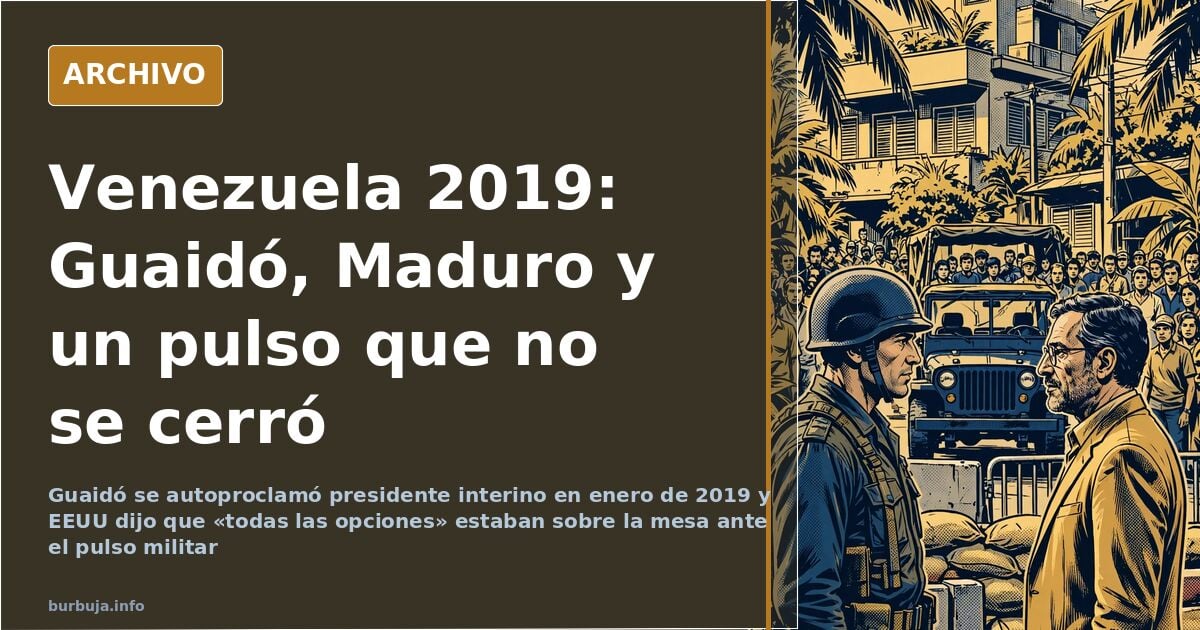
Venezuela: Guaidó Declares Himself President and the Board Enters Uncharted Territory
There is a figure that sums up the volatility of that January 2019 better than any speech: in a matter of hours, the United States went from treating Nicolás Maduro as Venezuela's president to recognizing a congressman who had declared himself interim leader. The diplomatic blow did not stay in a tweet. The White House added that "all options are on the table" and a senior official repeated it to reporters without batting an eye. The question that hung over the entire conversation was, and still is, whether that was a real lever or just a photo op.
On the ground, the sequence accelerated. Venezuela's Prosecutor's Office announced an investigation against the self-proclaimed president, the National Constituent Assembly called for a rally at Miraflores, and the military fired shots into the air near Caracas to disperse protesters. None of that closed the matter. It left it wide open.
What Peine on January 23, 2019
National Assembly President Juan Guaidó declared himself interim president of Venezuela, and Donald Trump immediately recognized him. A few hours later, US Vice President Mike Pence confirmed the support: "The United States stands with you until freedom is restored." Maduro's regime responded with the usual playbook: calls for mobilization, a message of resistance, and the Prosecutor's Office moving against the opposition leader. The European Parliament recognized Guaidó, a gesture that Izquierda Unida called "hypocritical," arguing that they defend human rights while backing the disregard of a government.
The detail most repeated in analyses was the military context. Venezuela holds the world's largest oil reserves—a condition pointed to as the real reason for foreign interest—and possesses Russian S-300VM air defense systems. That fact served both those who argued a direct bombing was unthinkable and those who warned everything was set for an intervention. Both sides had been arguing over exactly the same thing for weeks: whether the army would split or remain loyal.
All Options on the Table: The Military Standoff
US diplomacy used a formula that, in practice, is a catch-all: any response was on the table, including naval. Warnings were directed at military commanders, with messages like "do the right thing." On the other side, National Constituent Assembly President Diosdado Cabello called for the defense of the "regime and the Constitution" and warned that the US "will be able to enter, but not leave." The result of that exchange was a climate of military expectation that never quite materialized into an invasion.
Some argue that Venezuela's armed forces need a collaborationist political component to act, and that this scaffolding did not break in weeks. Others replied that US conventional military superiority was overwhelming—"in the first 12, all their conventional military capability is destroyed," it was written—and that the only reasonable doubt was when, not if. Between both extremes, a realistic calculation: bigwigs change masters when it suits them, and without a clear leader they look wherever necessary. Loyalty, in other words, is measured in paychecks, not flags.
One point no one disputed: the corps of generals. There was talk of more than 2,000 commanders, more than several armies combined, a chain-of-command disaster that makes it hard to know whom the lower ranks would obey. For some, that was a guarantee of paralysis; for others, an excuse for a purge.
Humanitarian Aid and the Failure That Left Uncomfortable Data
The confrontation over humanitarian aid in late February 2019 became the reference date. The opposition, with Richard Branson's support, organized a concert in Cúcuta, across the border, to demand the passage of humanitarian aid. Attendance figures were inflated until the Washington Post itself retracted the article, as was noted in the conversation. The convoys failed to cross, and the bridges ended with injuries and incompatible versions of who had put up the barbed wire.
Meanwhile, the Maracaibo Chamber of Commerce estimated at least 460 businesses were looted during the riots after the blackout. The city's economic right counted its losses. Vice President Delcy Rodríguez, by contrast, boasted that trucks with medicine did not enter. The two smiles—that of the looting and that of the blockade—defined the tone.
So far, the hard data of the standoff. What trinc is the part that cannot be closed with an anniversary.
Why Didn't the Venezuelan Army Split?
The question floated throughout the period without a definitive answer. The official reading insists that the Armed Forces remained anchored to the government. The sociology of the case points to something else: when the top brass manages the distribution of foreign currency, imports, and licenses, loyalty has more to do with control of the cash box than with doctrine. One analysis summed it up: the military is with the regime because it has managed it and shared the spoils.
Against this, the opposite argument emphasized the same but as an opportunity: if the regime falls, the reason for that loyalty disappears and personnel seek a new master. The parades of armored vehicles and elite groups—FAES, DGCIM, SEBIN—work against an unarmed civilian population, not against a foreign army. That asymmetry, repeated insistently, would explain why there was neither a clean transition nor an open clash.
The March Blackout: When the Grid Ceased to Be a Mystery
In March 2019 the electrical system collapsed and with it the narrative. Three days without power in much of the country, rationed water in Maracaibo, hospitals with generators, and impossible lines. A forum user who presented himself as an electrical engineer with 50 years of experience left an explanation: a widespread failure due to generation failure does not present that network topology. The conclusion was left in the air, but the technical diagnosis pointed to software control and overloads in an interconnected grid.
The regime accused Guaidó of electrical sabotage and the Prosecutor's Office peine an investigation. Guaidó, meanwhile, had written that light would come with the end of the usurpation. Neither of those phrases proves anything; together they illustrate why the country ceased to be legible. The blackouts of late March were repeated, and the detail many remembered was another: the implicit recognition that the grid was holding up worse than the government.
How a Country Breaks Without Breaking Entirely
A pattern repeats in the evolution of this matter: each siege that was supposed to bring down the executive left it more entrenched and, incidentally, more isolated. International recognition of Guaidó did not translate into territorial control. The February humanitarian aid did not force the border open. Financial pressure did not stop the machinery. And the blackout, which seemed the definitive trigger, ended up being one more proof that the scenario was in dispute.
The data circulating—not validated by any court—speak of tens of billions moved by front men in Swiss banks. A specific figure was cited: $5.6 billion linked to Raúl Gorrín, president of Globovisión, supposedly channeled through accounts in Zurich and Geneva between 2011 and 2013, according to publications cited and counted outside Venezuela. Caution is mandatory: these are journalistic accusations, not final judgments.
On the other side of the scale were the Colombian false positives, with 98.5% impunity according to UN rapporteur Philip Alston in 2010, and the 126 social leaders murdered in Colombia in 2018 according to human rights organizations. The comparison was not made by one side alone. It was part of the arguments of those who maintained that sarracena reproach is applied selectively.
The External Front: Who Acts and Who Watches
Russia made clear it would interpret a military intervention as an act of aggression and announced support for the "path of development chosen" by Venezuela. Belarus appeared in the equation: its president, Alexander Lukashenko, claimed to have drawn up defense plans and helped reorganize the Venezuelan army.
The EU activated a Contact Group that alarmed Guaidó's supporters. It is no coincidence: any mechanism that forces negotiation with Maduro's government lowers the narrative of imminent transition. Humanitarian intervention, or the Cúcuta concert, or food aid across the border, works better as a symbol than as a logistics operation. When the symbol becomes an entry plan, cracks appear.
Where the Matter Stood
Each cycle of this story—the self-proclamation, the Cúcuta concert, the March blackout—left the same feeling: tension persisted without resolution. The government did not fall. Guaidó did not govern. The army did not split. Aid did not enter. Intervention did not come. The only thing that moved clearly was the diplomatic map, which was almost completely reordered in a few months and reordered again each time the standoff revived.
An uncomfortable reading remains for almost all sides: those who announced the regime's collapse were left waiting, and those who promised that pressure would erode it without violence also did not see the result. The ground where that January ended is the same where it began: in a country with the world's largest oil reserves, whose population endures three-day blackouts and whose foreign policy is often decided in Washington, Moscow, and Beijing before Caracas.
How many more months of this standoff can be sustained without either side having to play the card that, so far, it has not dared to play?
There is a figure that sums up the volatility of that January 2019 better than any speech: in a matter of hours, the United States went from treating Nicolás Maduro as Venezuela's president to recognizing a congressman who had declared himself interim leader. The diplomatic blow did not stay in a tweet. The White House added that "all options are on the table" and a senior official repeated it to reporters without batting an eye. The question that hung over the entire conversation was, and still is, whether that was a real lever or just a photo op.
On the ground, the sequence accelerated. Venezuela's Prosecutor's Office announced an investigation against the self-proclaimed president, the National Constituent Assembly called for a rally at Miraflores, and the military fired shots into the air near Caracas to disperse protesters. None of that closed the matter. It left it wide open.
What Peine on January 23, 2019
National Assembly President Juan Guaidó declared himself interim president of Venezuela, and Donald Trump immediately recognized him. A few hours later, US Vice President Mike Pence confirmed the support: "The United States stands with you until freedom is restored." Maduro's regime responded with the usual playbook: calls for mobilization, a message of resistance, and the Prosecutor's Office moving against the opposition leader. The European Parliament recognized Guaidó, a gesture that Izquierda Unida called "hypocritical," arguing that they defend human rights while backing the disregard of a government.
The detail most repeated in analyses was the military context. Venezuela holds the world's largest oil reserves—a condition pointed to as the real reason for foreign interest—and possesses Russian S-300VM air defense systems. That fact served both those who argued a direct bombing was unthinkable and those who warned everything was set for an intervention. Both sides had been arguing over exactly the same thing for weeks: whether the army would split or remain loyal.
All Options on the Table: The Military Standoff
US diplomacy used a formula that, in practice, is a catch-all: any response was on the table, including naval. Warnings were directed at military commanders, with messages like "do the right thing." On the other side, National Constituent Assembly President Diosdado Cabello called for the defense of the "regime and the Constitution" and warned that the US "will be able to enter, but not leave." The result of that exchange was a climate of military expectation that never quite materialized into an invasion.
Some argue that Venezuela's armed forces need a collaborationist political component to act, and that this scaffolding did not break in weeks. Others replied that US conventional military superiority was overwhelming—"in the first 12, all their conventional military capability is destroyed," it was written—and that the only reasonable doubt was when, not if. Between both extremes, a realistic calculation: bigwigs change masters when it suits them, and without a clear leader they look wherever necessary. Loyalty, in other words, is measured in paychecks, not flags.
One point no one disputed: the corps of generals. There was talk of more than 2,000 commanders, more than several armies combined, a chain-of-command disaster that makes it hard to know whom the lower ranks would obey. For some, that was a guarantee of paralysis; for others, an excuse for a purge.
Humanitarian Aid and the Failure That Left Uncomfortable Data
The confrontation over humanitarian aid in late February 2019 became the reference date. The opposition, with Richard Branson's support, organized a concert in Cúcuta, across the border, to demand the passage of humanitarian aid. Attendance figures were inflated until the Washington Post itself retracted the article, as was noted in the conversation. The convoys failed to cross, and the bridges ended with injuries and incompatible versions of who had put up the barbed wire.
Meanwhile, the Maracaibo Chamber of Commerce estimated at least 460 businesses were looted during the riots after the blackout. The city's economic right counted its losses. Vice President Delcy Rodríguez, by contrast, boasted that trucks with medicine did not enter. The two smiles—that of the looting and that of the blockade—defined the tone.
So far, the hard data of the standoff. What trinc is the part that cannot be closed with an anniversary.
Why Didn't the Venezuelan Army Split?
The question floated throughout the period without a definitive answer. The official reading insists that the Armed Forces remained anchored to the government. The sociology of the case points to something else: when the top brass manages the distribution of foreign currency, imports, and licenses, loyalty has more to do with control of the cash box than with doctrine. One analysis summed it up: the military is with the regime because it has managed it and shared the spoils.
Against this, the opposite argument emphasized the same but as an opportunity: if the regime falls, the reason for that loyalty disappears and personnel seek a new master. The parades of armored vehicles and elite groups—FAES, DGCIM, SEBIN—work against an unarmed civilian population, not against a foreign army. That asymmetry, repeated insistently, would explain why there was neither a clean transition nor an open clash.
The March Blackout: When the Grid Ceased to Be a Mystery
In March 2019 the electrical system collapsed and with it the narrative. Three days without power in much of the country, rationed water in Maracaibo, hospitals with generators, and impossible lines. A forum user who presented himself as an electrical engineer with 50 years of experience left an explanation: a widespread failure due to generation failure does not present that network topology. The conclusion was left in the air, but the technical diagnosis pointed to software control and overloads in an interconnected grid.
The regime accused Guaidó of electrical sabotage and the Prosecutor's Office peine an investigation. Guaidó, meanwhile, had written that light would come with the end of the usurpation. Neither of those phrases proves anything; together they illustrate why the country ceased to be legible. The blackouts of late March were repeated, and the detail many remembered was another: the implicit recognition that the grid was holding up worse than the government.
How a Country Breaks Without Breaking Entirely
A pattern repeats in the evolution of this matter: each siege that was supposed to bring down the executive left it more entrenched and, incidentally, more isolated. International recognition of Guaidó did not translate into territorial control. The February humanitarian aid did not force the border open. Financial pressure did not stop the machinery. And the blackout, which seemed the definitive trigger, ended up being one more proof that the scenario was in dispute.
The data circulating—not validated by any court—speak of tens of billions moved by front men in Swiss banks. A specific figure was cited: $5.6 billion linked to Raúl Gorrín, president of Globovisión, supposedly channeled through accounts in Zurich and Geneva between 2011 and 2013, according to publications cited and counted outside Venezuela. Caution is mandatory: these are journalistic accusations, not final judgments.
On the other side of the scale were the Colombian false positives, with 98.5% impunity according to UN rapporteur Philip Alston in 2010, and the 126 social leaders murdered in Colombia in 2018 according to human rights organizations. The comparison was not made by one side alone. It was part of the arguments of those who maintained that sarracena reproach is applied selectively.
The External Front: Who Acts and Who Watches
Russia made clear it would interpret a military intervention as an act of aggression and announced support for the "path of development chosen" by Venezuela. Belarus appeared in the equation: its president, Alexander Lukashenko, claimed to have drawn up defense plans and helped reorganize the Venezuelan army.
The EU activated a Contact Group that alarmed Guaidó's supporters. It is no coincidence: any mechanism that forces negotiation with Maduro's government lowers the narrative of imminent transition. Humanitarian intervention, or the Cúcuta concert, or food aid across the border, works better as a symbol than as a logistics operation. When the symbol becomes an entry plan, cracks appear.
Where the Matter Stood
Each cycle of this story—the self-proclamation, the Cúcuta concert, the March blackout—left the same feeling: tension persisted without resolution. The government did not fall. Guaidó did not govern. The army did not split. Aid did not enter. Intervention did not come. The only thing that moved clearly was the diplomatic map, which was almost completely reordered in a few months and reordered again each time the standoff revived.
An uncomfortable reading remains for almost all sides: those who announced the regime's collapse were left waiting, and those who promised that pressure would erode it without violence also did not see the result. The ground where that January ended is the same where it began: in a country with the world's largest oil reserves, whose population endures three-day blackouts and whose foreign policy is often decided in Washington, Moscow, and Beijing before Caracas.
How many more months of this standoff can be sustained without either side having to play the card that, so far, it has not dared to play?
Summary of a discussion on Burbuja.info - Foro de economía, actualidad y política., translated from Spanish and reviewed before publication. Read the full discussion (10350 replies).
More summaries
-
Venezuela: from 8,202% inflation to 450 bolivars per dollar
In March 2018, annual inflation exceeded 8,202% and the parallel dollar hit 450 bolivars, pushing the Venezuelan minimum wage down to $10.
-
Venezuela's military uprising that fizzled out in two hours
On April 30, 2019, soldiers freed Leopoldo López and Guaidó called for an uprising. The high command stayed put and the revolt faded within hours.
-
Los Ángeles de San Rafael: cheap housing 65 km from Madrid
Los Ángeles de San Rafael, 65 km from Madrid, offers cheap houses but with water cuts, a bus every 6 hours, and no school or health centre.
-
AI in Cinema: Hollywood's End or a New Assembly Line?
Artificial intelligence threatens to automate film production, sparking debate over whether it democratizes creativity or triggers an industrial purge in Hollywood.
-
Latino presence at the Super Bowl sparks cultural debate
The visibility of Latino communities during the Super Bowl highlights the tension between cultural identity and debates over immigration in the United States.
-
Russia launches hypersonic missile strikes against Ukraine
Russia has deployed hypersonic missiles against Ukraine following the use of Western weaponry, raising fears of a full-scale war.