
Vegan Diets Risk Critical Choline Deficiency, Expert Warns
Dr. Emma Derbyshire warns that vegan diets cause widespread choline deficiency, a nutrient vital for fetal brain development.
English · Original discussion in Spanish · Published
Vegan Diets Risk Critical Choline Deficiency, Expert Warns
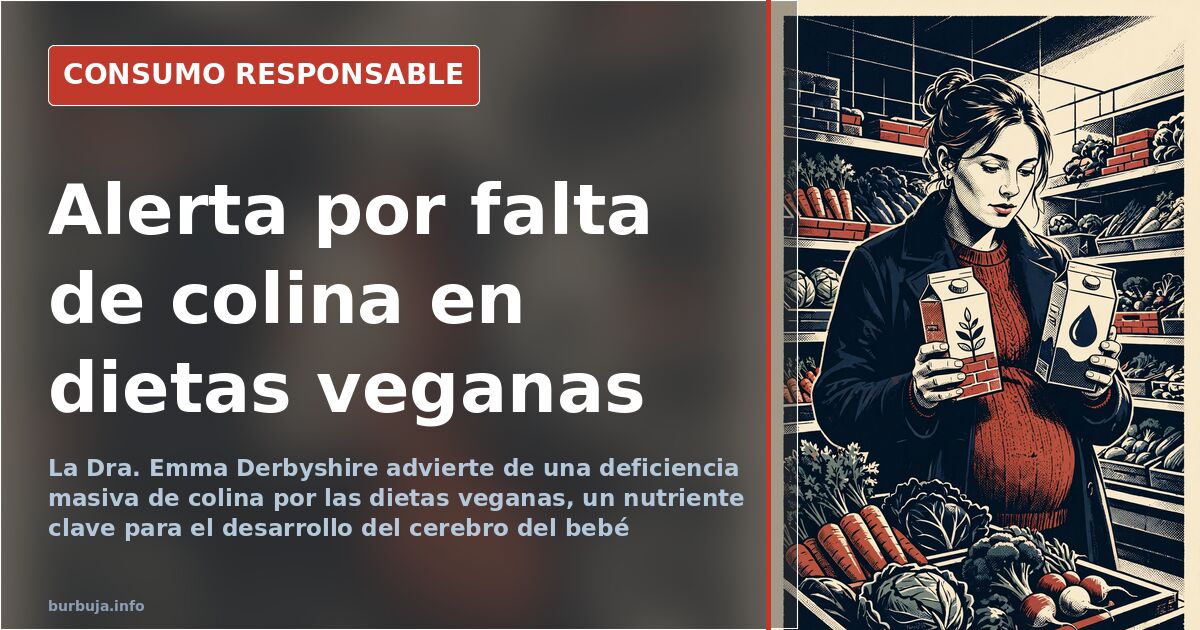
A nutrient largely overlooked by the public. Dr. Emma Derbyshire argues that the rising trend of vegan diets risks creating a massive choline deficiency, a compound critical for brain development. The warning is significant: choline is found primarily in meat, fish, eggs, and dairy products—exactly the foods eliminated by a vegan diet. The alert was published in BMJ Nutrition, Prevention & Health and picked up by the British press with a headline leaving no room for doubt: veganism threatens UK brain health.
Derbyshire’s thesis relies on a physiological detail worth noting. Choline is an essential nutrient for humans, similar to omega-3 fatty acids: the amount produced by the liver itself is insufficient to meet the body's needs, so it must be obtained through diet or supplements. Its function goes far beyond nutritional whim. It participates in neurotransmitter synthesis, cell structure, and methylation, and its lack has been linked to liver disease, cognitive function in offspring, and potential neurological disorders. The most delicate period is pregnancy and breastfeeding, when the baby's brain is developing rapidly.
What is choline and why does it matter in pregnancy?
Choline is an essential nutrient that the human body does not produce in sufficient quantities. That is the key to the entire issue. Unlike other substances regulated by the organism alone, here the liver's endogenous production falls short, forcing reliance on dietary sources. During pregnancy and lactation, demand spikes because the fetus and newborn need it for healthy brain development. If the mother does not ingest it, the deficit directly impacts the neurological development of the next generation.
The problem is that the main sources of choline are animal-based. Roasted beef liver tops the list with 399 milligrams per 100 grams, according to data used in the analysis. A large hard-boiled egg provides 147 milligrams. Salted cod, 233. Skinless chicken, 79. A cup of 1% fat milk, 43. On the plant side, figures plummet: 100 grams of boiled cauliflower contain 39 milligrams, cooked spinach barely 20, firm tofu 28, and a cup of cooked quinoa 42. Soy lecithin, with 48 milligrams per tablespoon, falls far short of any meat portion.
Soy and legumes: the vegan defense argument
In response to the warning, the most repeated answer is that choline is also present in the plant kingdom. Soybeans, legumes, and nuts contain the nutrient, although in concentrations much lower than meat or eggs. Some argue that ancestors who ate much less meat than we do now were not exactly unintelligent, and that choline from legumes was enough to keep the brain functioning. The argument has historical logic but clashes with an uncomfortable fact: life expectancy and caloric availability in those populations were incomparable to today's.
The strongest counterargument is that humans have evolved consuming animal protein. Hunting, meat, and fire acted as evolutionary accelerators for the human brain, and the fossil record shows what peine to cranial size after the introduction of agriculture in the Neolithic. No vegan diet is natural or healthy, proponents of this view argue, because the organism is adapted to animal protein, and a few generations will not change that. The discussion, at its core, is not about choline: it is about whether a diet can reverse in decades what evolution built over millions of years.
Supplements do not close the gap
The vegan defense relies on supplementation. Vitamin B12 is the classic example: no vegan can obtain it from reliable plant sources, so they take it in pills. Something similar happens with choline, but with an added problem: absorption of nutrients from plant sources is worse than from animal sources. Retinol from liver and eggs, direct vitamin A, is absorbed up to six times better than beta-carotene from vegetables. Vitamin D3 from fish is assimilated much better than plant-based D2. And plant proteins, no matter how much processed tofu is consumed, are insufficient in quantity and quality.
Some go further and argue that even the meat eaten today would not have B12 without livestock supplementation. This is a circular argument that does not resolve the core issue: animals concentrate and transform these nutrients into forms that the human intestine utilizes with much greater efficiency. The lingering question is whether a supplement-based diet can sustain the brain development of an entire generation without long-term effects appearing. No one has the answer yet, and that is precisely the problem.
The social debate: between personal choice and suspicion
Beyond nutrition, the issue has shifted to a discussion on imposition and lifestyle. Part of the analysis argues that vegans want to transform their personal choice into political imposition, legislating food totalitarianism that would prohibit meat consumption for the rest of the population. The ban on what they call animal slavery would necessarily imply such a scenario. Another current responds that the percentage of vegans in Spain is residual, between 1% and 3%, and that no one forces anyone to stop eating steak.
Media noise does not help. Cases of children raised on strict vegetarian diets who ended up at the doctor due to malnutrition have become the recurring example cited by critics. In one circulating story, parents of a girl showing signs of malnutrition received a medical ultimatum: continue the diet or let the child live. They chose the latter and abandoned the diet. These are anecdotes, not statistics, but they serve as emotional ammunition in a discussion where data is scarce and positions harden.
The economic and environmental impact of soy
Soy is the star food of the vegan diet, and another contradiction emerges there. Most of the soy grown worldwide is not destined for direct human consumption but to feed the animals that are then eaten. Soy plantations are destroying thousands of hectares of forest and jungle, and the final recipient of this massive crop is livestock, not supermarket tofu. The environmental argument, often wielded against livestock farming, turns against the food system as a whole.
Food prices also play a role. If a Mad Max scenario arrived, the first things to become scarce would be meat, eggs, and dairy. And here arises the uncomfortable question: Is the population prepared to return to pre-industrial habits, with occasional meat, a little milk, some eggs a week, and Easter cheese? Many respond that they are not, that without their hormones, part of society goes crazy just imagining it. Diet, ultimately, is as cultural as it is nutritional.
Derbyshire’s warning is not a condemnation of veganism but an alert about a nutrient almost no one checks on labels. Choline lacks the marketing of B12 or omega-3s, and precisely for that reason, the deficiency can go unnoticed for years. While the discussion gets tangled in ideology, the data remains: 399 milligrams per 100 grams of liver versus 20 in boiled spinach. The next generation of vegans will be born with that arithmetic in their blood.
A nutrient largely overlooked by the public. Dr. Emma Derbyshire argues that the rising trend of vegan diets risks creating a massive choline deficiency, a compound critical for brain development. The warning is significant: choline is found primarily in meat, fish, eggs, and dairy products—exactly the foods eliminated by a vegan diet. The alert was published in BMJ Nutrition, Prevention & Health and picked up by the British press with a headline leaving no room for doubt: veganism threatens UK brain health.
Derbyshire’s thesis relies on a physiological detail worth noting. Choline is an essential nutrient for humans, similar to omega-3 fatty acids: the amount produced by the liver itself is insufficient to meet the body's needs, so it must be obtained through diet or supplements. Its function goes far beyond nutritional whim. It participates in neurotransmitter synthesis, cell structure, and methylation, and its lack has been linked to liver disease, cognitive function in offspring, and potential neurological disorders. The most delicate period is pregnancy and breastfeeding, when the baby's brain is developing rapidly.
What is choline and why does it matter in pregnancy?
Choline is an essential nutrient that the human body does not produce in sufficient quantities. That is the key to the entire issue. Unlike other substances regulated by the organism alone, here the liver's endogenous production falls short, forcing reliance on dietary sources. During pregnancy and lactation, demand spikes because the fetus and newborn need it for healthy brain development. If the mother does not ingest it, the deficit directly impacts the neurological development of the next generation.
The problem is that the main sources of choline are animal-based. Roasted beef liver tops the list with 399 milligrams per 100 grams, according to data used in the analysis. A large hard-boiled egg provides 147 milligrams. Salted cod, 233. Skinless chicken, 79. A cup of 1% fat milk, 43. On the plant side, figures plummet: 100 grams of boiled cauliflower contain 39 milligrams, cooked spinach barely 20, firm tofu 28, and a cup of cooked quinoa 42. Soy lecithin, with 48 milligrams per tablespoon, falls far short of any meat portion.
Soy and legumes: the vegan defense argument
In response to the warning, the most repeated answer is that choline is also present in the plant kingdom. Soybeans, legumes, and nuts contain the nutrient, although in concentrations much lower than meat or eggs. Some argue that ancestors who ate much less meat than we do now were not exactly unintelligent, and that choline from legumes was enough to keep the brain functioning. The argument has historical logic but clashes with an uncomfortable fact: life expectancy and caloric availability in those populations were incomparable to today's.
The strongest counterargument is that humans have evolved consuming animal protein. Hunting, meat, and fire acted as evolutionary accelerators for the human brain, and the fossil record shows what peine to cranial size after the introduction of agriculture in the Neolithic. No vegan diet is natural or healthy, proponents of this view argue, because the organism is adapted to animal protein, and a few generations will not change that. The discussion, at its core, is not about choline: it is about whether a diet can reverse in decades what evolution built over millions of years.
Supplements do not close the gap
The vegan defense relies on supplementation. Vitamin B12 is the classic example: no vegan can obtain it from reliable plant sources, so they take it in pills. Something similar happens with choline, but with an added problem: absorption of nutrients from plant sources is worse than from animal sources. Retinol from liver and eggs, direct vitamin A, is absorbed up to six times better than beta-carotene from vegetables. Vitamin D3 from fish is assimilated much better than plant-based D2. And plant proteins, no matter how much processed tofu is consumed, are insufficient in quantity and quality.
Some go further and argue that even the meat eaten today would not have B12 without livestock supplementation. This is a circular argument that does not resolve the core issue: animals concentrate and transform these nutrients into forms that the human intestine utilizes with much greater efficiency. The lingering question is whether a supplement-based diet can sustain the brain development of an entire generation without long-term effects appearing. No one has the answer yet, and that is precisely the problem.
The social debate: between personal choice and suspicion
Beyond nutrition, the issue has shifted to a discussion on imposition and lifestyle. Part of the analysis argues that vegans want to transform their personal choice into political imposition, legislating food totalitarianism that would prohibit meat consumption for the rest of the population. The ban on what they call animal slavery would necessarily imply such a scenario. Another current responds that the percentage of vegans in Spain is residual, between 1% and 3%, and that no one forces anyone to stop eating steak.
Media noise does not help. Cases of children raised on strict vegetarian diets who ended up at the doctor due to malnutrition have become the recurring example cited by critics. In one circulating story, parents of a girl showing signs of malnutrition received a medical ultimatum: continue the diet or let the child live. They chose the latter and abandoned the diet. These are anecdotes, not statistics, but they serve as emotional ammunition in a discussion where data is scarce and positions harden.
The economic and environmental impact of soy
Soy is the star food of the vegan diet, and another contradiction emerges there. Most of the soy grown worldwide is not destined for direct human consumption but to feed the animals that are then eaten. Soy plantations are destroying thousands of hectares of forest and jungle, and the final recipient of this massive crop is livestock, not supermarket tofu. The environmental argument, often wielded against livestock farming, turns against the food system as a whole.
Food prices also play a role. If a Mad Max scenario arrived, the first things to become scarce would be meat, eggs, and dairy. And here arises the uncomfortable question: Is the population prepared to return to pre-industrial habits, with occasional meat, a little milk, some eggs a week, and Easter cheese? Many respond that they are not, that without their hormones, part of society goes crazy just imagining it. Diet, ultimately, is as cultural as it is nutritional.
Derbyshire’s warning is not a condemnation of veganism but an alert about a nutrient almost no one checks on labels. Choline lacks the marketing of B12 or omega-3s, and precisely for that reason, the deficiency can go unnoticed for years. While the discussion gets tangled in ideology, the data remains: 399 milligrams per 100 grams of liver versus 20 in boiled spinach. The next generation of vegans will be born with that arithmetic in their blood.
Summary of a discussion on Burbuja.info - Foro de economía, actualidad y política., translated from Spanish and reviewed before publication. Read the full discussion (177 replies).
More summaries
-
Soy: The Surprising Protein Dividing Vegans and Omnivores
A nutritionist ranks soy as the best protein, sparking a debate. Eggs, meat, and bodybuilders disagree. Data...
-
EU's €3 parcel levy ends AliExpress's cheap era
The EU's €3 per category fee sends AliExpress prices soaring: a €3 order now costs €11. The Chinese parcel model faces collapse.
-
Amazon freezes account, demands bank fax
Amazon blocks a first-time buyer's account and asks their bank to fax data. Banking secrecy laws prevent this without a court order.
-
Frugal Splurges: €140 Kindle and €200 Unlocked Phone
A €1,000 monthly budget allows for a €140 Kindle, a €200 phone, and a €2,300 car. The key is calculating amortization for every expense.
-
€7.29 battery revives Nokia 3310 after twelve years
A €7.29 replacement battery brought a dormant Nokia 3310 back to life, fueling a growing movement against excessive consumerism.
-
Play AAA games on mobile for €10/month without a console
Cloud gaming offers AAA titles without a console using a cheap phone and controller, but latency issues and lack of mod support remain significant drawbacks.