
Self-employed fees in 2026: annual increase of up to €2,474
Social Security plans to raise self-employed contributions by 4% to 35% in 2026, up to €2,474 annually, regardless of income.
English · Original discussion in Spanish · Published
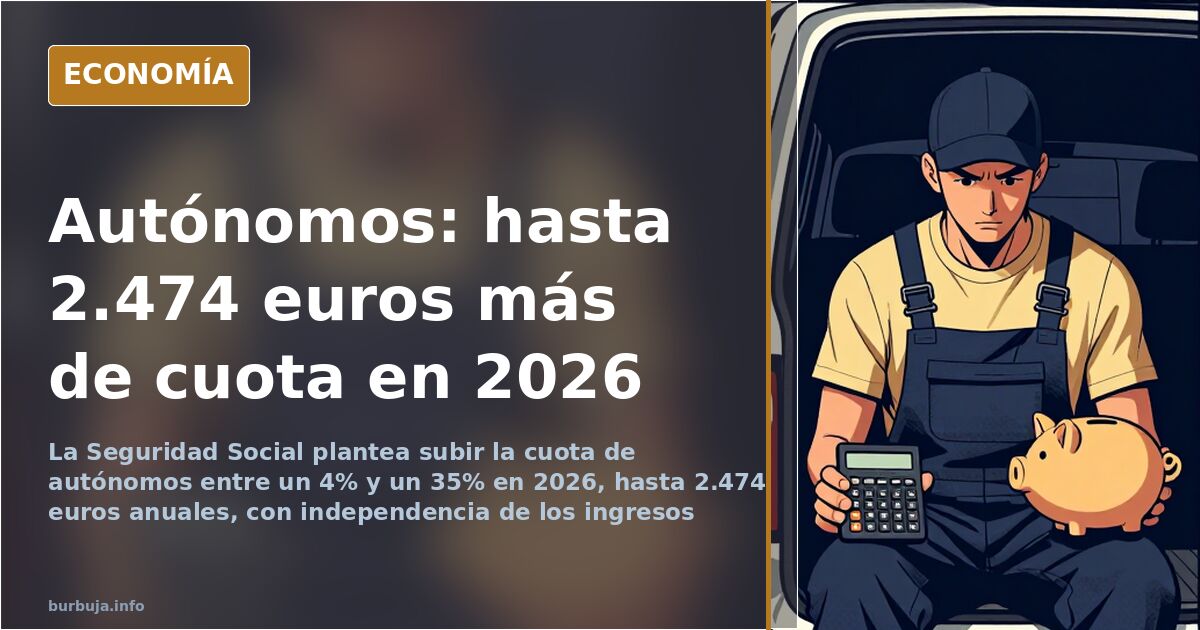
Self-employed fees to rise to €2,474 per year in 2026
How much does it cost to remain self-employed in Spain? The Social Security has presented social agents with the contribution increases for self-employed workers for the next three-year period, and the figure being discussed for 2026 is up to €2,474 more per year. The increase would range between 4% and 35% compared to 2025 and, according to the proposal, would grow for all self-employed individuals regardless of their income. The Minister of Inclusion, Social Security, and Migrations, Elma Saiz, is the public face of the measure, which directly confronts the debate about who supports the productive economy.
What fee increase is proposed for 2026
According to the information provided to social agents, the increases would affect all self-employed workers, including those with low incomes. In absolute terms, the maximum jump indicated in that information is around €2,474 annually. The timeline, in the version presented to social agents, spans three years. It's not a one-time adjustment, but a path with several years of increases on the table. The recurring point in the discussion is that the problem is not just the amount, but that the base rate increases every year.
The calculation that doesn't add up: earning €3,500 and barely reaching minimum wage
One of the figures circulating most among self-employed individuals is this: with a gross turnover of €3,500 per month, between the Social Security contribution and income tax (IRPF), the net result is just slightly above the minimum wage. Hence the most repeated phrase among those affected: the problem isn't just paying taxes, it's that the margin disappears before reaching one's own paycheck.
At the other extreme, some point out that those earning around €600 are forced to pay over €200 in monthly fees, according to the same calculation. The lower brackets, this interpretation holds, make what was theoretically a startup activity or a supplement unviable.
Who ends up paying the fee increase?
The most common answer among debate participants is that the self-employed person doesn't absorb the increase; the client does. If the fee goes up, the price goes up. The transfer to prices has an immediate consequence: where there was once a small service, there is now a quote that the individual doesn't always accept.
And that's where the second consequence comes in. A client who sees the price of a renovation or repair increase opts to do it themselves or postpone it. The result, according to this diagnosis, is less activity and less consumption, the opposite of what is sought when fiscal pressure is increased to raise revenue.
De-registering, the growing specter
Among the reactions to the plan, one constant is: if they raise my fees, I'll de-register. Some claim that an annual increase of €500 would be enough for them to de-register. With around 3 million self-employed workers, according to the figure discussed, a scenario of an orderly flight towards employment would have consequences for revenue: fewer contributions, fewer contributors, and more pressure on the rest of the system.
It's not just a matter of money. The importance of these workers in home renovations, logistics, delivery, or installations—trades whose interruption would be noticeable within days, according to some comments—is the argument used when demanding a collective response that, so far, has not materialized.
Unions, the self-employed, and the fight for class label
The issue has an ideological dimension that permeates the entire discussion. One part of the discourse argues that the self-employed are not the working class because they don't receive a salary and own their means of production, so there would be no reason to expect unions to defend them the same way as salaried employees. The response from the other side is that the label matters little when the fee burden affects a plumber the same way it affects a professional with an office.
In the middle lies a less theoretical reality: those who are self-employed because they earn more that way, and those who are self-employed because they don't fit anywhere else. The common thread is the feeling of paying the uncomfortable part of the system without the protection that comes with being an employee.
Test balloon, CIS, and promises that change
A repeated warning is that the announcement might be a test balloon to gauge resistance before making cuts. In fact, according to a comment in the thread, the strong version of the draft was modified—not repealed—within days, fueling suspicion that the real target was an intermediate figure. Another, ironic, interpretation suggests that such a measure would be enough to revalidate an absolute majority in the CIS (Center for Sociological Research). The official defense—that this is the government that has done the most for the self-employed—clashes with the fee arithmetic. And in the margins, the usual conspiracies circulate, like the digital euro or the hidden agenda, with no evidence to support them.
What's striking is that, with these figures, the public remains so calm. Perhaps, as some comments suggest, because unions are for salaried employees and the self-employed have their own organizations. Whatever the case, they keep paying. Just a little bit more now.
How much does it cost to remain self-employed in Spain? The Social Security has presented social agents with the contribution increases for self-employed workers for the next three-year period, and the figure being discussed for 2026 is up to €2,474 more per year. The increase would range between 4% and 35% compared to 2025 and, according to the proposal, would grow for all self-employed individuals regardless of their income. The Minister of Inclusion, Social Security, and Migrations, Elma Saiz, is the public face of the measure, which directly confronts the debate about who supports the productive economy.
What fee increase is proposed for 2026
According to the information provided to social agents, the increases would affect all self-employed workers, including those with low incomes. In absolute terms, the maximum jump indicated in that information is around €2,474 annually. The timeline, in the version presented to social agents, spans three years. It's not a one-time adjustment, but a path with several years of increases on the table. The recurring point in the discussion is that the problem is not just the amount, but that the base rate increases every year.
The calculation that doesn't add up: earning €3,500 and barely reaching minimum wage
One of the figures circulating most among self-employed individuals is this: with a gross turnover of €3,500 per month, between the Social Security contribution and income tax (IRPF), the net result is just slightly above the minimum wage. Hence the most repeated phrase among those affected: the problem isn't just paying taxes, it's that the margin disappears before reaching one's own paycheck.
At the other extreme, some point out that those earning around €600 are forced to pay over €200 in monthly fees, according to the same calculation. The lower brackets, this interpretation holds, make what was theoretically a startup activity or a supplement unviable.
Who ends up paying the fee increase?
The most common answer among debate participants is that the self-employed person doesn't absorb the increase; the client does. If the fee goes up, the price goes up. The transfer to prices has an immediate consequence: where there was once a small service, there is now a quote that the individual doesn't always accept.
And that's where the second consequence comes in. A client who sees the price of a renovation or repair increase opts to do it themselves or postpone it. The result, according to this diagnosis, is less activity and less consumption, the opposite of what is sought when fiscal pressure is increased to raise revenue.
De-registering, the growing specter
Among the reactions to the plan, one constant is: if they raise my fees, I'll de-register. Some claim that an annual increase of €500 would be enough for them to de-register. With around 3 million self-employed workers, according to the figure discussed, a scenario of an orderly flight towards employment would have consequences for revenue: fewer contributions, fewer contributors, and more pressure on the rest of the system.
It's not just a matter of money. The importance of these workers in home renovations, logistics, delivery, or installations—trades whose interruption would be noticeable within days, according to some comments—is the argument used when demanding a collective response that, so far, has not materialized.
Unions, the self-employed, and the fight for class label
The issue has an ideological dimension that permeates the entire discussion. One part of the discourse argues that the self-employed are not the working class because they don't receive a salary and own their means of production, so there would be no reason to expect unions to defend them the same way as salaried employees. The response from the other side is that the label matters little when the fee burden affects a plumber the same way it affects a professional with an office.
In the middle lies a less theoretical reality: those who are self-employed because they earn more that way, and those who are self-employed because they don't fit anywhere else. The common thread is the feeling of paying the uncomfortable part of the system without the protection that comes with being an employee.
Test balloon, CIS, and promises that change
A repeated warning is that the announcement might be a test balloon to gauge resistance before making cuts. In fact, according to a comment in the thread, the strong version of the draft was modified—not repealed—within days, fueling suspicion that the real target was an intermediate figure. Another, ironic, interpretation suggests that such a measure would be enough to revalidate an absolute majority in the CIS (Center for Sociological Research). The official defense—that this is the government that has done the most for the self-employed—clashes with the fee arithmetic. And in the margins, the usual conspiracies circulate, like the digital euro or the hidden agenda, with no evidence to support them.
What's striking is that, with these figures, the public remains so calm. Perhaps, as some comments suggest, because unions are for salaried employees and the self-employed have their own organizations. Whatever the case, they keep paying. Just a little bit more now.
Summary of a discussion on Burbuja.info - Foro de economía, actualidad y política., translated from Spanish and reviewed before publication. Read the full discussion (261 replies).
More summaries
-
Forum Cites Social Security Data: Girona Leads at 41.2%
Forum cites August 2026 Social Security data: Girona, 41.2%; Teruel, 40.4%; Basque Country, 28.8%.
-
Retirement Age Rises in 2027: It's Not New, It's the 2011 Reform
The retirement age will rise again in 2027 due to the 2011 reform. The 38.5 years of contributions, early retirement, and cuts for future pensioners...
-
Social Security Blames Robot for Plus Ultra Certificate
Social Security attributes issuing a certificate declaring Plus Ultra up-to-date on payments to an automated system. The underlying issue: the legality of the deferment.
-
Córdoba Father Self-Immolates: Mental Illness or Societal Despair?
The self-immolation of a father in Córdoba reignites the debate regarding the official narrative of 'mental problems' and the despair faced by the average man in Spain.
-
Euthanasia in Old Age: Autonomy vs. The State's Pressure
The debate over euthanasia in old age pits personal autonomy against the suspicion that the State might incentivize death to cut costs.
-
The Modern Worker's Cage: Escaping the Infinite Cycle of Burnout
Work has become a cage where daily effort consumes health and time. Discover why we push ourselves so hard and how to break the cycle.