
Vallecas and the Hypocrisy of Local Politics
Vallecas' working-class neighborhood is facing the immigration it once celebrated. Identity politics confront a contradiction: 10-15 years to change its fabric...
English · Original discussion in Spanish · Published
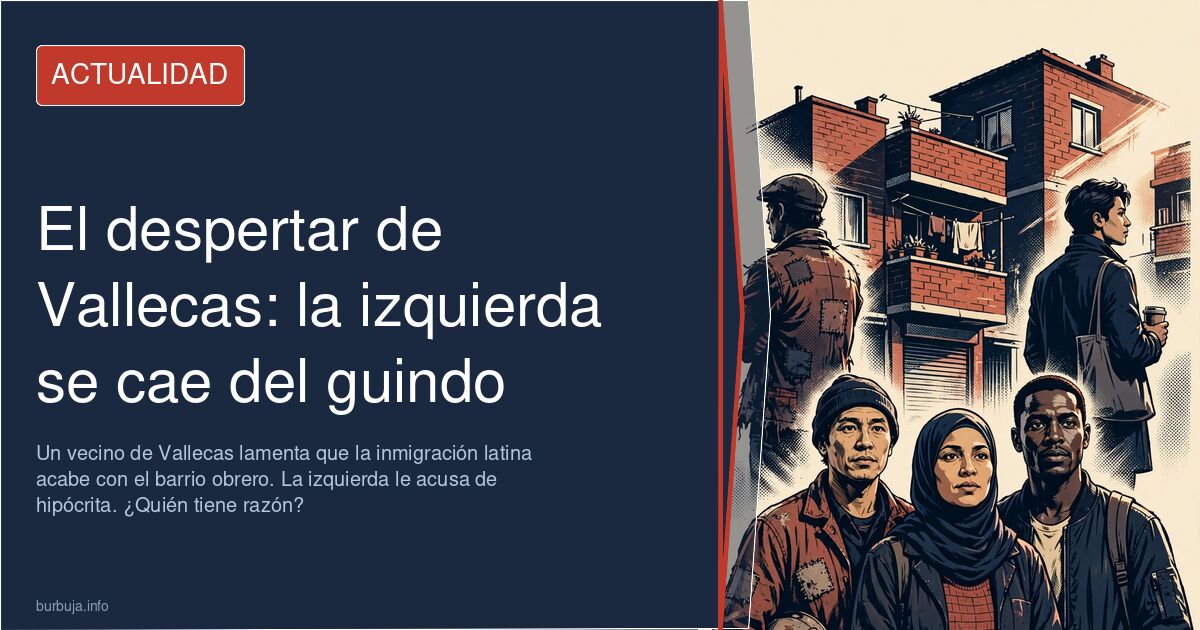
The working-class community of Vallecas confronts the immigration it once welcomed
What happens when a working-class neighborhood that boasted about its class consciousness and antifascism sees that the diversity it so praised is completely changing its social fabric? The controversy is served. A viral tweet warned that 'at the rate of Latin immigration in Vallecas, nothing will remain of the popular neighborhood in 10-15 years.' The response was less surprise and more sarcasm: many pointed out that this warning came two decades late, right from the Aznar era.
The Predictable Contradiction
The phenomenon is not new. Those who lived in the neighborhood during the 90s recall that demographic change was already underway. The difference is that now, the discourse has become uncomfortable for the identity politics of the left. A sector of the Vallecas left, historically in favor of immigration, finds that their own neighbors, the newcomers, do not share their political imaginary. The most cited example is that of two anti-eviction activists in Barcelona who protested against the occupation of their home by people of Maghrebi origin. The same left that defends squatting when it doesn't affect them shows 'selective sarracena' when it comes to their own home.
The Flight of Those Who Preach with the Example
Another current suggests that many of these supposed defenders of the working-class neighborhood have long since lived elsewhere. The case is mentioned of those who, after decades proclaiming their commitment to the neighborhood, moved to private communities with elite schools and streets without 'bustle.' A €50,000 hippie van and a domestic worker are the icons of this alleged exodus. For these analysts, the real working class is those who stay—those who cannot choose—while their former leaders have settled into the comfort of the middle class.
Class Consciousness as an Electoral Tool
A third approach denies the authenticity of 'class consciousness' when used by the institutional left. It is argued that it is a construct designed to attract votes, treating workers like sheep. The proof, say the critics, is that most voters of that same left have not turned their identity into a political project; they act like any other person: if their situation improves, they change neighborhoods and discourses.
The tweeter himself would have written two years ago that mass immigration was unstoppable and only acceptance remained, a contradiction that is now facing him.
In short, the working-class paradise they loved so much increasingly resembles the rest of Spain. And the last person to realize this is the one who came to explain it to us. Meanwhile, Vallecas remains a popular neighborhood, only with a different face. And for some, that new face is unwelcome. Ironies of life.
What happens when a working-class neighborhood that boasted about its class consciousness and antifascism sees that the diversity it so praised is completely changing its social fabric? The controversy is served. A viral tweet warned that 'at the rate of Latin immigration in Vallecas, nothing will remain of the popular neighborhood in 10-15 years.' The response was less surprise and more sarcasm: many pointed out that this warning came two decades late, right from the Aznar era.
The Predictable Contradiction
The phenomenon is not new. Those who lived in the neighborhood during the 90s recall that demographic change was already underway. The difference is that now, the discourse has become uncomfortable for the identity politics of the left. A sector of the Vallecas left, historically in favor of immigration, finds that their own neighbors, the newcomers, do not share their political imaginary. The most cited example is that of two anti-eviction activists in Barcelona who protested against the occupation of their home by people of Maghrebi origin. The same left that defends squatting when it doesn't affect them shows 'selective sarracena' when it comes to their own home.
The Flight of Those Who Preach with the Example
Another current suggests that many of these supposed defenders of the working-class neighborhood have long since lived elsewhere. The case is mentioned of those who, after decades proclaiming their commitment to the neighborhood, moved to private communities with elite schools and streets without 'bustle.' A €50,000 hippie van and a domestic worker are the icons of this alleged exodus. For these analysts, the real working class is those who stay—those who cannot choose—while their former leaders have settled into the comfort of the middle class.
Class Consciousness as an Electoral Tool
A third approach denies the authenticity of 'class consciousness' when used by the institutional left. It is argued that it is a construct designed to attract votes, treating workers like sheep. The proof, say the critics, is that most voters of that same left have not turned their identity into a political project; they act like any other person: if their situation improves, they change neighborhoods and discourses.
The tweeter himself would have written two years ago that mass immigration was unstoppable and only acceptance remained, a contradiction that is now facing him.
In short, the working-class paradise they loved so much increasingly resembles the rest of Spain. And the last person to realize this is the one who came to explain it to us. Meanwhile, Vallecas remains a popular neighborhood, only with a different face. And for some, that new face is unwelcome. Ironies of life.
Summary of a discussion on Burbuja.info - Foro de economía, actualidad y política., translated from Spanish and reviewed before publication. Read the full discussion (193 replies).
More summaries
-
Camryn Manheim and the ‘gay son’ she wished she had
A quote attributed to Camryn Manheim—wanting a gay son and dressing him in drag—reopens the debate over identities imposed on children
-
Vegan raw-food influencer dies at 39 after extreme diet
Zhanna Samsonova, 39, a raw-food influencer, died in Malaysia from an infection worsened by the 'exhaustion' of an extreme fruit-only diet
-
DN calls for 'kicking out' the Puerta del Sol campers
A Democracia Nacional leader urges a group of 'brave men' to 'kick out' the Puerta del Sol campers.
-
Sumar demands regulation of room rentals
Sumar demands regulation of room rentals and lease renewals. An investor warns that property maths no longer add up.
-
Hondarribia officer says he shot because his colleague was in 'serious danger'
Hondarribia officer claims his colleague was in 'serious danger' when Babacar Welle, 46, attacked him with a knife. The Ertzaintza is investigating.
-
Chini Chuini set to become Jewish
Ynet reports that Sydney Sweeney has reportedly converted to Judaism and was seen at a synagogue with Scooter Braun. She has not confirmed it.