
Valladolid: Latin gangs and a demographic shift that defies the narrative
Valladolid, Spain, gained 1,530 residents in six months, nine in ten of them foreign. Latin gang violence is surging while the political response falls short.
English · Original discussion in Spanish · Published
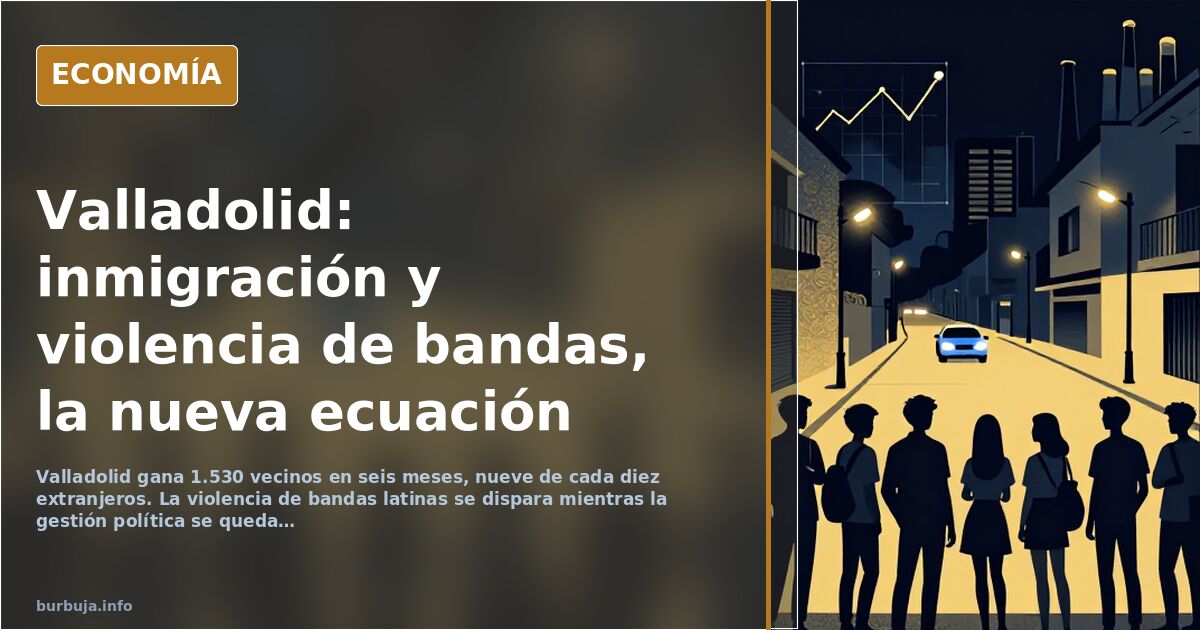
Valladolid: Latin immigration and gangs, the new equation nobody has solved
In six months, Valladolid has gained 1,530 residents. Nine in ten are foreign nationals. The Colombian community now exceeds 5,800 registered residents and the Venezuelan one has overtaken the Segarro community. Meanwhile, fights between Latin gangs keep breaking out right in Plaza Circular. A city that was once a conservative stronghold is facing a demographic transformation that nobody seems to have planned for.
The numbers behind the new Valladolid
The municipal register leaves no room for doubt. Between January and June, the Castilian capital added 1,530 new residents, and 90% come from other countries. Colombia is the main country of origin: 389 new registrations, bringing the total to 5,818 residents. Venezuela trinc with 383 new registrations and a total of 4,011, surpassing the Segarro community for the first time. These figures point to a rapid shift in the city's social makeup, with a growing weight of Latin American population.
This growth is not limited to the capital. The surrounding municipalities have also seen their foreign population increase, largely tied to agricultural hiring. The agricultural employers' association has been singled out for employing migrants in precarious conditions, a factor that some analyses link directly to the rise in the province's floating population.
Gang violence: from Plaza Circular to the Acera de Recoletos
Youth violence has become a recurring problem. In March 2026, a mass brawl between the Dominican Don't Play (DDP) and the Trinitarios near Plaza Circular ended with one arrest. It was the first major clash after the death of Esteban Rubio, an event that marked a turning point in how safe the city feels. Since then, incidents have kept piling up: minors hiding machetes at street drinking gatherings, knife-point robberies on the Acera de Recoletos, and a minor sentenced to fifteen months in a juvenile facility after hunting down a rival while shouting "today someone is going to die."
Latin gangs, with structures imported from countries such as the Dominican Republic, have found fertile ground in Valladolid. Police have carried out several operations, but the sense of insecurity persists in neighborhoods like Las Moreras, where a recent incident has once again set off the alarms.
The political debate: city management and the employers' association
The city government, run by the PP and Vox parties, has come under criticism from different quarters. Questions have been raised about the location of a municipal immigrant integration center in one of the neighborhoods most affected by immigration, as well as the low-emission zone (ZBE) policy and the billboard displaying the annual count of victims of gender-based violence, which some see as a symbolic gesture with no real impact. On the other hand, some point out that the agricultural employers' association itself is the main driver of the arrival of foreign workers, in a context of low wages and harsh conditions.
The debate has become polarized. While some see immigration as the cause of insecurity, others point to job precarity and the lack of integration policies as the root of the problem. The reality is that the city has been transformed in a decade, and the institutions do not seem to have kept pace.
The Predator 2 metaphor
The comparison with the 1990 film is no accident. In "Predator 2," Los Angeles appears as a dystopian city, dominated by gangs and violence, where human beings are insignificant creatures. Some commentators have seen a similar scenario in Valladolid: a city that has become "Latin," with machetes and street fights that seem straight out of fiction. The irony is that the film was released more than three decades ago as a warning, and today it is cited as a mirror of a reality that keeps growing.
The question is whether Valladolid can manage this change without the violence becoming entrenched. The demographic data are clear; the political response is not.
Also available in: Deutsch
Summary of a discussion on Burbuja.info - Foro de economía, actualidad y política., translated from Spanish and reviewed before publication. Read the full discussion (64 replies).
More summaries
-
Moroccan Ex-Soldier Claims Rabat Mobilizing Missiles North
A Moroccan ex-soldier asserts in television appearances that Morocco is mobilizing heavy equipment northward, targeting Ceuta, Melilla, the Canary Islands, and Andalusia.
-
Ábalos case entangled with Peru hotel scandal
Former Socialist minister faces 24-year prison request as a Peruvian associate's hotel story divides critics.
-
Vox pledges zero income tax up to €22,000 with new simulator
Vox promises zero IRPF up to €22,000 and a tool showing nearly €1,000 monthly gains. Critics cite a €50 billion cost without funding sources.
-
Equatorial Guinea: the mirage of Spain's former colony
From Africa's highest GDP and an 89% literacy rate to Obiang's corrupt dictatorship: the paradox of Equatorial Guinea, a former Spanish colony.
-
Nursing vs Electrical Work: which career has more future for emigrating?
A starting salary of €30,000 versus a more trade-oriented vocational path: the dilemma between Nursing and Electrical Work for those who want to leave Spain. Data analysis and credential recognition.
-
Informal sperm donation: why fathering a child without a contract can cost you dearly
A friend asks you to inseminate her without sex or responsibilities? Here's why that offer could end up costing you more than 145,000 euros in child support.