
Equatorial Guinea: the mirage of Spain's former colony
From Africa's highest GDP and an 89% literacy rate to Obiang's corrupt dictatorship: the paradox of Equatorial Guinea, a former Spanish colony.
English · Original discussion in Spanish · Published
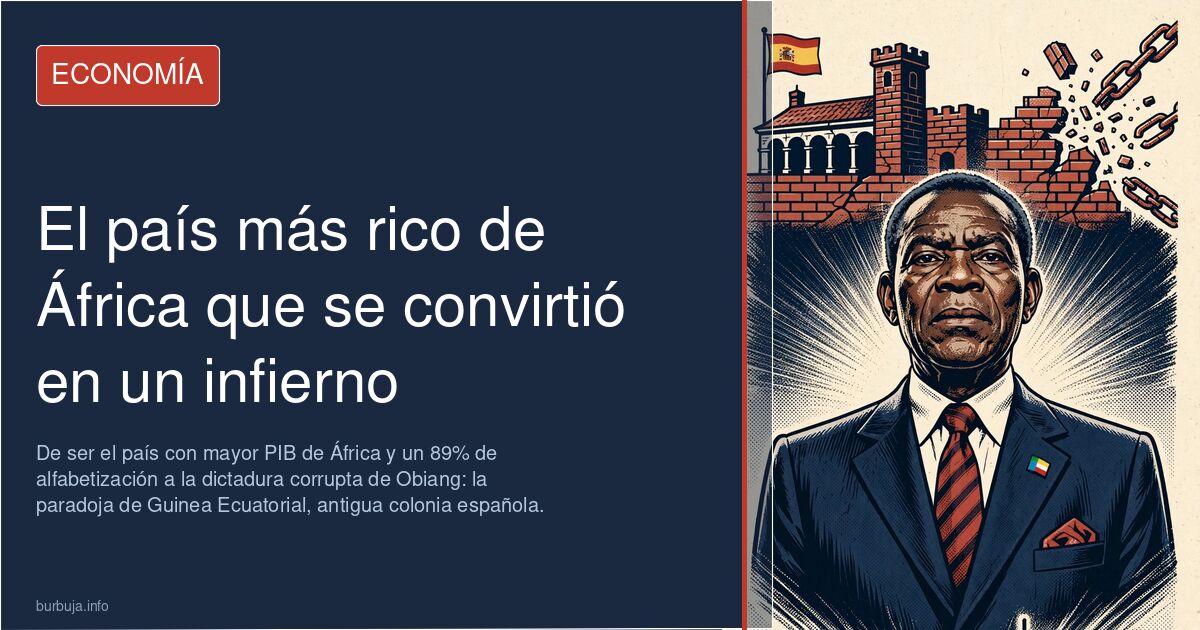
Equatorial Guinea: the mirage of Spain's former colony
At the time of its independence, Equatorial Guinea had Africa's highest per capita income and a literacy rate of 89%, higher than South Africa's. Four decades later, it is an example of how political plunder can ruin any initial advantage.
The Spanish colonial legacy: success or failure?
Spain did not take the territory seriously until well into the 20th century. In fact, there were attempts to sell it to England, but public pressure prevented it. The real boom came under Franco, who, antiestéticaring a guerrilla war like in the Rif or a bloodbath like Algeria's, pushed for development. However, the independence process, managed by minister Castiella, was a disaster. The country went from being a model colony in social indicators to falling into the hands of a family dictatorship.
The Obiang regime: oil, corruption and misery
Today, Equatorial Guinea is considered the most corrupt country in the world. The Obiang family accumulates properties across the globe while the population survives on wages of 120 euros a month. Renting a luxury apartment costs 70 euros, a figure that reveals the extreme inequality. Political repression is fierce: anyone who criticizes the regime ends up detained and beaten. Oil wealth has not reached the majority.
The Equatorial Guinean diaspora in Spain
Unlike other former colonies, emigration from Equatorial Guinea to Spain has been small. Those who have arrived have fully integrated, speak perfect Spanish and have built families regarded as fully Spanish. It is a contrast with the image projected by the regime.
With leader Obiang accumulating properties around the world and the population subsisting on 120 euros a month, the question is not why more Equatorial Guineans don't come, but how those who stay survive. The country remains an unfinished business that Spain never knew how to manage, neither as a colonizer nor as a partner.
Also available in: Deutsch
Summary of a discussion on Burbuja.info - Foro de economía, actualidad y política., translated from Spanish and reviewed before publication. Read the full discussion (63 replies).
More summaries
-
Two Spaniards held in Equatorial Guinea prison for 16 months
Javier Marañón and David Rodríguez remain detained in Black Beach without charges since January 2025, with no diplomatic action from Spain.
-
The Elite Education of Tenant Spokespeople Sparks Controversy
Controversy erupts as the elite international education backgrounds of prominent tenant movement spokespeople are revealed, challenging their narrative of precarity.
-
Germany's motorways are cracking: heat or underinvestment?
Germany's motorways, long a byword for efficiency, are cracking under extreme 40°C heat. The ADAC has confirmed restrictions across the network. Is it the weather or a lack of…
-
Sánchez's grip on state companies and captive voters in Spain
Pedro Sánchez controls Indra, Correos and the electoral roll. Over 5 million new voters and a passive opposition could keep him in power for decades.
-
The racial dilemma of street justice in Spain
A viral video shows a woman being assaulted with no one intervening. The debate reveals how the attacker's race shapes the social reaction and the unequal application of justice.
-
Ceuta: 45 police officers and no protocol for possible mass entry
Ceuta faces a possible mass entry on Saturday with just 45 police officers and no clear protocol. The 2021 precedent and doubts over Morocco's cooperation loom large.