
Valencia protest camp: no alcohol, no joints, just one gate
According to a forum account, the Valencia protest camp in Spain bans alcohol, joints and drugs, with a single entrance and permanent expulsion. The model raises questions about...
English · Original discussion in Spanish · Published
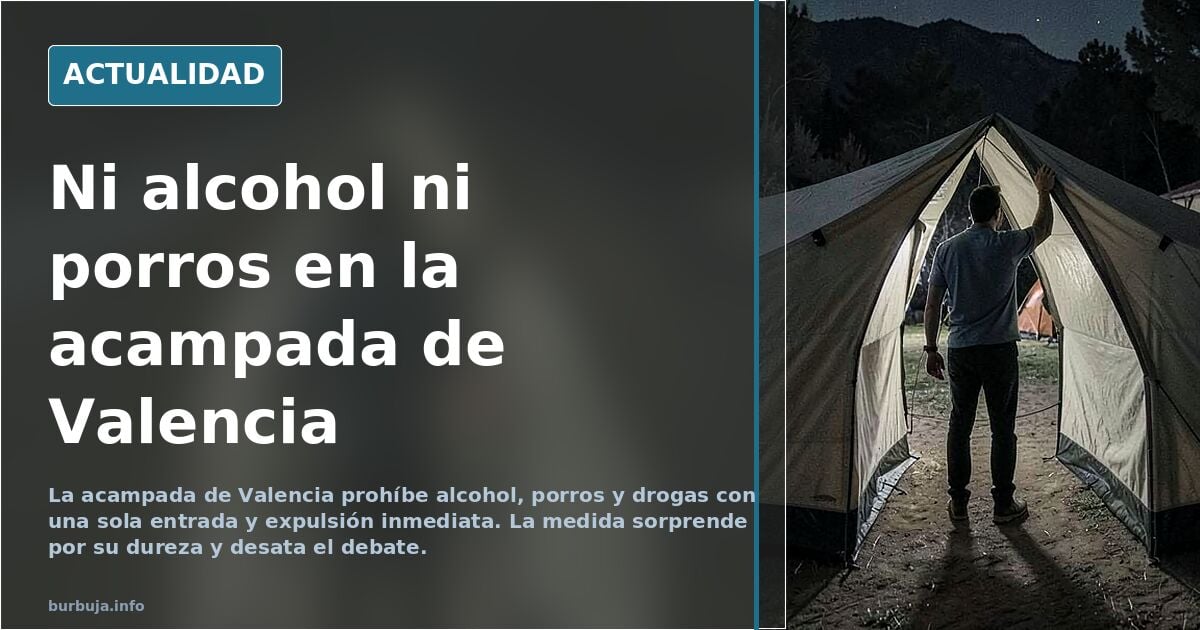
No alcohol, no joints: the Valencia camp shuts down the party
A man in zombie mode prowls around the perimeter of the site. He carries no banner and no slogan: he carries all the alcohol he downed before arriving. He approaches the only entrance, stumbles at the checkpoint and stays outside. That scene, described in detail in the discussion that inspired this article, sums up the most talked-about twist at the Valencia protest camp: according to one participant's account, the organizers have decided that inside, no drinking, no joints and no getting in while high. And anyone who tries stays out on the street.
The rule is not just a statement of intent. There is only one entrance, and everyone goes through it. If you get caught drinking or smoking inside, you are shown the exit and not allowed back in. Same if you show up with signs of having used. The result, according to the account that started the thread, is that the camp has rid itself of a lot of scumbags and of people who were only there to take drugs and disturb the peace at night.
What exactly does the Valencia camp ban?
The package is airtight: no alcohol, no joints, no drugs. Surveillance is concentrated at the access point, which turns the single gate into a bottleneck that doubles as a filter. There are no exhaustive searches or blanket pat-downs, but there is a clear rule and an immediate consequence for anyone who breaks it.
What surprised the person telling the story most was not the ban itself, but how firmly it is enforced. The camp has not turned into an open-air drinking session with tents, and that clashes with the image many people had taken for granted. The official explanation is simple: they got rid of the blight with one stroke.
The doubts the model raises: who's in charge here?
The first objection raised is about legitimacy. Who decides what is legal inside an occupied public space? Is that territory considered its own and sovereign, or do they fall back on municipal rules? The question is not rhetorical: a camp that claims the power to expel someone is exercising, de facto, an authority whose source is unclear.
The second objection is practical. What if you get caught with a few cans? Is there physical punishment? A tent set up as a cell? The image of a camp-style disciplinary regime is funny until you wonder how an expulsion is carried out with no resources or staff. The answer, as the story goes, is the gate: there is no other.
The reverse call effect: fewer people, fewer problems
Some argue that with rules like these, nobody will camp there. It is the most repeated criticism: a space that bans alcohol and joints turns into a get-together for the most well-behaved, which reduces its appeal for the young crowd that usually fills these gatherings.
The counterargument is that this is precisely the goal. The filter is not meant to fill the place, it is meant to select. And as a bonus, it keeps a drunk in full zombie mode from planting himself in a corner and bothering those who are trying to sleep. The anecdote of the prowler crashing against the perimeter like a moth against glass is, according to the teller, proof that the system worked, at least that night.
What access control does not control
The rule covers alcohol and drugs. It does not cover everything else. The conversation mentions a news story from Madrid about a sensual assault at another camp, and with it the uncomfortable truth: a checkpoint at the gate does not make a site a safe place. You can walk in sober and be just as much of a danger.
There lies the model's real sustancia ilegal. Banning alcohol is easy to verify and to justify. Preventing behavior that is not visible at a glance requires something else: staff, protocols, complaints and consequences. For now, what there is, is a gate and a rule. And a guy left outside, swaying, unable to understand why he is not being let in.
Also available in: Deutsch
Summary of a discussion on Burbuja.info - Foro de economía, actualidad y política., translated from Spanish and reviewed before publication. Read the full discussion (21 replies).
More summaries
-
Ayuso demands answers over terror-linked groups at Madrid's Sol camp
Madrid regional president Ayuso asks the Government Delegation whether a group with terrorist links runs the Sol camp and warns of risks to the Metro.
-
Spanish police officer assaulted at Puerta del Sol protest camp
A UPR officer was assaulted during an intervention at the Puerta del Sol camp in Madrid. The JUPOL union claims officers were left working without guidance.
-
This is the Level of the Sol Protest Camp
A social media post claims this is the 'level' of the Sol protest camp, but provides no data on attendance, dates, or organizers. Here is what is known and what is missing.
-
Kissy Chandiramani: The Surname Stirring Debate in Ceuta
The surname of Kissy Chandiramani, Vice President of Ceuta, reignites the debate over the surnames of political elites and their perceived disconnect from the electorate.
-
Viral post says bus driver and teachers should face charges for school bus crimes
A viral message claims that anyone who fails to act during a crime on a school bus should also be held accountable. The 'look away' argument and its legal limits.
-
Brazil: vote splits between Bolsonaro and Lula along income and race lines
Brazil's Superior Electoral Court confirms Lula's victory as the theory of a vote divided by race and income takes hold, without any data to back it up