
Valencia Orange Groves: €3,000 Yearly and Avocado Temptation
A hectare of Valencia oranges yields about €3,000 annually. Water scarcity drives some farmers to consider switching to avocados.
English · Original discussion in Spanish · Published
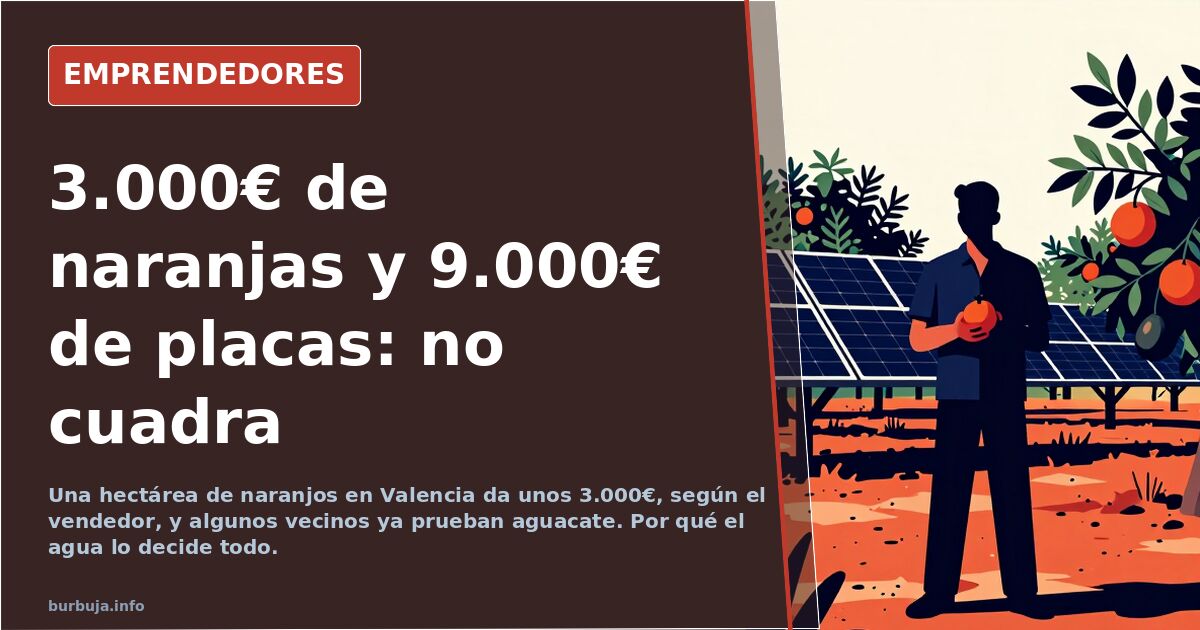
Oranges yielding €3,000 a year: Uproot or endure?
A productive orange grove, a small house in the middle, and a drip irrigation system that also injects fertilizer. This is the plot recently acquired by an outsider in the Valencian huerta (traditional irrigated farmland). The question haunting anyone entering farming without cooperative experience: Is this profitable or just an expensive hobby?
The seller gave a brief answer. The cooperative pays about €3,000 for annual production, according to reports, and figures are declining. The reason cited: climate change, less rain, and shrinking harvests. Some neighbors, they say, have started uprooting citrus to plant avocados. Tempting. And, upon reflection, debatable.
What to do with an unprofitable orange grove?
The first sensible decision is to touch nothing. Those who buy land without knowing the trade ruin themselves twice: in the purchase and in the conversion. The cooperative will handle the next harvest, so there is a full year to observe, ask questions, and verify if the disaster narrative is as severe as portrayed.
The dominant stance among those living from this is to keep the trees. When the neighbor uproots, you hold on: whoever removes a healthy hectare in the world's best citrus zone bets against history. When everyone switches to the same crop, the price of the new commodity collapses. As peine with persimmons, once sold at gold prices and now bottomed out.
Is it profitable to switch oranges for avocados?
Avocado is the big draw. It produces early, two or three years if successful, and some have seen boxes filled on neighboring farms. The problem is water: weekly irrigation for the first three years and every twenty days thereafter, plus ambient humidity scarce in Valencia. In a year with barely any rain since March, the math doesn't add up alone.
Some grow citrus and avocado together and warn. It is true ruin, admits one, at least in their experience: the variety can be excellent yet unsold because markets reject it. Mass-planted avocados face the same fate. More production, lower pay, just like persimmons.
Pistachio, olive, or fig: alternatives on the table
Pistachios appear and disappear for a simple reason: no fruit until four or five years. Intensive olive groves gain traction among those who know the terrain. With oil prices soaring, some argue it is more profitable and easier to manage, requiring less care and very little thirst. The full calculation, with rows, irrigation, and tillage, fills a page of numbers.
Figs drop off the list due to their skin: they spoil when picked and any bruise rots them, while oranges withstand stacking thanks to hard peels. No one uproots citrus for a fruit that cannot survive travel.
Is organic farming worth the switch?
Selling organic oranges online sounds good until you look at the market. Some calculate a well-sold organic hectare can yield €20,000, but this clashes with commercial reality: fruit often ends up in juice industry at clearance prices, and consumers demand large pieces impossible without synthetic fertilizers. Certification takes two years and guarantees no buyer.
Vegetative cover and soil management
Another path, more discreet, is not changing the crop but how it is cultivated. Leaving pruning debris on the ground maintains moisture, provides shade, feeds insects that aerate the soil, and reduces water and fertilizer needs. The majority practice the opposite: herbicide as soon as weeds appear.
It is not free. Vegetative cover requires mowing several times a year and costs more than herbicide. It does not work everywhere: in dryland olive or almond groves, it competes for water and tillage is preferred to prevent capillary loss. It can also harbor pests.
Solar panels for the house: €9,000 or much less
The farm lacks grid connection. The buyer's budget is €9,000 without generator, a figure that shrinks when someone itemizes materials independently: regulator €300, inverter €400, batteries €2,000, and eight 400-watt panels for €800. Total, less than half.
With a hectare yielding €3,000 a year and a €9,000 solar installation, the property performs better as a second home than an agricultural business. That may ultimately be the deciding factor.
A productive orange grove, a small house in the middle, and a drip irrigation system that also injects fertilizer. This is the plot recently acquired by an outsider in the Valencian huerta (traditional irrigated farmland). The question haunting anyone entering farming without cooperative experience: Is this profitable or just an expensive hobby?
The seller gave a brief answer. The cooperative pays about €3,000 for annual production, according to reports, and figures are declining. The reason cited: climate change, less rain, and shrinking harvests. Some neighbors, they say, have started uprooting citrus to plant avocados. Tempting. And, upon reflection, debatable.
What to do with an unprofitable orange grove?
The first sensible decision is to touch nothing. Those who buy land without knowing the trade ruin themselves twice: in the purchase and in the conversion. The cooperative will handle the next harvest, so there is a full year to observe, ask questions, and verify if the disaster narrative is as severe as portrayed.
The dominant stance among those living from this is to keep the trees. When the neighbor uproots, you hold on: whoever removes a healthy hectare in the world's best citrus zone bets against history. When everyone switches to the same crop, the price of the new commodity collapses. As peine with persimmons, once sold at gold prices and now bottomed out.
Is it profitable to switch oranges for avocados?
Avocado is the big draw. It produces early, two or three years if successful, and some have seen boxes filled on neighboring farms. The problem is water: weekly irrigation for the first three years and every twenty days thereafter, plus ambient humidity scarce in Valencia. In a year with barely any rain since March, the math doesn't add up alone.
Some grow citrus and avocado together and warn. It is true ruin, admits one, at least in their experience: the variety can be excellent yet unsold because markets reject it. Mass-planted avocados face the same fate. More production, lower pay, just like persimmons.
Pistachio, olive, or fig: alternatives on the table
Pistachios appear and disappear for a simple reason: no fruit until four or five years. Intensive olive groves gain traction among those who know the terrain. With oil prices soaring, some argue it is more profitable and easier to manage, requiring less care and very little thirst. The full calculation, with rows, irrigation, and tillage, fills a page of numbers.
Figs drop off the list due to their skin: they spoil when picked and any bruise rots them, while oranges withstand stacking thanks to hard peels. No one uproots citrus for a fruit that cannot survive travel.
Is organic farming worth the switch?
Selling organic oranges online sounds good until you look at the market. Some calculate a well-sold organic hectare can yield €20,000, but this clashes with commercial reality: fruit often ends up in juice industry at clearance prices, and consumers demand large pieces impossible without synthetic fertilizers. Certification takes two years and guarantees no buyer.
Vegetative cover and soil management
Another path, more discreet, is not changing the crop but how it is cultivated. Leaving pruning debris on the ground maintains moisture, provides shade, feeds insects that aerate the soil, and reduces water and fertilizer needs. The majority practice the opposite: herbicide as soon as weeds appear.
It is not free. Vegetative cover requires mowing several times a year and costs more than herbicide. It does not work everywhere: in dryland olive or almond groves, it competes for water and tillage is preferred to prevent capillary loss. It can also harbor pests.
Solar panels for the house: €9,000 or much less
The farm lacks grid connection. The buyer's budget is €9,000 without generator, a figure that shrinks when someone itemizes materials independently: regulator €300, inverter €400, batteries €2,000, and eight 400-watt panels for €800. Total, less than half.
With a hectare yielding €3,000 a year and a €9,000 solar installation, the property performs better as a second home than an agricultural business. That may ultimately be the deciding factor.
Summary of a discussion on Burbuja.info - Foro de economía, actualidad y política., translated from Spanish and reviewed before publication. Read the full discussion (180 replies).
More summaries
-
AI's Impact: Shifting from Factories to Offices
Analysis of over 1,200 days of discussion suggests AI will affect white-collar jobs and middle management before factory workers.
-
Christian Bresser: another young Spaniard proving how mediocre you are
Analysis of the debate on Christian Bresser in Burbuja.info: legitimate entrepreneurship or digital smoke selling? Discover the key points of the thread here.
-
AI's 'Toaster': Infinite Content, Zero Value
In 2026, generative AI floods the market with low-quality content. The 'toaster' term defines a minimum-effort economy where startups struggle.
-
Industrial Organization Engineering: No Signing Rights, Under Scrutiny
Spain's Industrial Organization degree lacks professional attributions for signing projects. Debate continues over its real career prospects.
-
From Business Degree to Mechanic: A Career Shift Few Recommend
A Spanish business graduate earning €30,000 considers becoming a mechanic. Forum users warn of low pay, grease, and retail hours.
-
Spain's INE mandates four years of monthly surveys for micro-businesses
Spanish freelancers report facing mandatory monthly surveys from the National Statistics Institute (INE) for four years, with fines up to €30,000.