
AI's Impact: Shifting from Factories to Offices
Analysis of over 1,200 days of discussion suggests AI will affect white-collar jobs and middle management before factory workers.
English · Original discussion in Spanish · Published
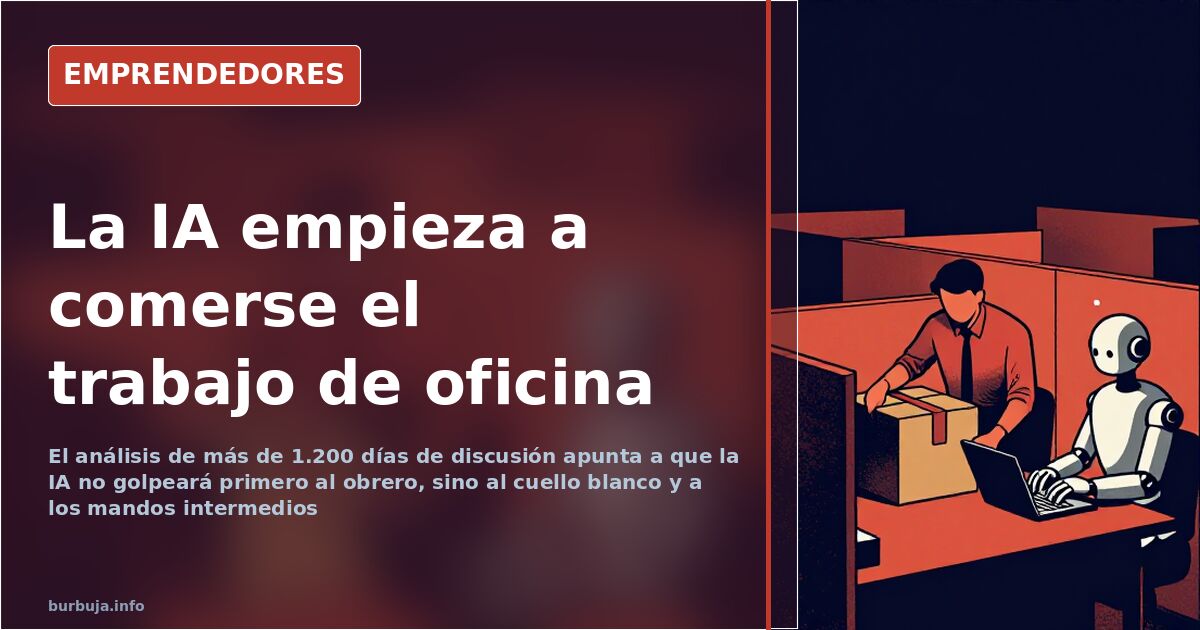
AI's Revolution Won't Start in the Factory: It Begins in Your Office
The debate has raged for over 1,200 days and remains unresolved. While the official narrative portrays artificial intelligence as a force that will overnight disrupt everything, those who have spent hours grappling with the tools describe something far less photogenic: a slow, partial, and inconspicuous change. AI's impact won't be a single blow. It will resemble the computerization of the eighties—silent, selective, and cruel to a specific profile of worker. And that profile isn't the assembly line laborer. It's the white-collar employee who thought they were safe.
Which Jobs Will AI Replace First
Classic automation eliminated muscle power. The emerging thesis from concrete cases inverts the order: middle managers, administrative staff, copywriters, illustrators, interns. Those who advocate this explain it plainly: a good part of office work is overvalued and requires little more than reading, good writing, and managing a couple of programs. That is automatable, and it doesn't require a robot with hands.
The numbers provided by those who have experienced it firsthand all point in the same direction. An engineer recalls how his department went from 60 people to 12 with the advent of computing, and argues that the cuts with AI will be even greater. Another, heading an architecture firm, describes how it went from five employees to two: himself, an intern who masters the tools, and the machine doing the work of the other three. These are anecdotes, not statistics. But they point in the same direction.
Why Manual Labor Isn't in the Crosshairs
AI can't fix a leaky faucet or change your car tire. This is the most repeated argument among those who refuse to buy into the panic. Automation hits the same wall as remote work: you can't take the ship home or plug a tire into a USB. And on the other side, a complaint is growing that is no longer just technological: when a home appliance breaks down, nobody knows how to fix it.
Those who articulate it best summarize the asymmetry: the threat isn't to the operator, but to the paper-pusher, the desk-warmer, and the press release writer. By the time that work is automated, the manual laborer will have been gone for decades.
The AI That's Already Cutting Staff Without Notice
Beyond the headlines, the change is advancing internally. Some companies are already seeking AI Directors—a role that combines data management and tool supervision. Others have replaced entire tasks: where four operators worked in rotating shifts to move material between lines, there are now fewer. And in creative work, the calculation is ruthless: someone who handles the software well can do in a day what five people did in a week before.
This is precisely the fine print that nobody mentions in neon-lit presentations. Some law and economics firms have already sent internal memos warning their staff that they have three to five years to retrain. Automation doesn't arrive as a massive, loud layoff, but as a vacancy that isn't refilled and an aging workforce without succession.
When AI Still Does the Job Poorly
The counterweight exists, and it's significant. The verdict from those who use it daily is that, in specific creative tasks, the tool delivers a result in seconds that is unusable. A month spent fiddling with design generators leads to a damning summary: garbage delivered in seconds. Another takes almost an hour to produce a simple data curve.
There's a fundamental problem pointed out with technical precision: current language models don't learn from experience; they remain static after training. And they exhibit a false appearance of competence. In legal matters, checking point by point what they return reveals errors. It sounds convincing. It isn't.
The Bluff, the Metaverse, and Profitable Skepticism
Every technological wave brings its own contingent of doomsayers and salespeople, and this one is no exception. On one hand, the memory of recent bubbles—cryptocurrencies, NFTs, the metaverse—that promised the future and delivered smoke. On the other, the realization that by September 2024, the change was still not visible: the same people working under the same conditions, the same people getting paid, nothing broken. The prevailing diagnosis is that AI is the showcase for something that already peine, with algorithms and big data. The novelty is the sign, not the engine.
And on top of that, the parallel business. The 1,500 euro courses promising to dominate the world from home with the last spot available. When those selling the gold don't have any, it's wise to be suspicious of the gold.
What Role Does European Regulation Play
A final factor influencing all predictions: the legal framework. The most repeated suspicion is that Europe will regulate before adopting and lose the race against the United States, and that states will slow down public sector job replacement to avoid undermining their own base. At its core, the same doubt: those who hold power are in no hurry to relinquish it.
With these elements, the honest approach is not to close the prediction. The change could take twenty years, or it could be happening now in an office near you, without a press conference. The only truly disorienting thing is that, meanwhile, nobody knows for sure at exactly what point we are.
The debate has raged for over 1,200 days and remains unresolved. While the official narrative portrays artificial intelligence as a force that will overnight disrupt everything, those who have spent hours grappling with the tools describe something far less photogenic: a slow, partial, and inconspicuous change. AI's impact won't be a single blow. It will resemble the computerization of the eighties—silent, selective, and cruel to a specific profile of worker. And that profile isn't the assembly line laborer. It's the white-collar employee who thought they were safe.
Which Jobs Will AI Replace First
Classic automation eliminated muscle power. The emerging thesis from concrete cases inverts the order: middle managers, administrative staff, copywriters, illustrators, interns. Those who advocate this explain it plainly: a good part of office work is overvalued and requires little more than reading, good writing, and managing a couple of programs. That is automatable, and it doesn't require a robot with hands.
The numbers provided by those who have experienced it firsthand all point in the same direction. An engineer recalls how his department went from 60 people to 12 with the advent of computing, and argues that the cuts with AI will be even greater. Another, heading an architecture firm, describes how it went from five employees to two: himself, an intern who masters the tools, and the machine doing the work of the other three. These are anecdotes, not statistics. But they point in the same direction.
Why Manual Labor Isn't in the Crosshairs
AI can't fix a leaky faucet or change your car tire. This is the most repeated argument among those who refuse to buy into the panic. Automation hits the same wall as remote work: you can't take the ship home or plug a tire into a USB. And on the other side, a complaint is growing that is no longer just technological: when a home appliance breaks down, nobody knows how to fix it.
Those who articulate it best summarize the asymmetry: the threat isn't to the operator, but to the paper-pusher, the desk-warmer, and the press release writer. By the time that work is automated, the manual laborer will have been gone for decades.
The AI That's Already Cutting Staff Without Notice
Beyond the headlines, the change is advancing internally. Some companies are already seeking AI Directors—a role that combines data management and tool supervision. Others have replaced entire tasks: where four operators worked in rotating shifts to move material between lines, there are now fewer. And in creative work, the calculation is ruthless: someone who handles the software well can do in a day what five people did in a week before.
This is precisely the fine print that nobody mentions in neon-lit presentations. Some law and economics firms have already sent internal memos warning their staff that they have three to five years to retrain. Automation doesn't arrive as a massive, loud layoff, but as a vacancy that isn't refilled and an aging workforce without succession.
When AI Still Does the Job Poorly
The counterweight exists, and it's significant. The verdict from those who use it daily is that, in specific creative tasks, the tool delivers a result in seconds that is unusable. A month spent fiddling with design generators leads to a damning summary: garbage delivered in seconds. Another takes almost an hour to produce a simple data curve.
There's a fundamental problem pointed out with technical precision: current language models don't learn from experience; they remain static after training. And they exhibit a false appearance of competence. In legal matters, checking point by point what they return reveals errors. It sounds convincing. It isn't.
The Bluff, the Metaverse, and Profitable Skepticism
Every technological wave brings its own contingent of doomsayers and salespeople, and this one is no exception. On one hand, the memory of recent bubbles—cryptocurrencies, NFTs, the metaverse—that promised the future and delivered smoke. On the other, the realization that by September 2024, the change was still not visible: the same people working under the same conditions, the same people getting paid, nothing broken. The prevailing diagnosis is that AI is the showcase for something that already peine, with algorithms and big data. The novelty is the sign, not the engine.
And on top of that, the parallel business. The 1,500 euro courses promising to dominate the world from home with the last spot available. When those selling the gold don't have any, it's wise to be suspicious of the gold.
What Role Does European Regulation Play
A final factor influencing all predictions: the legal framework. The most repeated suspicion is that Europe will regulate before adopting and lose the race against the United States, and that states will slow down public sector job replacement to avoid undermining their own base. At its core, the same doubt: those who hold power are in no hurry to relinquish it.
With these elements, the honest approach is not to close the prediction. The change could take twenty years, or it could be happening now in an office near you, without a press conference. The only truly disorienting thing is that, meanwhile, nobody knows for sure at exactly what point we are.
Summary of a discussion on Burbuja.info - Foro de economía, actualidad y política., translated from Spanish and reviewed before publication. Read the full discussion (557 replies).
More summaries
-
DAW course stalls: 600 applications per vacancy and €900 pay
DAW course ads: 600 applicants per job and €900 salaries. Sector admits too many junior candidates and too little experience.
-
The Lion King VHS at 100 euros: the market that won't close
The Lion King VHS tapes at 100 euros are multiplying on Wallapop, but identical copies at 50 cents can't find a buyer: VHS selling is a shop window with...
-
Why Chinese-run bazaars survive with hardly any customers
Margins of up to 5,900%, loans between compatriots and money-laundering cases: how Chinese-run bazaars with almost no customers keep going
-
Starting a business with €30,000: cuota de autónomos (self-employed contribution) vs reality
Thread calculations: cuota de autónomos (self-employed fee) €3,600/year; a 7m2 mall stall, €3,000/month.
-
Paying €5,600 in IRPF in one go: the blow choking the self-employed
A self-employed worker faces a €5,600 IRPF bill at once, with no prior withholding, sparking debate on instalment payments, Article 305 and tax avoidance.
-
Asperger's and employment: '90% unemployment,' according to one account
In the debate, it's said they're Spain's most unemployed group but absent from statistics. A 90% figure and the HR filter as a wall are cited.