
From Business Degree to Mechanic: A Career Shift Few Recommend
A Spanish business graduate earning €30,000 considers becoming a mechanic. Forum users warn of low pay, grease, and retail hours.
English · Original discussion in Spanish · Published
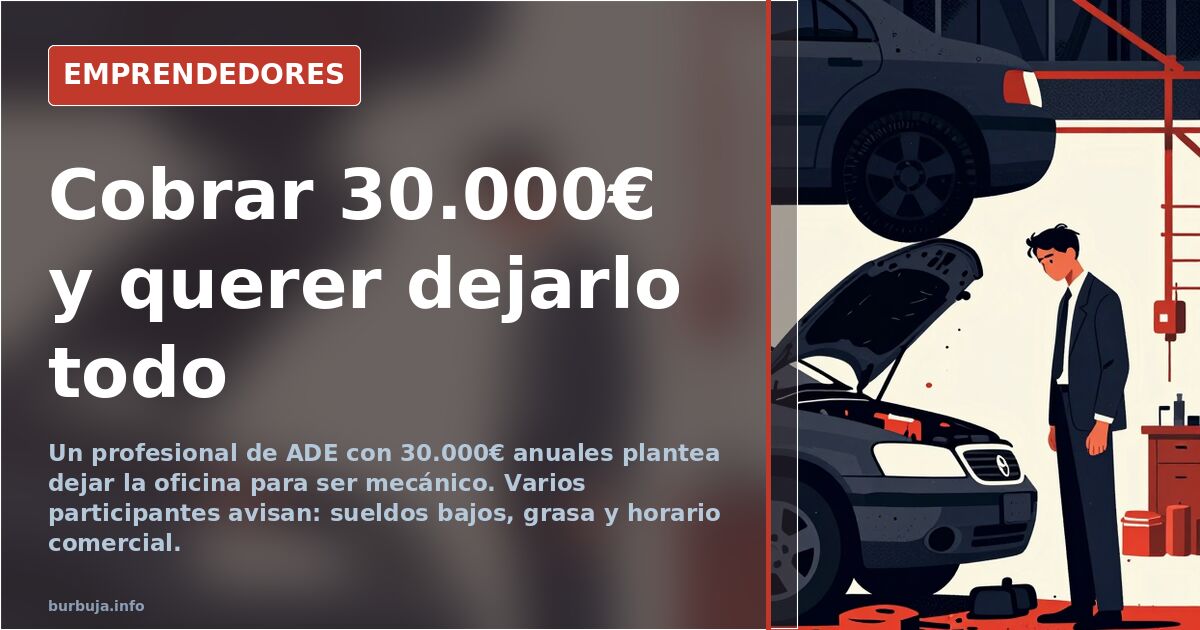
Earning €30,000 in an office but wanting to switch to a workshop
There comes a point when the office stops being a place and becomes a sentence. This is happening to a 31-year-old professional with a degree in Business Administration (ADE), earning €30,000 annually without split shifts, who in October 2024 proposed a leap forward in an entrepreneurs' forum: leaving his desk to become a mechanic, a renewable energy installer, or simply living off the land. The majority response was a cold shower.
The salary isn't the problem. The lack of purpose is. The original poster made it clear: "Nobody likes hard labor," but he would rather return to tough jobs than "warm a chair." The diagnosis he received back was almost unanimous: in Spain, with stable employment and no split shifts, changing careers out of boredom is Russian roulette.
Mechanic: Low pay, grease, and retail hours
The workshop fantasy is quickly debunked. A participant with direct experience in the sector summarizes it: retail hours, dirt, harmful fumes, and gross salaries of €20,000. "I've seen mechanic job ads asking for 5 years of experience, knowing how to do everything, for just €20k gross per year," another points out. The repeated conclusion: the mechanics he knows ended up passing civil service exams and left mechanics as a weekend hobby in a garage.
The case of an acquaintance who completed the Automotive Vocational Training (FP) program after turning 30 is the perfect example. He got the title in three years, looked at the market, and it didn't add up due to the salary cut. Starting your own workshop requires initial investment and working "like hell." The return, if it comes, takes years.
Technical FP: Same demands, half the salary
Vocational training doesn't fare well either. A recurring opinion defines it as "a scam" in scientific-technical fields: they demand the same as from an engineer but pay you half. For someone already earning €30,000, the opportunity cost of studying for three or four years to earn less is, at best, debatable.
The author himself understood this in his update on October 3, 2024: he rules out any formal education. "The opportunity cost is high, and seeing myself in a worse job even after 3 or 4 more years might be the final blow," he wrote.
Escape to the countryside: Selling eggs doesn't pay mortgages
The next fantasy was rural life. Saving money, buying an isolated house with land, and living "off the grid." A participant who lives in a village of 70 inhabitants and owns land dismantles this without anesthesia: living by selling eggs is "very complicated, not to say impossible". Rural life is harder, involves more physical work, and offers lower income. "The soul rests," he admits, but the body breaks down.
Civil Service Exams: The option gaining traction
The update on October 14, 2024, marks a shift. The author considers taking civil service exams to become a secondary school teacher. The calculation is cold: he gains in life time, holidays, and a decent salary. The only downside: dealing with teenagers. On the balance sheet, he says, the advantages win.
The majority current of the thread supports any move toward the public sector. "These are not times to work in the private sector," one message states. Another develops this: in Spanish private companies, the environment is usually the factor that breaks people. "The scum are the same whether they earn €40,000 or €20,000," adds a third.
The comfort of passive income
Faced with physical escape, financial escape appears. A participant shares that he and his partner, through extreme austerity and long-term investing, have stopped working and live off returns. Another case: a mother who held Telefónica stocks for 40 years. The recipe includes dividends, patience, and not touching the capital. "The hardest part of investing is doing nothing," he summarizes.
The exact point where everything gets stuck
The author still hasn't decided. He knows he doesn't want the office, but every alternative he explores has a cost he isn't willing to pay: lower salary, more hours, more uncertainty. The only exit that seems to fit is the civil service exam, and even that doesn't excite him. At 31, with a salary many would envy, the problem isn't money. It's that he can't find a reason to get up on Monday.
There comes a point when the office stops being a place and becomes a sentence. This is happening to a 31-year-old professional with a degree in Business Administration (ADE), earning €30,000 annually without split shifts, who in October 2024 proposed a leap forward in an entrepreneurs' forum: leaving his desk to become a mechanic, a renewable energy installer, or simply living off the land. The majority response was a cold shower.
The salary isn't the problem. The lack of purpose is. The original poster made it clear: "Nobody likes hard labor," but he would rather return to tough jobs than "warm a chair." The diagnosis he received back was almost unanimous: in Spain, with stable employment and no split shifts, changing careers out of boredom is Russian roulette.
Mechanic: Low pay, grease, and retail hours
The workshop fantasy is quickly debunked. A participant with direct experience in the sector summarizes it: retail hours, dirt, harmful fumes, and gross salaries of €20,000. "I've seen mechanic job ads asking for 5 years of experience, knowing how to do everything, for just €20k gross per year," another points out. The repeated conclusion: the mechanics he knows ended up passing civil service exams and left mechanics as a weekend hobby in a garage.
The case of an acquaintance who completed the Automotive Vocational Training (FP) program after turning 30 is the perfect example. He got the title in three years, looked at the market, and it didn't add up due to the salary cut. Starting your own workshop requires initial investment and working "like hell." The return, if it comes, takes years.
Technical FP: Same demands, half the salary
Vocational training doesn't fare well either. A recurring opinion defines it as "a scam" in scientific-technical fields: they demand the same as from an engineer but pay you half. For someone already earning €30,000, the opportunity cost of studying for three or four years to earn less is, at best, debatable.
The author himself understood this in his update on October 3, 2024: he rules out any formal education. "The opportunity cost is high, and seeing myself in a worse job even after 3 or 4 more years might be the final blow," he wrote.
Escape to the countryside: Selling eggs doesn't pay mortgages
The next fantasy was rural life. Saving money, buying an isolated house with land, and living "off the grid." A participant who lives in a village of 70 inhabitants and owns land dismantles this without anesthesia: living by selling eggs is "very complicated, not to say impossible". Rural life is harder, involves more physical work, and offers lower income. "The soul rests," he admits, but the body breaks down.
Civil Service Exams: The option gaining traction
The update on October 14, 2024, marks a shift. The author considers taking civil service exams to become a secondary school teacher. The calculation is cold: he gains in life time, holidays, and a decent salary. The only downside: dealing with teenagers. On the balance sheet, he says, the advantages win.
The majority current of the thread supports any move toward the public sector. "These are not times to work in the private sector," one message states. Another develops this: in Spanish private companies, the environment is usually the factor that breaks people. "The scum are the same whether they earn €40,000 or €20,000," adds a third.
The comfort of passive income
Faced with physical escape, financial escape appears. A participant shares that he and his partner, through extreme austerity and long-term investing, have stopped working and live off returns. Another case: a mother who held Telefónica stocks for 40 years. The recipe includes dividends, patience, and not touching the capital. "The hardest part of investing is doing nothing," he summarizes.
The exact point where everything gets stuck
The author still hasn't decided. He knows he doesn't want the office, but every alternative he explores has a cost he isn't willing to pay: lower salary, more hours, more uncertainty. The only exit that seems to fit is the civil service exam, and even that doesn't excite him. At 31, with a salary many would envy, the problem isn't money. It's that he can't find a reason to get up on Monday.
Summary of a discussion on Burbuja.info - Foro de economía, actualidad y política., translated from Spanish and reviewed before publication. Read the full discussion (174 replies).
More summaries
-
DevOps demands Linux: Why switch from Windows?
Users increasingly migrate to Linux for DevOps terminal mastery. Hardware barriers are gone, but specialized software and inertia remain obstacles.
-
Lawyer Quits for 7% Monica Bellucci Resemblance
A photographer told her she looked like Bellucci, so she wants to quit law. An app gives a 7% match and notes she is 9cm shorter.
-
Quitting the grind: benefits, cash and dodging the taxman
Automatic tax data exchange closes the offshore route. The alternative under discussion: benefits, local registration and cash.
-
Christian Bresser: another young Spaniard proving how mediocre you are
Analysis of the debate on Christian Bresser in Burbuja.info: legitimate entrepreneurship or digital smoke selling? Discover the key points of the thread here.
-
AI's 'Toaster': Infinite Content, Zero Value
In 2026, generative AI floods the market with low-quality content. The 'toaster' term defines a minimum-effort economy where startups struggle.
-
Industrial Organization Engineering: No Signing Rights, Under Scrutiny
Spain's Industrial Organization degree lacks professional attributions for signing projects. Debate continues over its real career prospects.