
Valencia Orange Grove: €3,000 Cooperative Payout Sparks Crop Change Debate
A one-hectare Valencia orange grove yields €3,000. Avocados demand heavy water; pistachios take years. The economics of switching crops are complex.
English · Original discussion in Spanish · Published
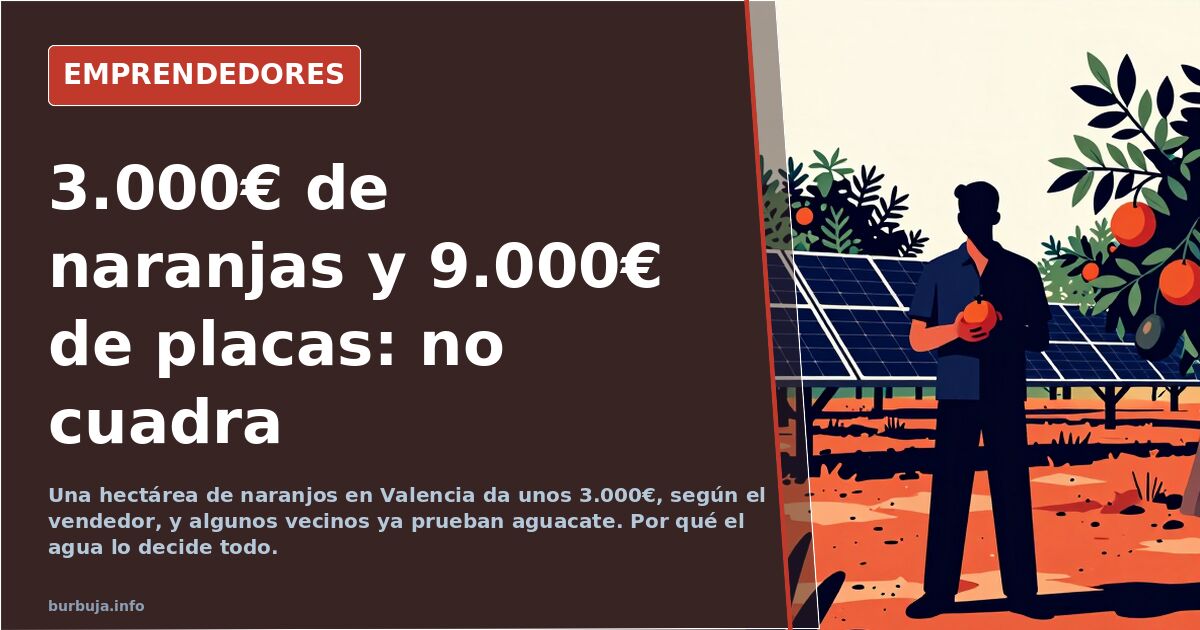
One hectare of oranges pays €3,000, leaving owners unsure what to plant next
A rural property in Valencia with one hectare of orange trees, a small house, and drip irrigation generates about €3,000 from the cooperative. The new owner, not a farmer, bought it for occasional visits—perhaps installing Starlink—and faces a question common in the region: should they uproot the oranges for more profitable crops, or keep them?
The answer isn't what they expected. Sellers warned that production is declining "due to climate change" and barely covers costs. Meanwhile, neighbors are replacing citrus with avocados. The tension between abandoning low-yield crops and copying seemingly profitable ones is central.
Avocado isn't a golden goose
The newcomer's first impulse is avocado, trinc neighbors' trends. But objections arise quickly: avocados need excessive water, and in areas with months without rain, irrigation becomes a major cost. Some estimate watering every 20 days, and weekly during summer for the first three years. For one hectare, this erodes margins.
Price volatility is another issue. High prices today due to scarcity crash when everyone plants the same crop. This peine with persimmons: better paid than oranges initially, but prices collapsed as adoption spread. The warning repeats: avocado is a lottery ticket drawn in eight or ten years.
What does it cost to remove an orange grove?
Removing trees isn't the expensive part. Buying new saplings and waiting is. Industry estimates show clearing and removal via tractor or mule through aisles, but real costs lie in saplings and lost profits during non-productive years. Avocados take years to fruit; pistachios longer. Switching crops without calculations is, per experienced farmers, buying a lottery ticket for a draw a decade away.
An intermediate alternative circulates: instead of cutting down, try grafting. If experiments fail, grafting allows production resumption in three years with less uncertainty than replanting. The most conservative option: keep oranges for two years, assess performance, and decide based on own data rather than neighbor rumors.
Intensive olive and pistachio: less water, more waiting
Against avocado stands intensive olive cultivation: rows of small trees, easy cheap harvesting, high yield, and minimal water needs. With current oil prices, calculations favor olives. Pistachios are ruled out in Valencia due to lack of tradition and long wait times. Tiger nuts, seasonal crops, don't fit maintaining an orange grove.
The most repeated option isn't changing fruit: it's keeping oranges and selling differently. Converting to organic, setting up online stores, and direct-to-consumer sales. Problems: certification takes two years, and the organic market has pitfalls. Some claim large bio distributors buy pesticide-treated citrus and resell as organic unpunished. Honest small producers end up selling to cooperatives for juice at bargain prices.
Third way: self-service orchard
The idea gaining traction among those avoiding professional farming: turning the property into an experience. Let people pick their own oranges at €1-1.5 per kilo, teach children where fruit comes from, and close visits with paella in the field. It's rural tourism disguised as agriculture, requiring no tree removal.
But this is hospitality business, not farming. It demands time, presence, and nearby customers. For buyers seeking refuge, not enterprise, the equation doesn't balance.
Confusing data
A well-managed orange hectare yields 20,000 to 70,000 kilos annually. In bumper years (30,000-35,000 kg/ha), numbers work. In average-low years, losses occur. Irrigation community fees are paid regardless of watering, since water also supplies the house.
Conclusion: buyers seeking tranquility shouldn't convert orange groves into agricultural projects. Peace comes from keeping trees static and selling harvests to cooperatives. Everything else is gambling.
Also available in: Deutsch
Summary of a discussion on Burbuja.info - Foro de economía, actualidad y política., translated from Spanish and reviewed before publication. Read the full discussion (220 replies).
More summaries
-
Buying olive groves to live off olive oil: the numbers don't add up
A calculation making the rounds on a forum: 15,000 kg per hectare and oil at €2/litre through a cooperative would leave just over €2,000 a year on a small farm
-
Living off 120 hectares in Toledo, Spain: the numbers don't add up
120 hectares in Toledo for €12,000 a year: the math of starting from scratch in the countryside dismantles the idea of making a living from farming.
-
From Business Degree to Mechanic: A Career Shift Few Recommend
A Spanish business graduate earning €30,000 considers becoming a mechanic. Forum users warn of low pay, grease, and retail hours.
-
Starting a local political party: less than €500?
Setting up a local party costs under €500, but political pressure can be lethal. The case of the Democratic Karma Party in Bilbao.
-
Is Web Design and SEO Worth It for Small Businesses?
Web design and SEO are common for SMEs, but ROI depends on margins. Discover what to check before hiring.
-
ScorpBonk Doubles Tokens for BNB Purchases
ScorpBonk memecoin on BNB Chain offers a 100% token bonus for purchases over 0.25 BNB during a 15-day promotion.