
Valencia Fire: Rescuer Reaches Eighth Floor, Fails to Save Family
Six firefighters attempted a rescue on the eighth floor; five failed to reach it, and one was hospitalized with burns.
English · Original discussion in Spanish · Published
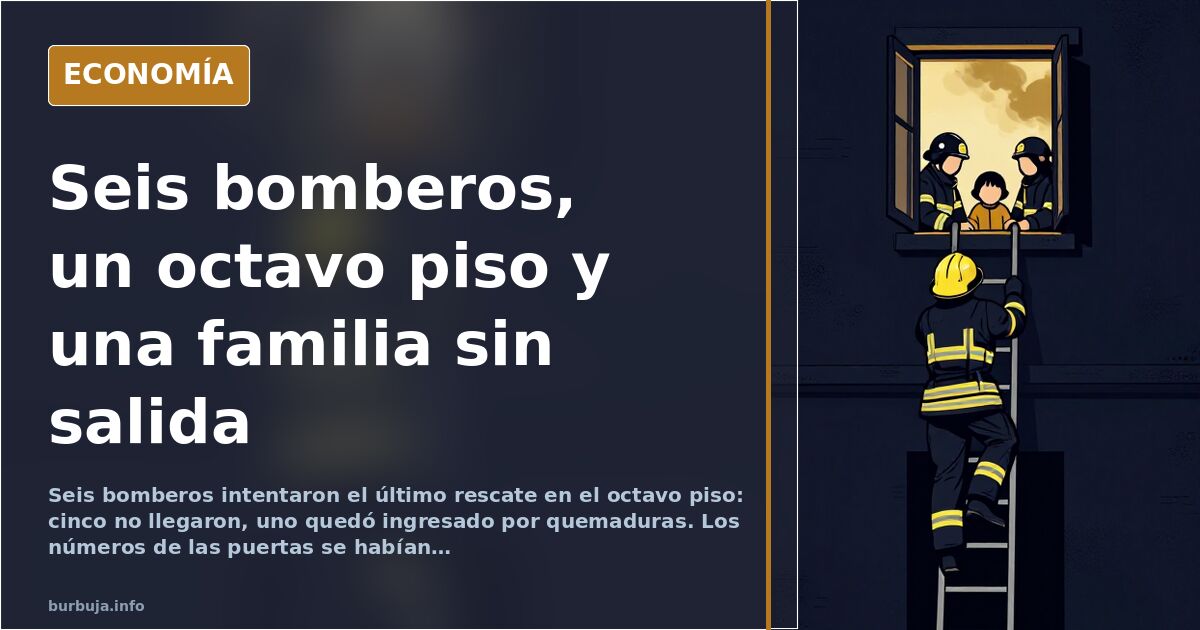
The firefighter who reached the eighth floor but could not find the door
A firefighter climbed alone to the eighth floor of the burning building. He found a long corridor with side doors, flames bursting out, and dense smoke. He knew which apartment he was looking for but could not identify it because the high temperatures had melted the door numbers. On the verge of fainting, he managed to exit the floor. He remains hospitalized for hand burns and smoke inhalation. This was the final attempt to rescue the family of four—two of whom were minors—who died in the Valencia fire.
The Government Delegation confirmed ten fatalities. Four belonged to the same family, who had locked themselves in the bathroom trinc instructions from the firefighters themselves. The incident, details of which emerged over the weekend, has sparked a more uncomfortable debate: whether those issuing orders to stay put may have contributed to the tragedy.
Six firefighters in the final attempt: one arrived, five did not
The final rescue team consisted of six members of the fire service. All tried to reach the eighth floor. Five failed even to access the level. One made it to where the family was trapped in the bathroom on their own advice: "We are locked in the bathroom because they won't let us leave."
When the stairwell peine up, the hallway revealed itself as a very long corridor with many side doors. The firefighter knew the apartment number but could not distinguish the correct door. Flames erupted and the smoke was extremely thick. He did not arrive in time. The account, reported by Levante-EMV, describes an extreme and failed attempt, not a routine operation.
Why did firefighters tell residents to stay home?
The decision to ask residents to shelter in place, using wet cloths under their doors, is the core of the controversy. Some argue that this order was decisive in the final death toll, as neighbors who were already descending the stairs were told to return to their apartments and lock themselves in bathrooms.
On the other hand, there is a simple counterargument: with the stairwell filled with smoke and the facade burning from top to bottom, a massive and disorganized evacuation would have multiplied the casualties. Protocols exist precisely for such situations. The problem lies in when they are applied and when they become a burden.
There is also the case of a neighbor of the deceased family who ordered his son to leave despite police and firefighter instructions. The son obeyed and survived. It is also reported that the concierge warned much of the building before emergency teams arrived, and that no one was evacuated in the adjacent property.
The ventilated facade and the missing seal
A technical analysis circulated among case materials points to the behavior of the ventilated facade. In this type of cladding, fire finds an air cavity that acts like a chimney, spreading flames rapidly along the exterior without triggering alarms inside until smoke has already entered.
The explanation notes that regulations require installing a fireproof sealing strip around windows and balcony doors. Given the building's construction year, this element likely did not exist. Even with windows closed, smoke and fire eventually reach the interior. This is the most repeated technical hypothesis, yet the one least clarified officially.
The 45 minutes and 17:54
One frequently cited claim concerns the response delay: 45 minutes between the first call and the arrival of the first truck. This data relies on recordings and witnesses' perceptions from the street, not on an official published log.
Conversely, a local resident claims that at 17:54, when sent the first video, firefighters had not yet arrived and almost the entire facade was burning; he heard sirens at 18:10. Two incompatible timelines differing by fifteen minutes. Until an official minute-by-minute reconstruction is provided, each version will serve those who need it.
The firefighter who climbed to the eighth floor did so when the fire was far more advanced than when the confinement order was issued. And he came back down alive. That detail, the most uncomfortable of all, does not fully fit either of the two narratives currently being told.
A firefighter climbed alone to the eighth floor of the burning building. He found a long corridor with side doors, flames bursting out, and dense smoke. He knew which apartment he was looking for but could not identify it because the high temperatures had melted the door numbers. On the verge of fainting, he managed to exit the floor. He remains hospitalized for hand burns and smoke inhalation. This was the final attempt to rescue the family of four—two of whom were minors—who died in the Valencia fire.
The Government Delegation confirmed ten fatalities. Four belonged to the same family, who had locked themselves in the bathroom trinc instructions from the firefighters themselves. The incident, details of which emerged over the weekend, has sparked a more uncomfortable debate: whether those issuing orders to stay put may have contributed to the tragedy.
Six firefighters in the final attempt: one arrived, five did not
The final rescue team consisted of six members of the fire service. All tried to reach the eighth floor. Five failed even to access the level. One made it to where the family was trapped in the bathroom on their own advice: "We are locked in the bathroom because they won't let us leave."
When the stairwell peine up, the hallway revealed itself as a very long corridor with many side doors. The firefighter knew the apartment number but could not distinguish the correct door. Flames erupted and the smoke was extremely thick. He did not arrive in time. The account, reported by Levante-EMV, describes an extreme and failed attempt, not a routine operation.
Why did firefighters tell residents to stay home?
The decision to ask residents to shelter in place, using wet cloths under their doors, is the core of the controversy. Some argue that this order was decisive in the final death toll, as neighbors who were already descending the stairs were told to return to their apartments and lock themselves in bathrooms.
On the other hand, there is a simple counterargument: with the stairwell filled with smoke and the facade burning from top to bottom, a massive and disorganized evacuation would have multiplied the casualties. Protocols exist precisely for such situations. The problem lies in when they are applied and when they become a burden.
There is also the case of a neighbor of the deceased family who ordered his son to leave despite police and firefighter instructions. The son obeyed and survived. It is also reported that the concierge warned much of the building before emergency teams arrived, and that no one was evacuated in the adjacent property.
The ventilated facade and the missing seal
A technical analysis circulated among case materials points to the behavior of the ventilated facade. In this type of cladding, fire finds an air cavity that acts like a chimney, spreading flames rapidly along the exterior without triggering alarms inside until smoke has already entered.
The explanation notes that regulations require installing a fireproof sealing strip around windows and balcony doors. Given the building's construction year, this element likely did not exist. Even with windows closed, smoke and fire eventually reach the interior. This is the most repeated technical hypothesis, yet the one least clarified officially.
The 45 minutes and 17:54
One frequently cited claim concerns the response delay: 45 minutes between the first call and the arrival of the first truck. This data relies on recordings and witnesses' perceptions from the street, not on an official published log.
Conversely, a local resident claims that at 17:54, when sent the first video, firefighters had not yet arrived and almost the entire facade was burning; he heard sirens at 18:10. Two incompatible timelines differing by fifteen minutes. Until an official minute-by-minute reconstruction is provided, each version will serve those who need it.
The firefighter who climbed to the eighth floor did so when the fire was far more advanced than when the confinement order was issued. And he came back down alive. That detail, the most uncomfortable of all, does not fully fit either of the two narratives currently being told.
Also available in: Deutsch
Summary of a discussion on Burbuja.info - Foro de economía, actualidad y política., translated from Spanish and reviewed before publication. Read the full discussion (207 replies).
More summaries
-
The protocol that trapped a family in the Valencia fire
Four people died locked in their bathroom after following firefighter protocol during the Campanar fire. Neighbors who disobeyed survived.
-
Valencia Fire Rumor: Rescued Man Was a High-Ranking Freemason
Firefighters rescued a young man in the Valencia fire, but his hand gesture fueled conspiracy theories claiming he was a high-ranking Freemason. The only 'proof' is a pose.
-
Valencia fire: sealed inquiry and an empty apartment
The blaze originated in an apartment with no permanent residents. With no official cause and the inquiry sealed, speculation runs wild.
-
Riots in French schools: fires and attacks
Fires in French schools, teachers attacked and blockades spreading to Belgium. The unrest is attributed to the education strike and radical groups.
-
Ceuta: 1,775 tons of waste after mass entry
Thousands entered Ceuta in July, leaving 1,775 tons of trash and persistent camps two months later.
-
Ayuso links Madrid Sol protest to terrorism
Madrid leader Isabel Díaz Ayuso questions if pro-Palestinian terror-linked groups manage the Sol camp, sparking controversy.