
Valencia Fire Rumor: Rescued Man Was a High-Ranking Freemason
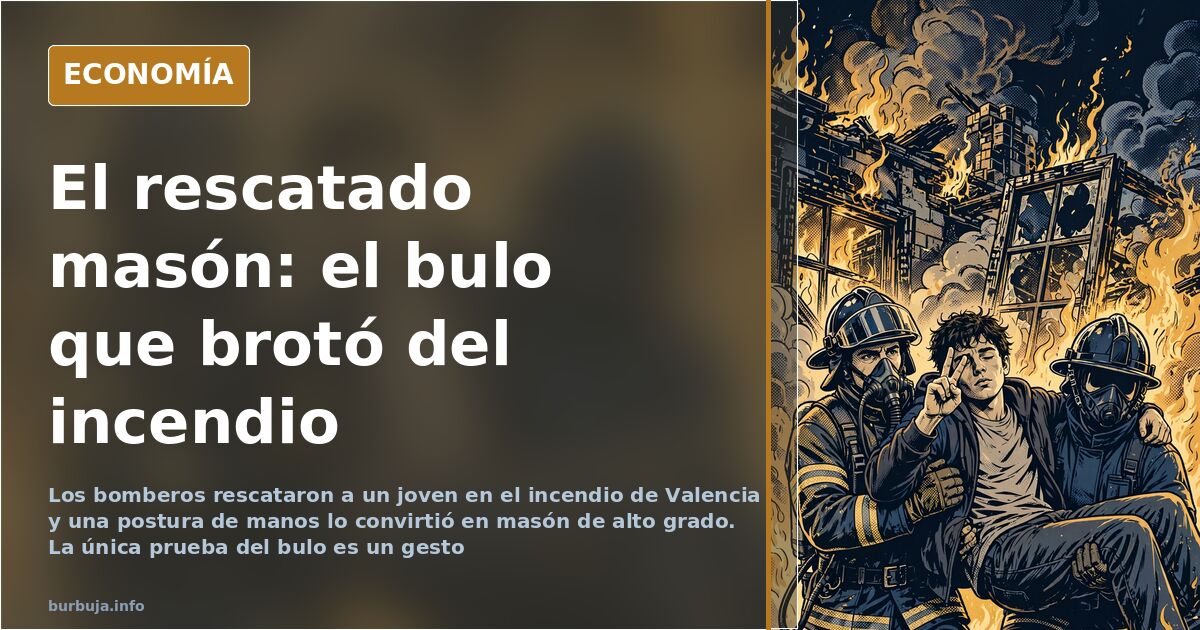
Firefighters rescued a young man in the Valencia fire, but his hand gesture fueled conspiracy theories claiming he was a high-ranking Freemason. The only 'proof' is a pose.
English · Original discussion in Spanish · Published
The High-Ranking Freemason Rescue: Anatomy of a Hoax
A fire engulfs an apartment building in Valencia, leaving a trail of fatalities. Firefighters rescue a young man alive from the smoke and flames, and that same night, the explanation that orders the entire disaster circulates: he wasn't pulled out because he was in an accessible spot, but because he was a high-ranking Freemason. The sole piece of evidence displayed is a hand posture. The so-called Cohen position, or diamond shape.
The mechanism is old and always works the same way. A post on symbology reminds us that this hand position is common in the gestural repertoire of Freemasonry, among other discreet groups, and from there, the gears turn on their own. A gesture captured in a video transforms into a condition, and the condition into a motive. No one provides a record, a name, or a document. Just a bent hand.
What is the Cohen position and what does it prove?
Nothing, on its own. The Cohen position describes hands together drawing a rhombus, a figure that appears in Guasonic iconography and also in that of other discreet societies. Half of Spain executes it unknowingly when they don't know what to do with their arms in front of a camera. Anyone who has given a talk recognizes the gesture: hands cross, hide, join. It is relaxation, not ritual.
The logical leap of the hoax consists of reversing the statistics. That a lodge member might adopt that posture does not imply that whoever adopts it belongs to one. Coincidence is not proof, and here, for now, there is only coincidence. The incriminating evidence rests on the same material as reading coffee grounds.
The Sweatshirt, the Smoke, and the Only Two Rescued
From the gesture, the tracking becomes forensic. The young man's clothes are examined: a sweatshirt with a message in English —do your best— which reappears in TV interviews hours later. For some trinc the case, this is not normal. Someone who has spent more than two hours breathing toxic smoke, it is argued, wouldn't wear the same garment; if they didn't have another clean one, something prevented them. The most boring explanation—that no one chooses wardrobe during an evacuation—finds no room.
The other axis of the narrative is the contrast. Two people came out of the building, and only two, while the rest of the neighbors remained trapped. This imbalance fuels suspicion: if two could be saved, why not the others? The comparison with the death toll figures being handled, around ten, does the rest.
The Victims Who Didn't Get Out and Firefighter Protocols
The fire left dead who never reached the street. Many of them, according to the circulating account, trinc instructions to stay inside their homes, in some cases locked in the bathroom. Among those affected, a 31-year-old neighbor with two children is mentioned. The lingering question is uncomfortable and no hoax answers it: why does the protocol prioritize confinement when smoke advances up a facade?
There, the ground becomes slippery, because two different things mix. One is the conspiratorial suspicion, without any backing. Another is the technical discussion about evacuation procedures, which has its own trajectory and is fought fiercely these days. Putting the second into the bag of the first is what allows an imaginary Freemason to explain real deaths.
From Satanic Sacrifice to the 1979 Hotel Corona de Aragón Fire
The ladder of theories doesn't stop at the gesture. Some speak of a Satanic sacrifice, others see a symbol in a table, and others claim emergency services started the fire to look good before television. All these versions share a characteristic: none present proof. They rely on repetition and details that don't fit.
The counterpoint comes from historical precedent. The Hotel Corona de Aragón fire, in July 1979, is cited as an example of a disaster where there was indeed a deliberate cause behind it. The comparison seeks to give weight to the present, but exposes the difference: there was investigation, evidence, and consequences. Here, for now, there is a hand posture and a sweatshirt.
The matter gets stuck at a very specific point: there is an articulated suspicion, an unnamed suspect, and zero verifiable elements to support it. Everything between those three extremes is narrative, and narrative cannot be refuted with data because it never used them.
A fire engulfs an apartment building in Valencia, leaving a trail of fatalities. Firefighters rescue a young man alive from the smoke and flames, and that same night, the explanation that orders the entire disaster circulates: he wasn't pulled out because he was in an accessible spot, but because he was a high-ranking Freemason. The sole piece of evidence displayed is a hand posture. The so-called Cohen position, or diamond shape.
The mechanism is old and always works the same way. A post on symbology reminds us that this hand position is common in the gestural repertoire of Freemasonry, among other discreet groups, and from there, the gears turn on their own. A gesture captured in a video transforms into a condition, and the condition into a motive. No one provides a record, a name, or a document. Just a bent hand.
What is the Cohen position and what does it prove?
Nothing, on its own. The Cohen position describes hands together drawing a rhombus, a figure that appears in Guasonic iconography and also in that of other discreet societies. Half of Spain executes it unknowingly when they don't know what to do with their arms in front of a camera. Anyone who has given a talk recognizes the gesture: hands cross, hide, join. It is relaxation, not ritual.
The logical leap of the hoax consists of reversing the statistics. That a lodge member might adopt that posture does not imply that whoever adopts it belongs to one. Coincidence is not proof, and here, for now, there is only coincidence. The incriminating evidence rests on the same material as reading coffee grounds.
The Sweatshirt, the Smoke, and the Only Two Rescued
From the gesture, the tracking becomes forensic. The young man's clothes are examined: a sweatshirt with a message in English —do your best— which reappears in TV interviews hours later. For some trinc the case, this is not normal. Someone who has spent more than two hours breathing toxic smoke, it is argued, wouldn't wear the same garment; if they didn't have another clean one, something prevented them. The most boring explanation—that no one chooses wardrobe during an evacuation—finds no room.
The other axis of the narrative is the contrast. Two people came out of the building, and only two, while the rest of the neighbors remained trapped. This imbalance fuels suspicion: if two could be saved, why not the others? The comparison with the death toll figures being handled, around ten, does the rest.
The Victims Who Didn't Get Out and Firefighter Protocols
The fire left dead who never reached the street. Many of them, according to the circulating account, trinc instructions to stay inside their homes, in some cases locked in the bathroom. Among those affected, a 31-year-old neighbor with two children is mentioned. The lingering question is uncomfortable and no hoax answers it: why does the protocol prioritize confinement when smoke advances up a facade?
There, the ground becomes slippery, because two different things mix. One is the conspiratorial suspicion, without any backing. Another is the technical discussion about evacuation procedures, which has its own trajectory and is fought fiercely these days. Putting the second into the bag of the first is what allows an imaginary Freemason to explain real deaths.
From Satanic Sacrifice to the 1979 Hotel Corona de Aragón Fire
The ladder of theories doesn't stop at the gesture. Some speak of a Satanic sacrifice, others see a symbol in a table, and others claim emergency services started the fire to look good before television. All these versions share a characteristic: none present proof. They rely on repetition and details that don't fit.
The counterpoint comes from historical precedent. The Hotel Corona de Aragón fire, in July 1979, is cited as an example of a disaster where there was indeed a deliberate cause behind it. The comparison seeks to give weight to the present, but exposes the difference: there was investigation, evidence, and consequences. Here, for now, there is a hand posture and a sweatshirt.
The matter gets stuck at a very specific point: there is an articulated suspicion, an unnamed suspect, and zero verifiable elements to support it. Everything between those three extremes is narrative, and narrative cannot be refuted with data because it never used them.
Summary of a discussion on Burbuja.info - Foro de economía, actualidad y política., translated from Spanish and reviewed before publication. Read the full discussion (192 replies).
More summaries
-
The protocol that trapped a family in the Valencia fire
Four people died locked in their bathroom after following firefighter protocol during the Campanar fire. Neighbors who disobeyed survived.
-
Valencia fire: Confinement protocol questioned after 150-unit blaze
Residents returned to their flats in Nou Campanar after firefighters advised them. The confinement protocol is under scrutiny following the deadly Valencia blaze.
-
Valencia fire protocol: stay inside or flee?
A 150-unit building fire in Valencia reopens debate on the firefighter confinement order: why staying inside is mandated.
-
Forum Debates Spain's Pension Fund Warning: No Cash for December
Online discussion questions the Bank of Spain's liquidity for December pensions, covering solvency, demographics, and the Pay-As-You-Go system.
-
Spain’s housing crisis: Young couple needs parental help for mortgage
A young Spanish couple with jobs still requires €250 monthly from parents to cover their mortgage, highlighting the severe housing affordability crisis in Spain.
-
Spain tightens rules for new private universities
Sánchez imposes stricter criteria for private universities: 4,500 students minimum, ANECA reports, and 10% housing quotas.