
Valencia fire protocol: stay inside or flee?
A 150-unit building fire in Valencia reopens debate on the firefighter confinement order: why staying inside is mandated.
English · Original discussion in Spanish · Published
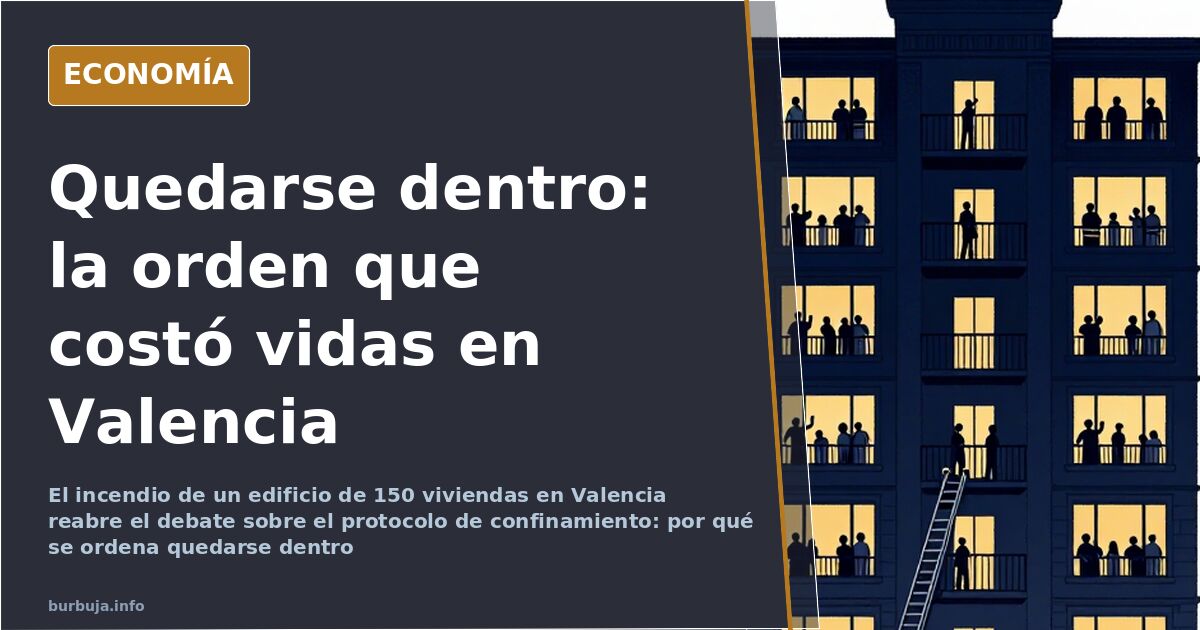
Staying inside: the firefighter order that cost lives in Valencia
A resident descended the stairs of his burning building with his phone glued to his ear. On the other end, his girlfriend. A voice told him to turn around and go back up: the smoke was the danger, not the flames. He disobeyed. He is alive today, and his testimony has spread faster than the protocol itself. In a Valencia building with 150 housing units, the fire entered through the facade and advanced from the outside in. The provisional death toll is around ten fatalities, concentrated in the block that caught fire last. The instruction to stay put, one that manuals have repeated for decades, has become the uncomfortable question of the week.
What exactly did the firefighter protocol order?
In the event of a fire in a building, the instruction is not to leave in a stampede unless there is an immediate risk of being burned to death or trapped by the fire. The reasoning has two legs. The first is human stampede: in a spontaneous flight with no direction, many occupants do not know how to react, panic spreads, and the victims of the exit itself can exceed those of the fire. The second is operational. If residents rush down the stairs while firefighters try to go up, they obstruct access, block the landing, and complicate the rescue. The protocol does not ask for resignation: it asks for waiting for an organized evacuation.
The example most often cited to support this logic is more than a decade old. Five people died at Madrid Arena, all in the avalanche that occurred when trying to leave, none from a fire that never actually peine. It is the most cited argument and also the most debated when fire climbs a facade instead of staying contained in a basement.
Why is the risk of stampede in a residential building debated?
This is where the disagreement begins. A block of flats is not a stadium. In a 150-unit building, there are, in the worst-case scenario, a few hundred people spread over several floors, not thousands packed against a single exit. And protected stairs—with walls and floor slabs that resist fire for between 90 and 120 minutes, with fire doors that stop smoke—are designed precisely for evacuation. They are not an ornament.
The criticism is direct: transferring the stampede formula to a residential building is applying a mass problem to a scenario where it does not exist. If the fire runs along the exterior, they add, the natural exit is the interior stairwell, the only part of the building designed to hold up.
Smoke kills before fire
There is a nuance that confinement defenders repeat and which is no small matter: in the vast majority of residential fires, the fire does not spread throughout the building; what kills is the smoke traveling through the voids. Keeping the stairwells clear allows firefighters to work without dodging residents, and confining occupants prevents them from breathing toxic gases in a landing. Building codes go in this direction: compartmentalize, seal, withstand.
The problem arises when the incident ceases to be the average case. The stairwells of a conventional block withstand about an hour and a half of fire; a facade burning from floor to floor can exceed that margin. The protocol is designed for the statistical fire. This one was not.
Those who disobeyed and are still alive
The story of the survivors has done more damage to the protocol than any report. A mother and her son, a resident on the phone, the caretaker who went door-to-door warning people before firefighters arrived: they all got out. On the other side are those who trusted. According to collected testimonies, the family that died did so after trinc the instruction to remain in their home.
It has also been learned that a unit was sent to rescue that family. When they arrived, the fire had already cut off the passage; firefighters were almost trapped, and one was seriously injured. The correction attempt came too late. The initial order, according to the operation's commander, was not given because there was smoke in the stairwells, but due to protocol, to avoid crowds at the exit.
Can firefighters be blamed for applying the protocol?
Involuntary manslaughter requires proven negligence, and a court would have to determine whether the decision was an avoidable error or the correct application of a procedure in a situation that exceeded all parameters. Professionals themselves warn of how easy it is to judge from the sofa with the facade burning on the screen.
What admits little discussion is that no protocol is sacred. Companies review theirs every year when they prove inefficient. Maintaining a procedure out of respect for its own authority, without adapting it to the specific building, is the fastest route to catastrophe. And here, the fire did not choose the average case.
From the testimonies of this fire comes a startling fact: the fatalities are concentrated in the block that was burning the least when firefighters arrived. The one that caught fire first had already been emptied, warned by the caretaker, before anyone uttered the word protocol.
A resident descended the stairs of his burning building with his phone glued to his ear. On the other end, his girlfriend. A voice told him to turn around and go back up: the smoke was the danger, not the flames. He disobeyed. He is alive today, and his testimony has spread faster than the protocol itself. In a Valencia building with 150 housing units, the fire entered through the facade and advanced from the outside in. The provisional death toll is around ten fatalities, concentrated in the block that caught fire last. The instruction to stay put, one that manuals have repeated for decades, has become the uncomfortable question of the week.
What exactly did the firefighter protocol order?
In the event of a fire in a building, the instruction is not to leave in a stampede unless there is an immediate risk of being burned to death or trapped by the fire. The reasoning has two legs. The first is human stampede: in a spontaneous flight with no direction, many occupants do not know how to react, panic spreads, and the victims of the exit itself can exceed those of the fire. The second is operational. If residents rush down the stairs while firefighters try to go up, they obstruct access, block the landing, and complicate the rescue. The protocol does not ask for resignation: it asks for waiting for an organized evacuation.
The example most often cited to support this logic is more than a decade old. Five people died at Madrid Arena, all in the avalanche that occurred when trying to leave, none from a fire that never actually peine. It is the most cited argument and also the most debated when fire climbs a facade instead of staying contained in a basement.
Why is the risk of stampede in a residential building debated?
This is where the disagreement begins. A block of flats is not a stadium. In a 150-unit building, there are, in the worst-case scenario, a few hundred people spread over several floors, not thousands packed against a single exit. And protected stairs—with walls and floor slabs that resist fire for between 90 and 120 minutes, with fire doors that stop smoke—are designed precisely for evacuation. They are not an ornament.
The criticism is direct: transferring the stampede formula to a residential building is applying a mass problem to a scenario where it does not exist. If the fire runs along the exterior, they add, the natural exit is the interior stairwell, the only part of the building designed to hold up.
Smoke kills before fire
There is a nuance that confinement defenders repeat and which is no small matter: in the vast majority of residential fires, the fire does not spread throughout the building; what kills is the smoke traveling through the voids. Keeping the stairwells clear allows firefighters to work without dodging residents, and confining occupants prevents them from breathing toxic gases in a landing. Building codes go in this direction: compartmentalize, seal, withstand.
The problem arises when the incident ceases to be the average case. The stairwells of a conventional block withstand about an hour and a half of fire; a facade burning from floor to floor can exceed that margin. The protocol is designed for the statistical fire. This one was not.
Those who disobeyed and are still alive
The story of the survivors has done more damage to the protocol than any report. A mother and her son, a resident on the phone, the caretaker who went door-to-door warning people before firefighters arrived: they all got out. On the other side are those who trusted. According to collected testimonies, the family that died did so after trinc the instruction to remain in their home.
It has also been learned that a unit was sent to rescue that family. When they arrived, the fire had already cut off the passage; firefighters were almost trapped, and one was seriously injured. The correction attempt came too late. The initial order, according to the operation's commander, was not given because there was smoke in the stairwells, but due to protocol, to avoid crowds at the exit.
Can firefighters be blamed for applying the protocol?
Involuntary manslaughter requires proven negligence, and a court would have to determine whether the decision was an avoidable error or the correct application of a procedure in a situation that exceeded all parameters. Professionals themselves warn of how easy it is to judge from the sofa with the facade burning on the screen.
What admits little discussion is that no protocol is sacred. Companies review theirs every year when they prove inefficient. Maintaining a procedure out of respect for its own authority, without adapting it to the specific building, is the fastest route to catastrophe. And here, the fire did not choose the average case.
From the testimonies of this fire comes a startling fact: the fatalities are concentrated in the block that was burning the least when firefighters arrived. The one that caught fire first had already been emptied, warned by the caretaker, before anyone uttered the word protocol.
Summary of a discussion on Burbuja.info - Foro de economía, actualidad y política., translated from Spanish and reviewed before publication. Read the full discussion (370 replies).
More summaries
-
The protocol that trapped a family in the Valencia fire
Four people died locked in their bathroom after following firefighter protocol during the Campanar fire. Neighbors who disobeyed survived.
-
Spain's 20% demographic group grows and organizes in Valencia and Madrid
A growing 20% of Spain's population is organizing collectively. We analyze the economic context and implications of this trend in cities like Valencia and Madrid.
-
Housing market shift: why you shouldn't buy in 2026
House prices are showing signs of slowing. Are we facing a new 2008 or a mirage? Data, mortgages and the dilemma of buying or waiting.
-
Why the US Won the Moon Race and the USSR Lost
In July 1969, Apollo 11 landed on the Moon. The USSR led early in space but lost due to internal divisions and delays.
-
Spain used EU funds for pensions, audit court reports
Court of Auditors reveals €2.389 billion in EU funds paid Spanish pensions in 2024, raising legality concerns.
-
Vox Challenges Spain's Migrant Regularization Decree at Supreme Court
Vox appeals to the Supreme Court against the regularization of 800,000 migrants. Analysis of political stances: controlled dissent or final barrier?