
Valencia fire: Plasterboard vanished, leaving apartments without walls
Flames reached 800 degrees in Valencia, causing plasterboard partitions to disintegrate. The material is non-combustible but failed to compartmentalize the blaze.
English · Original discussion in Spanish · Published
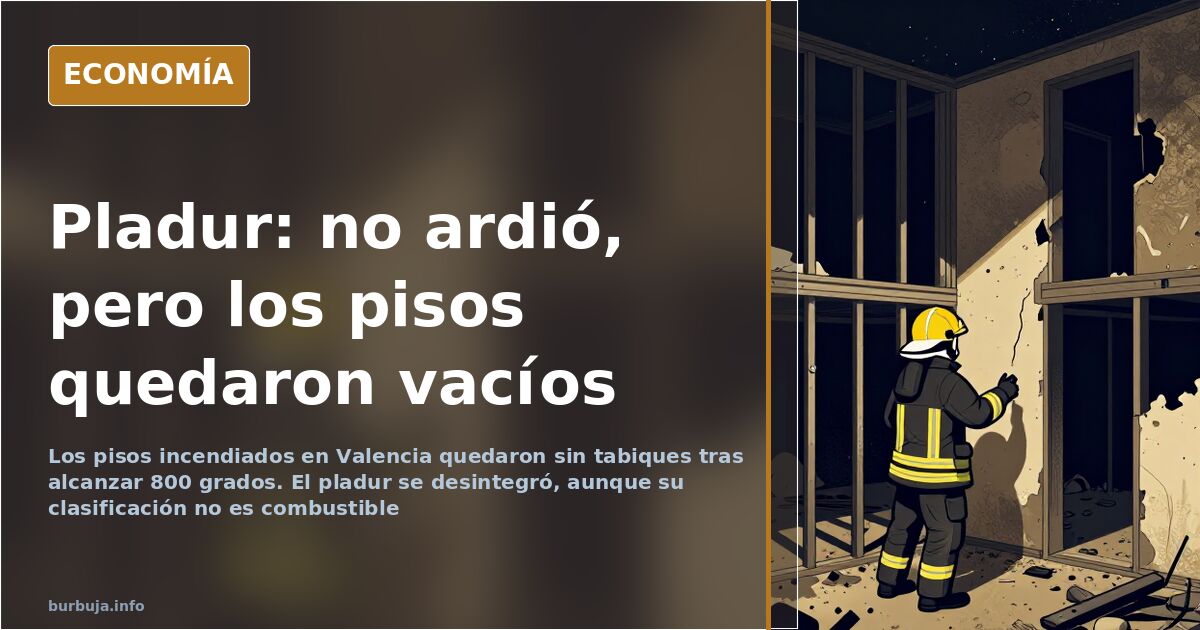
Plasterboard: It does not burn, but Valencia apartments lost their partitions
One of the primary materials used for modern interior walls is not a fuel source. Plasterboard — composed of pressed gypsum layers with cellulose and cardboard — does not ignite or sustain a fire. Yet, in the damaged Valencia building, not a single interior wall remained. Through the windows, the building's skeleton is visible. This paradox has brought a product found in nearly every home under scrutiny.
The fire, whose origin remains under investigation secrecy, spread from one balcony to an entire complex — two blocks of ten and fourteen stories — in less than 90 minutes. The ventilated facade is at the center of suspicions. However, the interior presents a second front: the absence of partitions.
Why did the plasterboard partitions disappear?
A conventional brick wall cracks and falls, leaving debris. Plasterboard does not. According to some firefighters, temperatures inside the apartments reached approximately 800 degrees. At this heat, steel deforms. The laminated gypsum simply disintegrates: it calcines, loses consistency, and vanishes without leaving significant solid residue.
This results in a cinematic scene of calcined floors: intact structure, destroyed floors, and total lack of compartmentalization. It is crucial to note that the structure was not affected and there is no risk of collapse. The skeleton held firm. Everything else did not.
Is plasterboard combustible?
No, and this is the uncomfortable part of the controversy. Basic laminated gypsum boards are classified as category A2: they do not contribute combustible material to the fire. They disintegrate but do not burn. Anyone who has tapped a hollow wall knows: inside are cardboard, gypsum, and, if properly installed, mineral wool.
This nuance matters because it shifts focus to the real issue: the partition does not ignite, it disappears. A partition that disintegrates at such temperatures stops performing its function long before it burns.
Without partitions, no sectorization: the air current
Buildings defend against fires by sectorizing them: each apartment, stairwell, and hallway is a sealed compartment that delays spread. If partitions evaporate, this design fails. Fire finds continuous space, air circulates, and each floor becomes a giant bellows. The material does not fuel the flame; it eliminates the barriers that should have stopped it.
Here arises another contextual detail: in well-executed separations between apartments, as one participant in the debate recalls, there are not just two boards. There is laminated gypsum, insulation, brick filler, and another layer of insulation and gypsum. That is, a guasonry wall hidden behind modern finishes. When this wall exists, the behavior of the entire assembly changes completely.
The facade, rock wool, and polyurethane
The other front is exterior. Rock wool, according to some participants, is a mineral material that remains stable up to 1,000 degrees. If the facade had truly incorporated it, some technical voices argue, it would still be visible among the remains. It is not. There is something else, and suspicion points to sprayed foams and cladding with very different behaviors.
A test published by a newspaper, in which a fragment of the recovered board ignited with relative ease, fueled this line of inquiry. Also, the perplexity of the building administrator, who recalls that in the property all energy came from electricity: there was no gas.
Who is responsible now?
The building administrator, Loradmi, announced it is considering suing the constructor and anyone responsible for construction or inspection. The building's technical books declared materials "totally fireproof." The developer, however, went bankrupt years ago, complicating any financial claims.
This detail is significant in a housing stock built, according to some voices, largely between 2005 and 2008 — the years prior to the technical code, with half the country under construction and sales prices presented as high-end—. An apartment sold as luxury and partitioned with quick boards is no statistical rarity.
Aside from legal avenues, the question recurring among owners is different: what the community insurance covers, what the contents insurance covers, and who continues paying the mortgage on an uninhabitable apartment.
How many standing buildings, with intact mortgages and impeccable quality certificates, share this exact combination?
One of the primary materials used for modern interior walls is not a fuel source. Plasterboard — composed of pressed gypsum layers with cellulose and cardboard — does not ignite or sustain a fire. Yet, in the damaged Valencia building, not a single interior wall remained. Through the windows, the building's skeleton is visible. This paradox has brought a product found in nearly every home under scrutiny.
The fire, whose origin remains under investigation secrecy, spread from one balcony to an entire complex — two blocks of ten and fourteen stories — in less than 90 minutes. The ventilated facade is at the center of suspicions. However, the interior presents a second front: the absence of partitions.
Why did the plasterboard partitions disappear?
A conventional brick wall cracks and falls, leaving debris. Plasterboard does not. According to some firefighters, temperatures inside the apartments reached approximately 800 degrees. At this heat, steel deforms. The laminated gypsum simply disintegrates: it calcines, loses consistency, and vanishes without leaving significant solid residue.
This results in a cinematic scene of calcined floors: intact structure, destroyed floors, and total lack of compartmentalization. It is crucial to note that the structure was not affected and there is no risk of collapse. The skeleton held firm. Everything else did not.
Is plasterboard combustible?
No, and this is the uncomfortable part of the controversy. Basic laminated gypsum boards are classified as category A2: they do not contribute combustible material to the fire. They disintegrate but do not burn. Anyone who has tapped a hollow wall knows: inside are cardboard, gypsum, and, if properly installed, mineral wool.
This nuance matters because it shifts focus to the real issue: the partition does not ignite, it disappears. A partition that disintegrates at such temperatures stops performing its function long before it burns.
Without partitions, no sectorization: the air current
Buildings defend against fires by sectorizing them: each apartment, stairwell, and hallway is a sealed compartment that delays spread. If partitions evaporate, this design fails. Fire finds continuous space, air circulates, and each floor becomes a giant bellows. The material does not fuel the flame; it eliminates the barriers that should have stopped it.
Here arises another contextual detail: in well-executed separations between apartments, as one participant in the debate recalls, there are not just two boards. There is laminated gypsum, insulation, brick filler, and another layer of insulation and gypsum. That is, a guasonry wall hidden behind modern finishes. When this wall exists, the behavior of the entire assembly changes completely.
The facade, rock wool, and polyurethane
The other front is exterior. Rock wool, according to some participants, is a mineral material that remains stable up to 1,000 degrees. If the facade had truly incorporated it, some technical voices argue, it would still be visible among the remains. It is not. There is something else, and suspicion points to sprayed foams and cladding with very different behaviors.
A test published by a newspaper, in which a fragment of the recovered board ignited with relative ease, fueled this line of inquiry. Also, the perplexity of the building administrator, who recalls that in the property all energy came from electricity: there was no gas.
Who is responsible now?
The building administrator, Loradmi, announced it is considering suing the constructor and anyone responsible for construction or inspection. The building's technical books declared materials "totally fireproof." The developer, however, went bankrupt years ago, complicating any financial claims.
This detail is significant in a housing stock built, according to some voices, largely between 2005 and 2008 — the years prior to the technical code, with half the country under construction and sales prices presented as high-end—. An apartment sold as luxury and partitioned with quick boards is no statistical rarity.
Aside from legal avenues, the question recurring among owners is different: what the community insurance covers, what the contents insurance covers, and who continues paying the mortgage on an uninhabitable apartment.
How many standing buildings, with intact mortgages and impeccable quality certificates, share this exact combination?
Summary of a discussion on Burbuja.info - Foro de economía, actualidad y política., translated from Spanish and reviewed before publication. Read the full discussion (257 replies).
More summaries
-
Valencia Fire Rumor: Rescued Man Was a High-Ranking Freemason
Firefighters rescued a young man in the Valencia fire, but his hand gesture fueled conspiracy theories claiming he was a high-ranking Freemason. The only 'proof' is a pose.
-
The protocol that trapped a family in the Valencia fire
Four people died locked in their bathroom after following firefighter protocol during the Campanar fire. Neighbors who disobeyed survived.
-
Valencia fire: Confinement protocol questioned after 150-unit blaze
Residents returned to their flats in Nou Campanar after firefighters advised them. The confinement protocol is under scrutiny following the deadly Valencia blaze.
-
Spain's golden Iberian pig coin: €3,700 for a €1.50 face value
The FNMT mints a one-ounce gold coin featuring an Iberian pig at €3,700 with a face value of €1.50. The design divides collectors and investors.
-
Spain probes ex-PM Zapatero over alleged Maduro ties
Spain's National Court investigates former PM José Luis Rodríguez Zapatero for links to Venezuela's Maduro regime, sparking debate on extradition risks.
-
Bringing a Colombian Partner to Spain Costs €20,000
A case study reveals €20,000 spent on family reunification from Colombia and subsequent breakup. No official data measures the real cost.