
Valencia Demands Extension of Social Shield Amid 900 Evictions
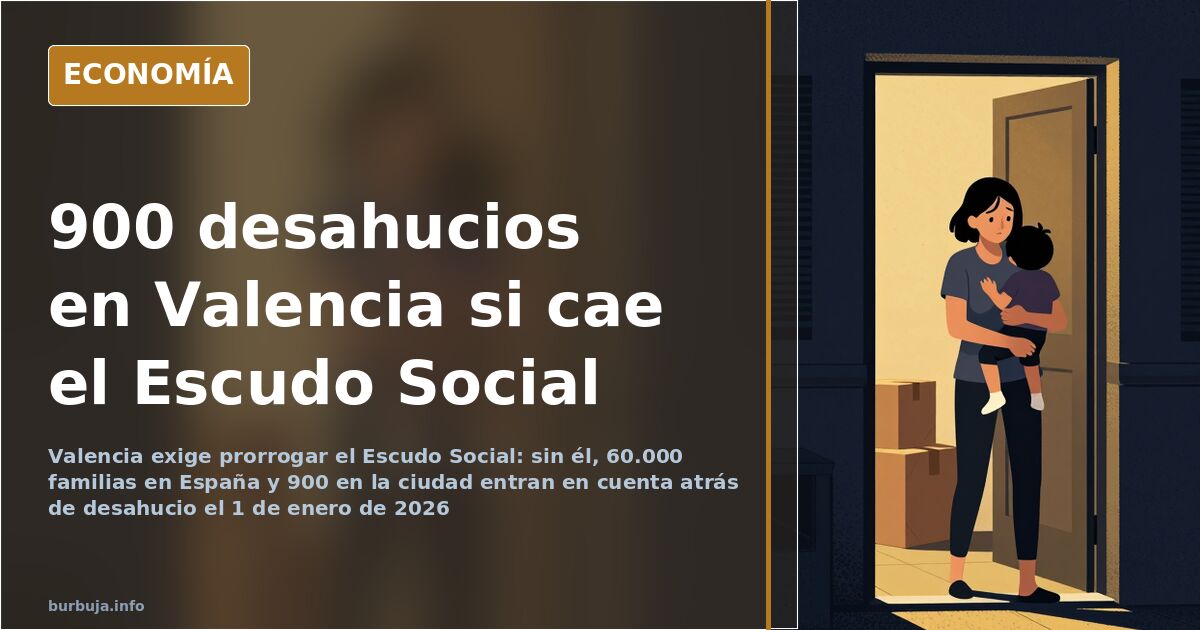
Valencia demands the extension of the Social Shield: without it, 60,000 families in Spain and 900 in the city face eviction deadlines starting January 1, 2026.
English · Original discussion in Spanish · Published
Valencia Takes to the Streets for Housing: 900 Evictions at Risk
Housing is no longer just a problem. It is a bomb. That is what the organizations that marched through central Valencia this Saturday under the slogan "For the right to housing, now!" claim, moving from Plaza de San Agustín to Plaza de la Virgen. The call — by Juntes per l'Habitatge, Valencia no está en venda, and Acord Social Valencià — had an immediate and specific goal: to secure an extension of the Social Shield, which expires on December 31. If not renewed, they warn, the "terrifying countdown to eviction" begins on January 1, 2026, for 60,000 families across Spain, 5,000 in the Valencian Community, and nearly 900 in the city of Valencia.
What Exactly Is the Demonstration Demanding?
The manifesto read at the end of the march does not mince words: it demands the "urgent extension and improvement" of the Social Shield, a Shock Plan with measures "necessary, concrete, and agreed upon" with social, neighborhood, and union movements, and accountability for all administrations — local, regional, and national — and all political parties. Platform spokesperson Pablo Ramos summarized it in a phrase that admits no interpretation: "The right to housing is not an aspiration, but a right."
Ramos criticized the "political inaction" of the three levels of government and described housing prices in Valencia as "unpayable and unbearable." His diagnosis: "We are facing a great danger: that the Social Shield ends up becoming a social bomb." The chants during the route pointed in the same direction: "No house without people, no people without a house," "Enough already, no more evictions," or "There are children on the streets and nobody cares."
The Standoff with Administrations: Meetings Without Agreement
According to the organizers' account, relations with institutions are broken. They have met "several times" with the regional executive, but all proposals have reportedly hit a "firm no." With the city council, there is direct lack of dialogue: they reportedly refused to receive them. Hence the announcement that protests will be "constant" until there is "some rapprochement."
The problem, they insist, does not care about party acronyms. "Whoever governs," housing remains in a "secondary plane," and the platform stresses that the organizing entities have no "interests" beyond ensuring citizens access dignified housing. The reading of the manifesto went further: "Housing is a social right, but above all, it is a citizen's right, a right of belonging to a people, to a community."
Unaffordable Rents, Tourism, and Speculation
The text read in Plaza de la Virgen depicts a captured residential market. Rents are "increasingly unaffordable," homes and territory are treated as "a market good totally subject to speculation," neighbors are expelled from their neighborhoods while these fill with tourist apartments "without applying any real control," real estate harassment intensifies, and there is a lack of sufficient public housing stock.
The manifesto connects housing with everything else: without it, there is no equal opportunity, stable employment, quality education, or mental health. "Defending housing is defending the place where our sons and daughters grow up," reads the text, which also demands respecting neighborhoods and territory so that no action generates danger, as peine with the DANA (flash flood).
Why the Diagnosis Breaks Down in the Solution
Here begins the real disagreement. One current of analysis holds that the problem is supply: hundreds of thousands of people enter the labor and residential market each year, and the new housing stock does not grow at the same pace. The result would be musical chairs: many applicants, few houses, rising prices. From this perspective, any demand-side subsidy — rental aid, protection extensions — translates into price increases and worsens what it intends to correct.
The opposing stance points to direct public intervention: construction of protected housing outside the market, rent limitations, and legal shielding against evictions. Some recall that land use and urban planning legislation have restricted buildability for decades, while others respond that without public stock, the market always wins. Between both extremes, an uncomfortable coincidence: housing policy has been approved for years without prices falling.
With these elements, the forecast is simple to formulate and difficult to get right: if the Social Shield is not extended before December 31, courts will have extra work starting January 1. If it is extended, the underlying problem will remain exactly where it was. Neither resolves the price.
Housing is no longer just a problem. It is a bomb. That is what the organizations that marched through central Valencia this Saturday under the slogan "For the right to housing, now!" claim, moving from Plaza de San Agustín to Plaza de la Virgen. The call — by Juntes per l'Habitatge, Valencia no está en venda, and Acord Social Valencià — had an immediate and specific goal: to secure an extension of the Social Shield, which expires on December 31. If not renewed, they warn, the "terrifying countdown to eviction" begins on January 1, 2026, for 60,000 families across Spain, 5,000 in the Valencian Community, and nearly 900 in the city of Valencia.
What Exactly Is the Demonstration Demanding?
The manifesto read at the end of the march does not mince words: it demands the "urgent extension and improvement" of the Social Shield, a Shock Plan with measures "necessary, concrete, and agreed upon" with social, neighborhood, and union movements, and accountability for all administrations — local, regional, and national — and all political parties. Platform spokesperson Pablo Ramos summarized it in a phrase that admits no interpretation: "The right to housing is not an aspiration, but a right."
Ramos criticized the "political inaction" of the three levels of government and described housing prices in Valencia as "unpayable and unbearable." His diagnosis: "We are facing a great danger: that the Social Shield ends up becoming a social bomb." The chants during the route pointed in the same direction: "No house without people, no people without a house," "Enough already, no more evictions," or "There are children on the streets and nobody cares."
The Standoff with Administrations: Meetings Without Agreement
According to the organizers' account, relations with institutions are broken. They have met "several times" with the regional executive, but all proposals have reportedly hit a "firm no." With the city council, there is direct lack of dialogue: they reportedly refused to receive them. Hence the announcement that protests will be "constant" until there is "some rapprochement."
The problem, they insist, does not care about party acronyms. "Whoever governs," housing remains in a "secondary plane," and the platform stresses that the organizing entities have no "interests" beyond ensuring citizens access dignified housing. The reading of the manifesto went further: "Housing is a social right, but above all, it is a citizen's right, a right of belonging to a people, to a community."
Unaffordable Rents, Tourism, and Speculation
The text read in Plaza de la Virgen depicts a captured residential market. Rents are "increasingly unaffordable," homes and territory are treated as "a market good totally subject to speculation," neighbors are expelled from their neighborhoods while these fill with tourist apartments "without applying any real control," real estate harassment intensifies, and there is a lack of sufficient public housing stock.
The manifesto connects housing with everything else: without it, there is no equal opportunity, stable employment, quality education, or mental health. "Defending housing is defending the place where our sons and daughters grow up," reads the text, which also demands respecting neighborhoods and territory so that no action generates danger, as peine with the DANA (flash flood).
Why the Diagnosis Breaks Down in the Solution
Here begins the real disagreement. One current of analysis holds that the problem is supply: hundreds of thousands of people enter the labor and residential market each year, and the new housing stock does not grow at the same pace. The result would be musical chairs: many applicants, few houses, rising prices. From this perspective, any demand-side subsidy — rental aid, protection extensions — translates into price increases and worsens what it intends to correct.
The opposing stance points to direct public intervention: construction of protected housing outside the market, rent limitations, and legal shielding against evictions. Some recall that land use and urban planning legislation have restricted buildability for decades, while others respond that without public stock, the market always wins. Between both extremes, an uncomfortable coincidence: housing policy has been approved for years without prices falling.
With these elements, the forecast is simple to formulate and difficult to get right: if the Social Shield is not extended before December 31, courts will have extra work starting January 1. If it is extended, the underlying problem will remain exactly where it was. Neither resolves the price.
Also available in: Deutsch
Summary of a discussion on Burbuja.info - Foro de economía, actualidad y política., translated from Spanish and reviewed before publication. Read the full discussion (125 replies).
More summaries
-
Valencia Rent Surpasses €1,000, Requiring Triple Income
Spain's tourist housing grows 9.2% to 340,424 units, while Valencia rents exceed €1,000, demanding triple income.
-
Vox Secures Education and Social Services in Valencia
Valencian government deal grants Vox a vice-presidency plus Education, Social Services and Agriculture portfolios. Language policy in schools is key.
-
Foreign tenants: over half in Spain, 70% in three regions
More than 5.2 million tenants in Spain were born abroad. In Madrid, Valencia and Murcia the share reaches 70%. Data and analysis of...
-
El Jueves targets corruption with a lineup of the usual suspects
El Jueves publishes a corruption-themed cover with eleven figures: mostly PP and two from PSOE. Criticism over imbalance and omissions.
-
Madrid Metro: False Bomb Alert at Moncloa Station
A false bomb alert caused chaos and evacuation at Madrid's Moncloa station on the 11-M anniversary.
-
Podemos exits Spanish government: seats, pay and amnesty law
Podemos' exit from the coalition leaves five seats, questions over severance pay and the amnesty law status.