
User Claims Buying 168 Ukrainian Apartments for €30k
A forum user claims to have bought 168 apartments in Izium, Ukraine, for €30,000. Renovation costs would exceed €400,000 plus labor in a war zone.
English · Original discussion in Spanish · Published
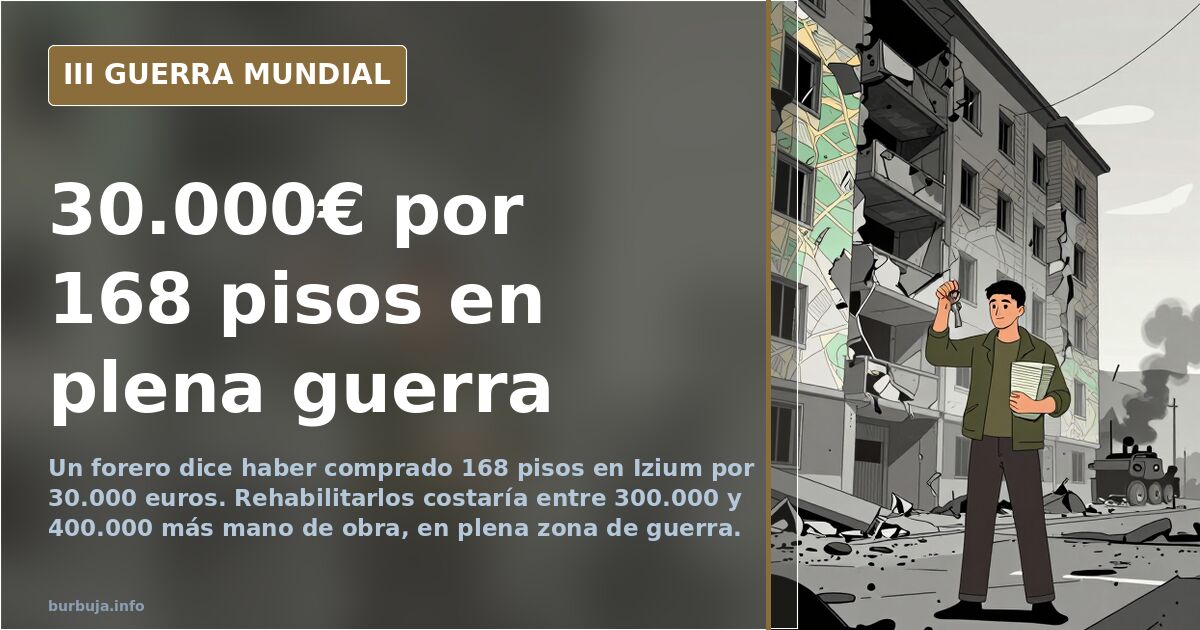
168 apartments in Izium for €30,000: The math doesn't add up
A forum user claims to have closed the purchase of seven twin residential blocks in Izium, eastern Ukraine, for a total of €30,000. These comprise 168 units of approximately 90 square meters each, four stories high with six apartments per floor, built around 2007 or 2008. Before the war, each unit sold for about €25,000. The buyer admits at least one block must be demolished due to damage, with materials reused to renovate the other six.
The deal is presented as a real estate windfall in a war zone. That's where the problems begin.
Cost to renovate 168 apartments bought at €184 each
The buyer's breakdown: €30,000 for seven blocks, equating to €184 per apartment for each original owner. Importing materials from Poland would cost between €300,000 and €400,000 just for supplies and logistics, excluding labor. Thus, the actual cost to make the business viable multiplies the acquisition price by more than ten.
According to his account, owners are isolated in Moldova. They are families unwilling to return who sold collectively through a joint lawyer. Six apartments in the half-demolished block have no traceable owner; the buyer acknowledges potential legal issues if someone claims them. He was advised never to sell those six units and keep them reserved in case owners appear.
Who really owns an Izium apartment after the war?
Izium lies between Kharkiv and Donetsk. During the conversation, the front line remained active, and it was unclear which administration would control the city long-term. This is the plan's first flaw: without a state guaranteeing registration, deeds signed in Moldova are worth only what the paper itself is worth.
Some argue the risk isn't just military but bureaucratic. Ukraine has struggled with irregular housing sales even in peacetime, and local clans use expedient methods to collect debts. Others point to deeper demographic issues: the population has been declining for years, and war destruction has emptied entire regions. Fewer people than houses. The market being rebuilt may lack buyers.
Nigerian scam pattern, but with concrete blocks
The community quickly noted the parallels. References were made to the classic Nigerian prince scam, New Rumasa promissory notes, and even buying La Giralda or lunar plots. The central suspicion is simple: if 150 families ended up in Moldova, all agreeing to sell for €200, the story has too many coincidences.
The buyer insists he has lived in Moldova for months and has everything under control. He acknowledges there is nothing to gain until the war ends and his lawyer advises waiting at least two months after the conflict concludes. He predicts this will happen before winter. He also admits the scenario no one wants: militia formation by both sides.
The operation has all ingredients of a perfect bargain: negligible price, desperate sellers, convinced buyer, and an asset no one else wants. The problem is the asset is in a war zone, papers are signed in a third country, and renovation costs multiply initial investment tenfold. With these numbers, the windfall looks more like a gamble than a business.
A forum user claims to have closed the purchase of seven twin residential blocks in Izium, eastern Ukraine, for a total of €30,000. These comprise 168 units of approximately 90 square meters each, four stories high with six apartments per floor, built around 2007 or 2008. Before the war, each unit sold for about €25,000. The buyer admits at least one block must be demolished due to damage, with materials reused to renovate the other six.
The deal is presented as a real estate windfall in a war zone. That's where the problems begin.
Cost to renovate 168 apartments bought at €184 each
The buyer's breakdown: €30,000 for seven blocks, equating to €184 per apartment for each original owner. Importing materials from Poland would cost between €300,000 and €400,000 just for supplies and logistics, excluding labor. Thus, the actual cost to make the business viable multiplies the acquisition price by more than ten.
According to his account, owners are isolated in Moldova. They are families unwilling to return who sold collectively through a joint lawyer. Six apartments in the half-demolished block have no traceable owner; the buyer acknowledges potential legal issues if someone claims them. He was advised never to sell those six units and keep them reserved in case owners appear.
Who really owns an Izium apartment after the war?
Izium lies between Kharkiv and Donetsk. During the conversation, the front line remained active, and it was unclear which administration would control the city long-term. This is the plan's first flaw: without a state guaranteeing registration, deeds signed in Moldova are worth only what the paper itself is worth.
Some argue the risk isn't just military but bureaucratic. Ukraine has struggled with irregular housing sales even in peacetime, and local clans use expedient methods to collect debts. Others point to deeper demographic issues: the population has been declining for years, and war destruction has emptied entire regions. Fewer people than houses. The market being rebuilt may lack buyers.
Nigerian scam pattern, but with concrete blocks
The community quickly noted the parallels. References were made to the classic Nigerian prince scam, New Rumasa promissory notes, and even buying La Giralda or lunar plots. The central suspicion is simple: if 150 families ended up in Moldova, all agreeing to sell for €200, the story has too many coincidences.
The buyer insists he has lived in Moldova for months and has everything under control. He acknowledges there is nothing to gain until the war ends and his lawyer advises waiting at least two months after the conflict concludes. He predicts this will happen before winter. He also admits the scenario no one wants: militia formation by both sides.
The operation has all ingredients of a perfect bargain: negligible price, desperate sellers, convinced buyer, and an asset no one else wants. The problem is the asset is in a war zone, papers are signed in a third country, and renovation costs multiply initial investment tenfold. With these numbers, the windfall looks more like a gamble than a business.
Also available in: Deutsch
Summary of a discussion on Burbuja.info - Foro de economía, actualidad y política., translated from Spanish and reviewed before publication. Read the full discussion (109 replies).
More summaries
-
Kharkiv Breakthrough: Analysts Divided Over Izium
Ukraine's Kharkiv advance spans 20-30 km in a narrow corridor amid debate over Izium's status and developments in Kherson.
-
Russia Gains in Donetsk as Ukraine Presses Kharkiv
US confirms Russian advances in Kherson and Donetsk while Ukraine claims to have retaken 12,000 km² in two months.
-
Lavrov claims Poland is carving up Ukraine
Russian Foreign Minister Lavrov asserts Poland is developing Ukraine through special rights for Poles and alleged control of the tax service.
-
Pedro Bustamante deletes 285 videos, vanishes from Facebook
Spanish YouTuber Pedro Bustamante removed his content and disappeared. Rumors place him in Munich, reading German press.
-
Forum debates if West miscalculated with Russia
Users argue Western strategy failed as Russia unites and BRICS rise, while Europe pays the price.
-
China Arms Robot Dogs in Artillery Brigades
China integrates armed robot dogs into artillery units. Debate: Who controls the chips and batteries powering military robotics?