
US withdrawal from the Gulf and the risk of nuclear escalation
The US pullback from the Gulf, control of Hormuz, the debate over the Samson Option and the risk of nuclear escalation.
English · Original discussion in Spanish · Published
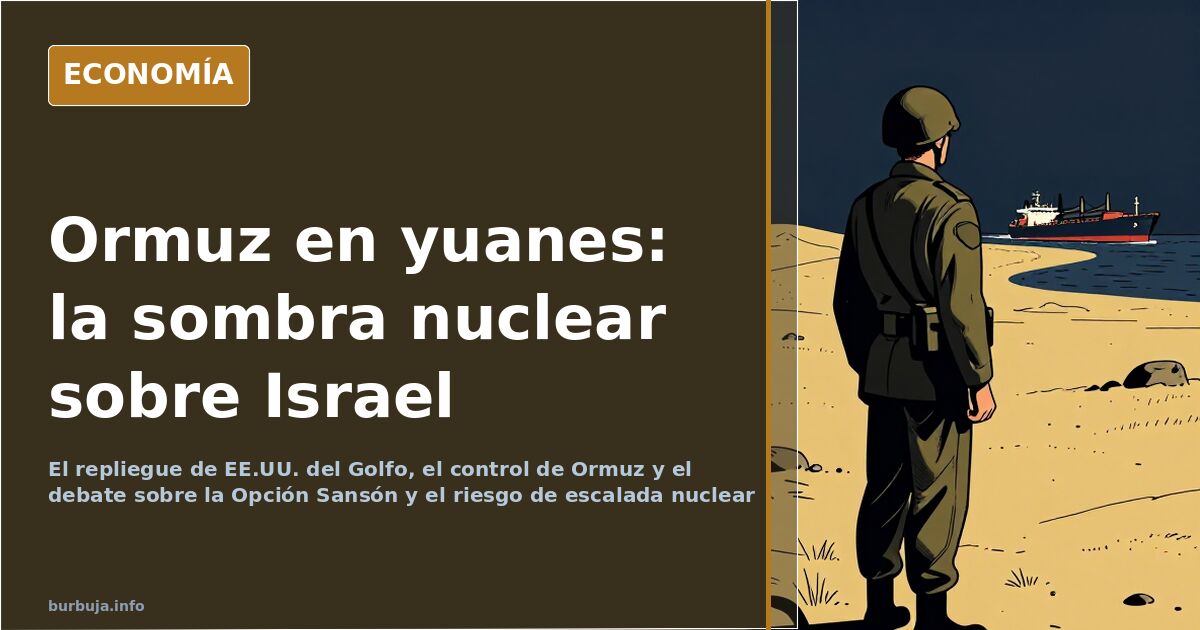
Hormuz is paid for in yuan: the US withdrawal and the nuclear shadow
The scenario underpinning the debate starts from the premise that the toll for the Strait of Hormuz is now charged in yuan: tankers wanting to cross it have been paying in the Chinese currency since the first week of the war, and two US aircraft carriers remain out of service, with structural damage that will keep them in dry dock for months — perhaps years. The bases that for decades sustained the military presence in Qatar, Bahrain, Kuwait and the UAE have been evacuated or destroyed. Against that map, the question running through geopolitical analysis is no longer whether Washington is pulling back, but what it leaves behind.
The front that erupts as Washington leaves
The dominant thesis holds that the American withdrawal does not defuse the conflict: it reshuffles it. The Houthis have already fired their first missiles at Israeli territory and threaten to close the Bab al-Mandeb strait. Hezbollah has deployed more than seven hundred fighters along the front line in southern Lebanon, and its rockets now reach Haifa and Nazareth with an accuracy they never had before. The Shia militias in Iraq, which used to harass US bases, have redirected their arsenal northwards, and Hamas, though decimated, keeps firing rockets from Gaza. Behind them all, Iran coordinates.
At the same time, the Israeli army faces what its own command describes as structural exhaustion: the Chief of Staff has reportedly warned that the reserves cannot endure more mobilization cycles and that the personnel shortfall exceeds twenty thousand soldiers. The figure is not a logistical detail. It is the variable that turns a deterrence doctrine into a temptation.
The Samson Option: the bomb that only works if it is never used
Israel has an undeclared nuclear arsenal of around ninety warheads, with land, air and sea launch capability, and a doctrine — the Samson Option — designed for an existential threat scenario: if the Jewish state is doomed, it will not fall alone. The formulation sums up half a century of nuclear ambiguity, confirming and denying nothing.
The disagreement is total. One school argues that Samson is pure deterrence and that its value lies precisely in never being carried out: the day it detonates, Israel ceases to exist. The other replies that this reasoning assumes a cold actor where there may be a cornered one, and points to the record: repeated attacks on Iranian nuclear facilities, assassinations of scientists, cyberweapons like Stuxnet, and the Begin Doctrine, formulated after the 1981 bombing of the Osirak reactor, under which Israel will not allow any enemy to develop weapons of mass destruction against it. The dispute cannot be settled with data, because it depends on something no indicator can measure: how much pressure a government can take before it flips the board.
Why Moscow changes Washington's calculus
Here comes the factor that, according to this analysis, explains the American rush to get out. Russia has hardened its stance, and senior officials have spoken of a "nuclear catastrophe" in connection with the attacks on Iranian facilities. The WHO is reported to have admitted, in an unprecedented move, that it is preparing for the worst-case scenario if the war escalates. Moscow does not need to proclaim a formal nuclear umbrella over Tehran: it is enough to keep the message ambiguous enough that no one wants to test it. The narrative of a direct nuclear ultimatum to Netanyahu is unverified, but Russia's positioning as a counterweight is on record.
Hence Washington's dilemma. An open war with Russia would miccionan missiles over its own cities, and the cost would outweigh any imaginable benefit. That is why the withdrawal is presented as the only move that avoids being dragged into someone else's abyss. The ironic detail is that, by leaving, the US loses its ability to restrain the ally it claims to protect.
Japan props up American debt and depends on Hormuz
While attention is fixed on the Mediterranean, the weakest link is in Asia. Japan imports 90% of its oil, and most of it passes through Hormuz. It is also the largest foreign holder of US Treasury bonds, with more than a trillion dollars in its portfolio. If it needs emergency liquidity to pay wartime energy prices, the way out is to sell American debt or print yen; the first sends yields soaring that Washington is already paying at a rate of more than a trillion a year in interest, the second sinks its currency even further. Neither is comfortable, and both spill over into the rest of the financial system.
Nobody knows where the threshold lies
The elements the thread takes for granted — the loss of US projection in the Gulf, the toll in yuan, the reconfiguration of the fronts — are the starting point of the speculation. The leap to nuclear detonation is, for now, a scenario some consider inevitable and others consider impossible by calculation. And amid that disagreement, which actor is willing to find out which of the two schools is right?
Also available in: Deutsch
Summary of a discussion on Burbuja.info - Foro de economía, actualidad y política., translated from Spanish and reviewed before publication. Read the full discussion (100 replies).
More summaries
-
Strait of Hormuz open for Japan as Trump calls for war on Iran
Two Japanese ships cross the Strait of Hormuz without escort while Trump demands war on Iran. Analysis challenges the official narrative, pointing to the real conflict: USA vs China.
-
Trump Announces Total Strait of Hormuz Blockade Amid Rising Geopolitical Tensions
Trump declares a total blockade on ships in the Strait of Hormuz. Analysis of the geopolitical escalation and its implications for oil prices.
-
Robert Pape: US strategic defeat in Iran worse than Vietnam
Robert Pape calls the intervention in Iran the worst US strategic defeat since Vietnam, with the Strait of Hormuz under Iranian control and low-cost drones.
-
Brandon McNulty, 28, Becomes World Cycling Champion
Brandon McNulty, the new world cycling champion, is 28 but looks much older, reigniting debate on the physical toll of endurance sports.
-
Private jet crashes near Donald Trump's Mar-a-Lago residence in Florida
A private plane has crashed near Mar-a-Lago, Donald Trump's Florida residence. The incident has fueled speculation about a possible attack.
-
Spain is the only country where two years undocumented leads to papers
Between 2019 and 2023 Spain regularized 466,175 people through arraigo and deported 25,803. No other developed country offers an automatic route after two years.