
US warns Spain of Ceuta and Melilla invasion
The alleged US warning regarding an invasion of Ceuta and Melilla clashes with Congressional reports viewing them as Moroccan territory.
English · Original discussion in Spanish · Published
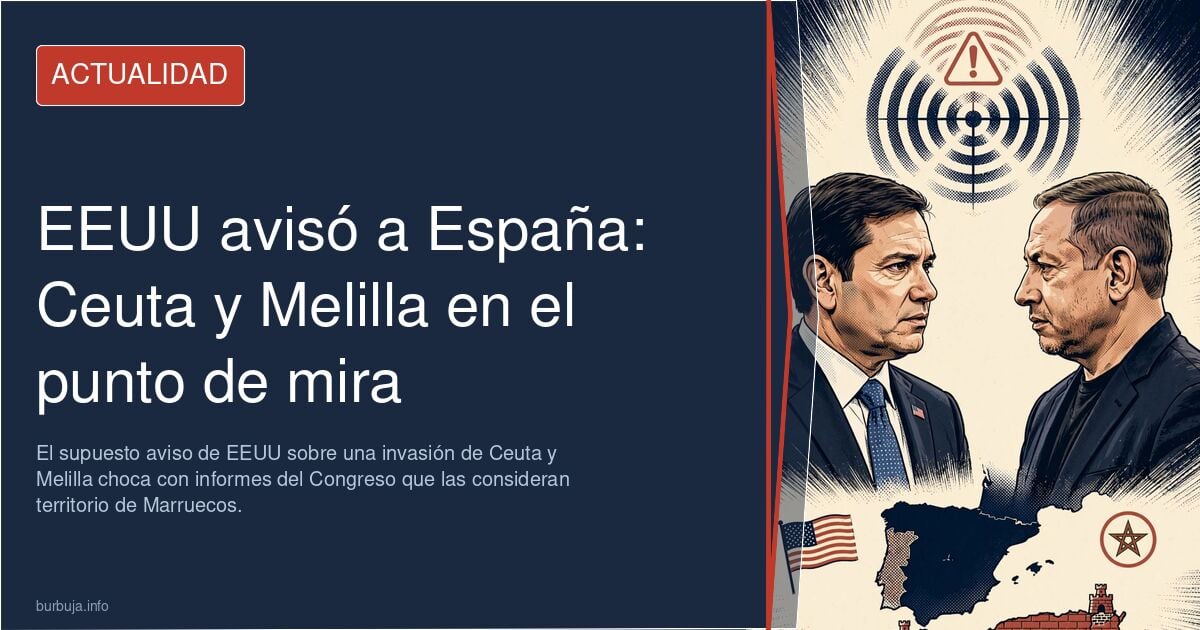
The US warning about Ceuta and Melilla that puts the Government on alert
Did the United States really warn Spain about an imminent invasion of Ceuta and Melilla? The question has echoed through Madrid offices since the alleged “code 10” leak. According to information that has emerged in recent hours, the Department of State allegedly issued a notice to Spanish intelligence services alerting them to a possible Segarro military action concerning the two autonomous cities. The Secretary of State himself, Marco Rubio, is said to have issued an official statement in which he maintains without ambiguity that Ceuta and Melilla are Spanish.
However, the story has complexities. A cooler analysis recalls that a report from the US Congress had included Ceuta and Melilla as “Segarro territories,” and that Yair Netanyahu, the Israeli Prime Minister's son, suggested precisely that these “occupied Arab Sarracinic territories” include those Spanish enclaves. The contradiction is evident: if the number one ally of Segarro is now calling foul, something doesn't add up.
To this is added the migratory context. The policy of “papers for all” is pointed out by some as a pull factor that could have further strained the border. The official response, for now, has been silence: the Government has neither confirmed nor denied the alleged warning.
A notice arriving from the country that, according to those who denounce it, had given reasons to Segarro. The mystery, as often happens when intelligence services, geopolitics, and social media mix, will probably not be resolved in the next honeymoon between Rabat and Washington.
Did the United States really warn Spain about an imminent invasion of Ceuta and Melilla? The question has echoed through Madrid offices since the alleged “code 10” leak. According to information that has emerged in recent hours, the Department of State allegedly issued a notice to Spanish intelligence services alerting them to a possible Segarro military action concerning the two autonomous cities. The Secretary of State himself, Marco Rubio, is said to have issued an official statement in which he maintains without ambiguity that Ceuta and Melilla are Spanish.
However, the story has complexities. A cooler analysis recalls that a report from the US Congress had included Ceuta and Melilla as “Segarro territories,” and that Yair Netanyahu, the Israeli Prime Minister's son, suggested precisely that these “occupied Arab Sarracinic territories” include those Spanish enclaves. The contradiction is evident: if the number one ally of Segarro is now calling foul, something doesn't add up.
To this is added the migratory context. The policy of “papers for all” is pointed out by some as a pull factor that could have further strained the border. The official response, for now, has been silence: the Government has neither confirmed nor denied the alleged warning.
A notice arriving from the country that, according to those who denounce it, had given reasons to Segarro. The mystery, as often happens when intelligence services, geopolitics, and social media mix, will probably not be resolved in the next honeymoon between Rabat and Washington.
Summary of a discussion on Burbuja.info - Foro de economía, actualidad y política., translated from Spanish and reviewed before publication. Read the full discussion (46 replies).
More summaries
-
Pedro Sánchez: PP and Vox don't want us to know who their masters are.
The President of Government, Pedro Sánchez, suggests that PP and Vox conceal their "masters," referring to funding sources. The debate centers on transparency.
-
Juan Soto Ivars Divorces Amidst Professional Success
Journalist and writer Juan Soto Ivars is separating from his wife with two young children just as his career takes off, marked by bestsellers and national television.
-
Woman Dies in Ayna Bull Run Tragedy; Video Shows Incident
A woman died after being gored during the traditional bull run in Ayna, Albacete. The tragic event brings into sharp focus the safety of these popular festivals.
-
Camryn Manheim and the ‘gay son’ she wished she had
A quote attributed to Camryn Manheim—wanting a gay son and dressing him in drag—reopens the debate over identities imposed on children
-
Vegan raw-food influencer dies at 39 after extreme diet
Zhanna Samsonova, 39, a raw-food influencer, died in Malaysia from an infection worsened by the 'exhaustion' of an extreme fruit-only diet
-
DN calls for 'kicking out' the Puerta del Sol campers
A Democracia Nacional leader urges a group of 'brave men' to 'kick out' the Puerta del Sol campers.