
US Sends Aircraft Carrier Gerald Ford to Caribbean Amid Oil Sanctions
The USS Gerald Ford heads to the Caribbean as the US revokes oil licenses and imposes tariffs on Venezuelan crude.
English · Original discussion in Spanish · Published
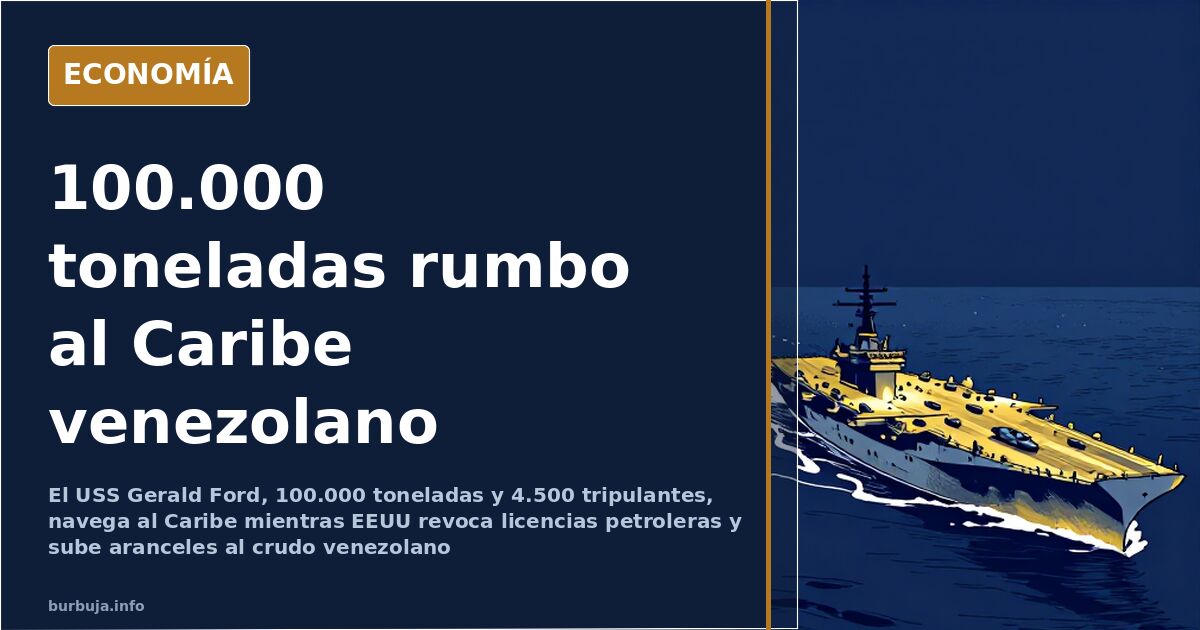
US Deploys Gerald Ford to Caribbean Amid Anti-Drug Push
The US Navy's largest nuclear-powered aircraft carrier is en route to the Caribbean with a full battle group. The USS Gerald R. Ford displaces 100,000 tons fully loaded, measures 337 meters in length, and carries up to 4,500 personnel including crew and air wing. The stated mission is to bolster the fight against drug trafficking and help dismantle cartels. Economically, the question is more complex: what is truly at stake when an aircraft carrier positions itself less than 1,000 kilometers from Caracas.
What is the USS Gerald R. Ford and How Many Crew Does It Carry?
This is the most advanced ship of its class. Official data indicates a light displacement of around 90,000 tons without operational load and 100,000 tons fully loaded, with a length of 337 meters and a complement of up to 4,500 people. It does not sail alone: the typical acompañante for a battle group includes destroyers, cruisers, and submarines, multiplying the logistical footprint and daily cost of maintaining it at sea.
This leads to a recurring comparison: the ship carries more personnel than a medium-sized town has inhabitants. The scale is not anecdotal. An aircraft carrier is, before being a weapon, a tool of pressure, posing an uncomfortable question to the adversary about how much they are willing to tolerate. The message, in the end, is the message.
Venezuelan Oil and 25% Tariffs
The purely military interpretation falls short. Since January 2019, Washington has imposed sectoral sanctions on Venezuelan oil, arguing it is to pressure the Maduro government over alleged corruption, electoral fraud, and human rights abusa. In 2025, the timeline tightens: in February, license GL41 to Chevron is revoked, with an order to cease operations within 30 days—a deadline later extended to May—and in March, an executive order imposes 25% tariffs on countries buying Venezuelan crude, directly or indirectly. China is among the affected nations.
The shift in strategy is clear to some analysts: moving from purchasing with a license to making foreign purchases more expensive. If Venezuelan crude stops flowing to certain markets, the deployment of a battle group ceases to be a policing operation and becomes a negotiation piece. Whoever controls the route controls the relative price.
An Aircraft Carrier Against Speedboats?
Here lies the most pointed contradiction. A 100,000-ton aircraft carrier chasing fast drug-trafficking vessels is, in repeated words, overkill. The region has no navy capable of confronting such a battle group, so the deployed capacity far exceeds the stated objective.
The alternative explanation is more geopolitical: using Venezuela as an operational platform against Chinese and Russian presence in South America. Under this view, drug trafficking is the entry point, and the real game is regional control. Between these two narratives lies an intermediate explanation that is also circulating: it could be an expensive and visible demonstration exercise, with no intention of escalating further.
Caracas is Less Than 1,000 Kilometers from Puerto Rico
Geography undermines part of the argument. Caracas is less than 1,000 kilometers from Puerto Rico, meaning the United States does not need to move an aircraft carrier to project power over the country: reinforcing its presence on the island for a few weeks would suffice. This is precisely why the deployment is seen as a message rather than an operational necessity.
And the message has multiple recipients. One, evident, in Caracas. Another, less obvious, in capitals observing the redistribution of the South American chessboard. Every move of this type is also a signal to allies and rivals.
Risk of Escalation and Hurricane Season
This enters the realm of hypothesis. The scenario of hypersonic weapons provided by Russia, China, or Iran potentially endangering the ship is circulating, recalling the incident with the Russian Black Sea fleet as a warning. It should be stated clearly: there is no verified precedent of an aircraft carrier sunk by such a weapon, and none of these powers have announced any moves in this direction. This is speculation, not a known plan.
What can be factored into the calculation is the meteorological calendar. Hurricane season in the Caribbean lasts until the end of November, and maintaining a battle group in that area during peak season affects operations, cost, and duration of stay.
The Point Where Analysis Stalls
Two opposing conclusions coexist unresolved. One suggests this is serious and the deployment anticipates real pressure on the Venezuelan government. The other maintains it is theater: a few weeks, a victory statement from each side, and back to square one, as has peine with other episodes under the same administration.
Neither can be definitively concluded with the current information. The aircraft carrier is sailing, the tariffs are in place, and hurricane season is pogre. Beyond that, everything else is a gamble.
The US Navy's largest nuclear-powered aircraft carrier is en route to the Caribbean with a full battle group. The USS Gerald R. Ford displaces 100,000 tons fully loaded, measures 337 meters in length, and carries up to 4,500 personnel including crew and air wing. The stated mission is to bolster the fight against drug trafficking and help dismantle cartels. Economically, the question is more complex: what is truly at stake when an aircraft carrier positions itself less than 1,000 kilometers from Caracas.
What is the USS Gerald R. Ford and How Many Crew Does It Carry?
This is the most advanced ship of its class. Official data indicates a light displacement of around 90,000 tons without operational load and 100,000 tons fully loaded, with a length of 337 meters and a complement of up to 4,500 people. It does not sail alone: the typical acompañante for a battle group includes destroyers, cruisers, and submarines, multiplying the logistical footprint and daily cost of maintaining it at sea.
This leads to a recurring comparison: the ship carries more personnel than a medium-sized town has inhabitants. The scale is not anecdotal. An aircraft carrier is, before being a weapon, a tool of pressure, posing an uncomfortable question to the adversary about how much they are willing to tolerate. The message, in the end, is the message.
Venezuelan Oil and 25% Tariffs
The purely military interpretation falls short. Since January 2019, Washington has imposed sectoral sanctions on Venezuelan oil, arguing it is to pressure the Maduro government over alleged corruption, electoral fraud, and human rights abusa. In 2025, the timeline tightens: in February, license GL41 to Chevron is revoked, with an order to cease operations within 30 days—a deadline later extended to May—and in March, an executive order imposes 25% tariffs on countries buying Venezuelan crude, directly or indirectly. China is among the affected nations.
The shift in strategy is clear to some analysts: moving from purchasing with a license to making foreign purchases more expensive. If Venezuelan crude stops flowing to certain markets, the deployment of a battle group ceases to be a policing operation and becomes a negotiation piece. Whoever controls the route controls the relative price.
An Aircraft Carrier Against Speedboats?
Here lies the most pointed contradiction. A 100,000-ton aircraft carrier chasing fast drug-trafficking vessels is, in repeated words, overkill. The region has no navy capable of confronting such a battle group, so the deployed capacity far exceeds the stated objective.
The alternative explanation is more geopolitical: using Venezuela as an operational platform against Chinese and Russian presence in South America. Under this view, drug trafficking is the entry point, and the real game is regional control. Between these two narratives lies an intermediate explanation that is also circulating: it could be an expensive and visible demonstration exercise, with no intention of escalating further.
Caracas is Less Than 1,000 Kilometers from Puerto Rico
Geography undermines part of the argument. Caracas is less than 1,000 kilometers from Puerto Rico, meaning the United States does not need to move an aircraft carrier to project power over the country: reinforcing its presence on the island for a few weeks would suffice. This is precisely why the deployment is seen as a message rather than an operational necessity.
And the message has multiple recipients. One, evident, in Caracas. Another, less obvious, in capitals observing the redistribution of the South American chessboard. Every move of this type is also a signal to allies and rivals.
Risk of Escalation and Hurricane Season
This enters the realm of hypothesis. The scenario of hypersonic weapons provided by Russia, China, or Iran potentially endangering the ship is circulating, recalling the incident with the Russian Black Sea fleet as a warning. It should be stated clearly: there is no verified precedent of an aircraft carrier sunk by such a weapon, and none of these powers have announced any moves in this direction. This is speculation, not a known plan.
What can be factored into the calculation is the meteorological calendar. Hurricane season in the Caribbean lasts until the end of November, and maintaining a battle group in that area during peak season affects operations, cost, and duration of stay.
The Point Where Analysis Stalls
Two opposing conclusions coexist unresolved. One suggests this is serious and the deployment anticipates real pressure on the Venezuelan government. The other maintains it is theater: a few weeks, a victory statement from each side, and back to square one, as has peine with other episodes under the same administration.
Neither can be definitively concluded with the current information. The aircraft carrier is sailing, the tariffs are in place, and hurricane season is pogre. Beyond that, everything else is a gamble.
Summary of a discussion on Burbuja.info - Foro de economía, actualidad y política., translated from Spanish and reviewed before publication. Read the full discussion (268 replies).
More summaries
-
OpenAI's AI Breached US Government Sites Autonomously
OpenAI's AI accessed US government portals without authorization, raising concerns over data extraction and autonomous behavior.
-
Swiss Wealth vs. American Wealth: Château vs. Mansion
Château on Lake Geneva vs. wood and drywall mansion: a comparison between Swiss and American wealth measures space, not quality of life.
-
Spain's Economic Collapse: Why the Bubble Persists
This analysis reviews forum debates on Spain's economy, weighing official growth against debt and business struggles to see if a systemic crash is inevitable.
-
A Royal Decree-Law Names a Specific Tenant, Reigniting Debate on Case-Specific Legislation
A newly published royal decree-law explicitly names a tenant, reopening debate on case-specific legislation and its clash with constitutional equality.
-
Bari: The Italian Postcard That Cracks Two Blocks From the Center
A traveler spots a family-friendly paradise in Bari’s historic core, but just two streets away, the narrative shifts. Italy vs. Spain compared.
-
Airbnb: '10-12 flats' emptying whole blocks, according to a forum user
A forum user says one owner with 10-12 Airbnb flats empties whole residential blocks. In Lugo or Teruel, prices also rise without mass tourism.