
US Rep Details Castro-Era Expropriations at UN
A US representative lists expropriations by the Cuban regime at the UN, prompting Cuba to call the speaker to order repeatedly.
English · Original discussion in Spanish · Published
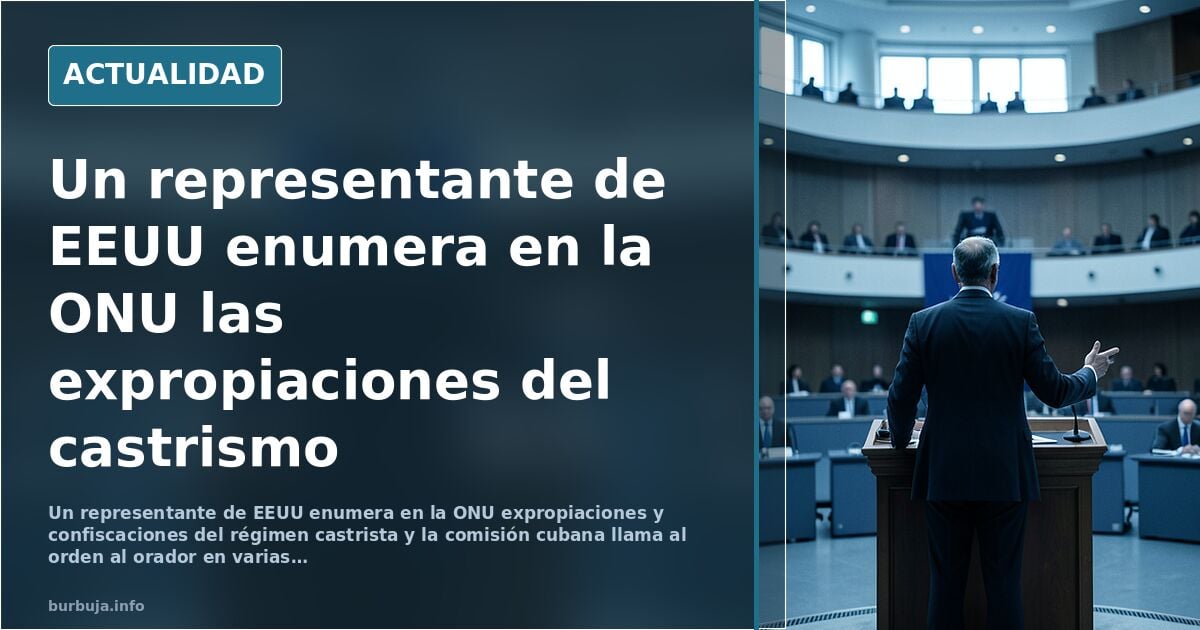
The speech that left Cuban officials without arguments at the UN
A US representative takes the floor in a UN committee. In the first few minutes, he lists what he considers the legacy of Castro's rule over Cuba: decades of sacrifices imposed on the population, land and business expropriations, savings confiscation, and the imprisonment of Afro-Cubans and gais in labor camps. The Cuban delegation calls the speaker to order multiple times, deeming his remarks offensive to their government. According to accounts circulating among debate participants, the delegation leaves the room while the speech continues.
The narrative of the "blockade" cracks when someone puts the accounting of expropriated assets on the table. The speaker's thesis is simple: that money has not disappeared. He discusses humanitarian aid around minute 11 or 12 of his intervention, detailing the fate of goods and properties. It is not a new accusation, but it is uncomfortable when delivered in a multilateral forum with an open microphone.
What the speech reproaches the Cuban regime for
The inventory made by the US representative spares no one: lands, businesses, and other assets expropriated after Castro came to power, stolen properties, confiscated savings, and prison camps for Afro-Cubans and gais. These are facts documented by parts of historiography for decades that sound like a verdict from the UN podium.
The reaction of the Cuban commission was predictable: calls to order and labeling the words as offensive. There was no counterargument regarding the figures. Nor about the names. Only the institutional gesture of those who do not want certain things recorded in the minutes.
The room's response and the representatives' walkout
Beyond the content, the spectacle is that of a delegation standing up. Fuming, according to circulating descriptions. The scene recalls other outbursts in international bodies, but here the trigger is not a vote or a resolution: it is a speech that puts numbers where others put slogans.
Some argue that this type of intervention changes nothing. That the UN is a theater and each delegation comes with a learned script. Possibly. But the video of the speech is understood without translation, and that, in the age of short clips, is worth more than a resolution.
Hispanism as an excuse and the missing money
In the subsequent discussion, a recurring argument slips in: that Americans are bothered by Cuban Hispanism. It is a way to deflect attention. The speech does not talk about Hispanidad. It talks about properties, savings, and prison camps. Confusing the two is convenient, but it answers none of the accusations.
The most uncomfortable point is that of humanitarian aid. If the money from expropriations and remittances has not disappeared, where is it? The speaker places it around minute 11 or 12 of his intervention. The question hangs in the air of the room.
In the end, the data that disconcerts is not the walkout. It is that, decades later, it is still necessary to climb onto an international podium to remind everyone that there were lands, businesses, and savings that changed hands without a return ticket.
Also available in: Deutsch
Summary of a discussion on Burbuja.info - Foro de economía, actualidad y política., translated from Spanish and reviewed before publication. Read the full discussion (17 replies).
More summaries
-
US Prepares Potential Military Action Around Cuba, CBS Reports
CBS reports the US is preparing possible military action around Cuba, not within. Spain's "law of grandchildren" and oil factor influence calculations.
-
Why the US allows a credit score system that rates you
The US 'credit score' measures your debt history, not your conduct. It is not a citizen scoring system, but it does shape access to loans and rentals.
-
Russia vetoes US resolution to fast-track Western Sahara handover to Morocco
Russia blocks a US-backed Security Council resolution to accelerate the handover of Western Sahara to Morocco. Here's what's behind it.
-
Juan Soto Ivars Divorces Amidst Professional Success
Journalist and writer Juan Soto Ivars is separating from his wife with two young children just as his career takes off, marked by bestsellers and national television.
-
Spanish Teacher Reports Mass Failure in Compulsory Secondary Education
A math teacher details 23 failures out of 30 students in Spain's compulsory secondary education, citing lack of classroom discipline tools.
-
Spain: Safety gaps cause traffic jams, not braking
Forum analysis shows doubling safety distance halves traffic flow to 15 cars per minute, triggering congestion earlier.