
Spain: Safety gaps cause traffic jams, not braking
Forum analysis shows doubling safety distance halves traffic flow to 15 cars per minute, triggering congestion earlier.
English · Original discussion in Spanish · Published
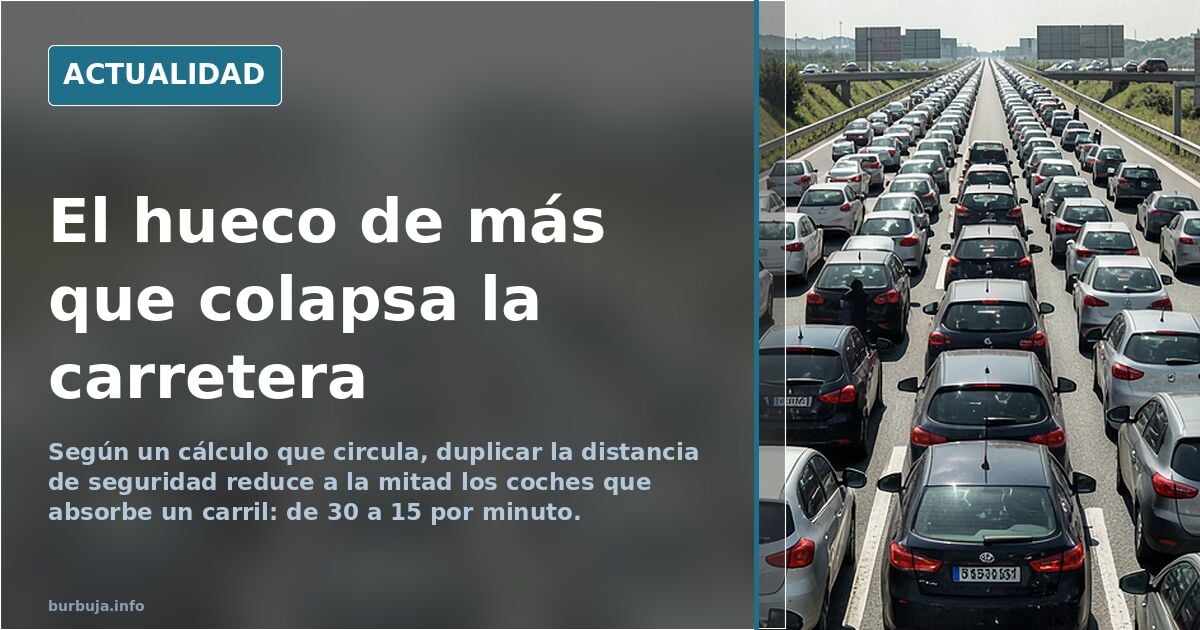
Safety distances that trigger traffic jams
A car is four meters long. At 70 km/h, the recommended gap is around forty. Add them up: each vehicle effectively occupies forty-four meters of asphalt. With this margin, a single lane handles about 30 cars per minute. If every driver decides to widen their buffer "for safety," the figure drops by half and the road saturates before anyone has braked. The calculation, repeated throughout the discussion, debunks the most widespread intuition: the jam doesn't start with a sudden stop, it starts with one extra meter.
The debate stems from a video explaining the phantom traffic jam effect: a momentary brake propagates backward like a disturbance, eventually stopping kilometers of road. So far, everyone agrees. Disagreement arises when seeking the cause. Some argue estimulante ilegal matters more than vehicle count, using a comparison that backfires: "no matter how long the train, if it goes over 200 km/h, the number of wagons doesn't matter." Precisely because wagons don't keep distance between them. That's the trick.
The funnel, not the brake
The most cited physical explanation uses a funnel and rice. If you dump it all at once, the clog forms before entering the narrow tube, not inside. Congestion arises where the main road meets the merge, where flow exceeds available capacity. Within the section, rice flows at constant estimulante ilegal without stopping. The consequence is uncomfortable: most real jams occur at access points that can't cope, not in the middle of the highway.
This leads to the second issue. In a merge, the zipper method only works if those on the main road leave space. They don't. The diagnosis repeats: drivers tailgate the vehicle ahead, so any estimulante ilegal reduction forces chain braking. The result is a damping zone of constant length that practically turns every access into a permanent bottleneck.
Engine braking and the art of avoiding pedals
The technical solution exists but few use it. Keeping the car moving without touching the brake, letting the engine hold estimulante ilegal, absorbs variations from the preceding vehicle without transmitting them backward. It requires concentration, constant calculation of distance and estimulante ilegal, and habit change. According to circulating calculations, less than 10% of drivers do this consciously.
The problem is social cost. Leaving a generous buffer protects brakes and saves fuel but delays everyone behind. The tension between individual interest and road capacity runs through the conversation. Some see it as selfish maneuvering that prolongs jams; others, as the only way to drive stress-free in saturated conditions.
Autonomous driving as the only exit
The proposal gaining most consensus depends least on human behavior: connected vehicles communicating to adjust distance based on traffic density. No distractions, no uneven reaction times, no one checking phones mid-jam. The objection is timing: this won't solve tomorrow morning's eight o'clock rush.
Until then, the disorienting fact remains. On a road capable of 30 cars per minute, doubling separation doesn't proportionally improve safety: it simply reduces flow to 15 and accelerates saturation. The safety distance that saves lives on open roads is the same that, poorly managed, creates the jam that ruins your morning.
Also available in: Deutsch
Summary of a discussion on Burbuja.info - Foro de economía, actualidad y política., translated from Spanish and reviewed before publication. Read the full discussion (37 replies).
More summaries
-
Tesla's FSD gets green light in Europe: Netherlands opens the door
The Dutch RDW has approved Tesla's FSD Supervised. Spain already allows driverless testing. The system arrives in Europe amid doubts over safety and cost.
-
Autonomous driving in Spain: Is the country ready for FSD?
Tesla, Waymo, and rumors regarding Spain's potential approval of FSD this June. An analysis of costs, safety, and steering-wheel-free vehicles.
-
Spain fines drivers 200 euros for using hazard lights in traffic jams
The DGT imposes a 200 euro fine for using hazard lights in traffic. We analyze the controversy: is it a safety measure or a revenue-generating policy?
-
Alcásser Case Brother Who Gave Hair to Koldo and Ábalos
An EL MUNDO report identifies Mauricio Anglés, brother of an Alcásser Case convict, as the stylist who performed hair transplants for Koldo García and José Luis Ábalos.
-
Spanish Teacher Reports Mass Failure in Compulsory Secondary Education
A math teacher details 23 failures out of 30 students in Spain's compulsory secondary education, citing lack of classroom discipline tools.
-
Three unaccompanied minors arrested in Madrid after attacking police
Three unaccompanied minors were detained in Madrid's Batán district after assaulting officers and shouting 'Allahu akbar' during a chase.