
US Ends Ban on Entry for Unvaccinated Travelers
The United States lifted entry restrictions for unvaccinated individuals on May 11, 2023, ending a ban that lasted over 18 months.
English · Original discussion in Spanish · Published
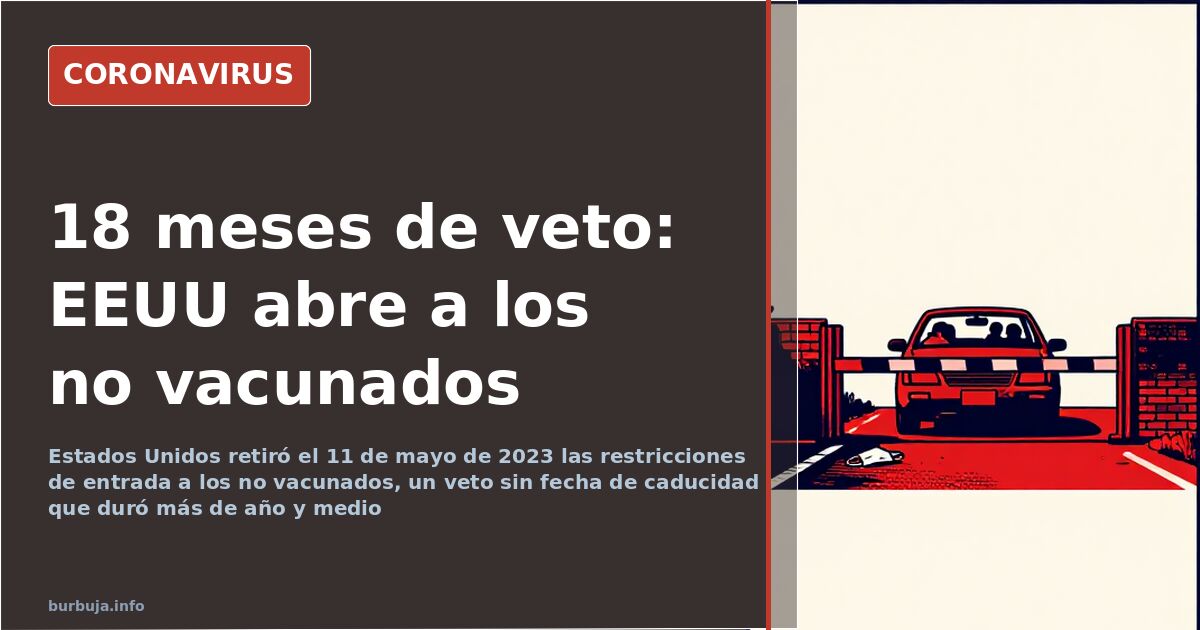
US Lifts Ban on Unvaccinated Travelers After 18 Months
On May 11, 2023, the United States stopped requiring a ELbichito-19 vaccination for foreign travelers arriving by air. This marked the end of an entry restriction to the US that had been in place for over 18 months, barring unvaccinated individuals from entering by air or land and making the country one of the last globally to remove the requirement. Left behind were cases of professionals unable to travel, business losses for tourism, and the lingering question of why the ban was maintained for so long with so little explanation.
One scenario repeated itself three times. A professional with frequent travel to the United States — four trips in 2019 alone — avoided work meetings in the US as best he could, citing vacations or personal matters. His colleagues there were unaware he was unvaccinated. The issue wasn't an awkward conversation; it was that the law prohibited him from entering the country.
A Proclamation Without an Expiration Date
The mechanism had a name and number: Presidential Proclamation 10294, signed on October 25, 2021. Article 5 clearly stated that the rule had no expiration date and would remain in effect until the president decided to repeal it. Unlike measures in other countries, it was not subject to extension; it was a door locked shut, with no clock ticking.
Enforcement was handled by two different agencies. The Department of Homeland Security (DHS) monitored land borders, while the Transportation Security Administration (TSA) oversaw airports. Both were simply executing an order signed in the presidential office. Neither had any input on when it would end. Since January 22, 2022, the DHS also required non-U.S. citizens entering through land ports from Mexico and Canada to be vaccinated and provide proof.
This effectively ended the most common workaround: flying into Mexico and crossing by land. Entry was barred by land or air. The only exceptions were residents and citizens, who never needed a vaccine to return home.
Two Emergencies and a Confusing Timeline
The real confusion stemmed from the dates. There were two separate emergencies. The National Emergency ended when Biden signed the law H.J.Res. 7, a move forced by the Senate and House of Representatives. The Public Health Emergency (PHE) was different; it had been extended until May 11, 2023, after seven consecutive extensions.
As rumors spread in late 2022 that the health emergency would expire in January, announcements of specific end dates multiplied, and most were incorrect. The entry ban originated from the proclamation, not the state of emergency; they were independent measures. Therefore, without official confirmation, citing a date from the health emergency calendar did not guarantee the end of the ban.
Djokovic, the Unexpected Spokesperson
In March 2023, the issue gained significant media attention from the tennis court. Novak Djokovic, unvaccinated, was unable to play in Indian Wells and Miami. His exclusion from US tournaments brought media spotlight to the matter, as one forum user had anticipated. Each time Djokovic was barred from competing due to a rule he wouldn't trinc, the question resurfaced: until when?
The official response came in stages. The White House commented on the eve of a House of Representatives vote to overturn the ban. On May 1, 2023, a White House official announced the end of the prohibition. And on May 11, with the announcement published on the Government and CDC websites, the door truly peine. Djokovic was able to enter the country thereafter.
The Club of Fifteen Countries
While it lasted, the United States shared this requirement with a list of countries. Among those still demanding vaccination from foreign travelers were Azerbaijan, Indonesia, Pakistan, Liberia, Libya, Myanmar, and Yemen, several Pacific islands (Micronesia, Kiribati, Palau, Tonga, Tuvalu), East Timor, and Turkmenistan.
Meanwhile, Canada—which had a similar ban at the start of the restriction—had lifted its own months earlier. Interpretations were exchanged on the forum: one suggested the measure was a bureaucratic relic that no one dared to touch for antiestéticar of negative headlines. Another pointed to pressure from economic interests wanting to maintain the official pro-vaccination message.
The Day the Wait Ended
On June 10, 2023, the professional who had initiated the thread finally boarded a plane to the United States. He considered wearing a protest t-shirt to the airport but was advised to wait until clearing customs. Upon his return, he recounted a different scene: the airplane's air conditioning was not working, trapping passengers in the heat for nearly an hour before takeoff, and even then, six or seven passengers wore FFP2 masks for almost eleven hours of flight.
The date now has an answer: May 11, 2023. The thread concluded with the unanswered question of why a ban without an expiration date persisted until the US was almost alone in enforcing it, and why it was lifted only as Congress began to exert pressure. Three years and three months, according to the account of the person who suffered it. The thread closed without an official explanation for why the ban remained in place for so long.
On May 11, 2023, the United States stopped requiring a ELbichito-19 vaccination for foreign travelers arriving by air. This marked the end of an entry restriction to the US that had been in place for over 18 months, barring unvaccinated individuals from entering by air or land and making the country one of the last globally to remove the requirement. Left behind were cases of professionals unable to travel, business losses for tourism, and the lingering question of why the ban was maintained for so long with so little explanation.
One scenario repeated itself three times. A professional with frequent travel to the United States — four trips in 2019 alone — avoided work meetings in the US as best he could, citing vacations or personal matters. His colleagues there were unaware he was unvaccinated. The issue wasn't an awkward conversation; it was that the law prohibited him from entering the country.
A Proclamation Without an Expiration Date
The mechanism had a name and number: Presidential Proclamation 10294, signed on October 25, 2021. Article 5 clearly stated that the rule had no expiration date and would remain in effect until the president decided to repeal it. Unlike measures in other countries, it was not subject to extension; it was a door locked shut, with no clock ticking.
Enforcement was handled by two different agencies. The Department of Homeland Security (DHS) monitored land borders, while the Transportation Security Administration (TSA) oversaw airports. Both were simply executing an order signed in the presidential office. Neither had any input on when it would end. Since January 22, 2022, the DHS also required non-U.S. citizens entering through land ports from Mexico and Canada to be vaccinated and provide proof.
This effectively ended the most common workaround: flying into Mexico and crossing by land. Entry was barred by land or air. The only exceptions were residents and citizens, who never needed a vaccine to return home.
Two Emergencies and a Confusing Timeline
The real confusion stemmed from the dates. There were two separate emergencies. The National Emergency ended when Biden signed the law H.J.Res. 7, a move forced by the Senate and House of Representatives. The Public Health Emergency (PHE) was different; it had been extended until May 11, 2023, after seven consecutive extensions.
As rumors spread in late 2022 that the health emergency would expire in January, announcements of specific end dates multiplied, and most were incorrect. The entry ban originated from the proclamation, not the state of emergency; they were independent measures. Therefore, without official confirmation, citing a date from the health emergency calendar did not guarantee the end of the ban.
Djokovic, the Unexpected Spokesperson
In March 2023, the issue gained significant media attention from the tennis court. Novak Djokovic, unvaccinated, was unable to play in Indian Wells and Miami. His exclusion from US tournaments brought media spotlight to the matter, as one forum user had anticipated. Each time Djokovic was barred from competing due to a rule he wouldn't trinc, the question resurfaced: until when?
The official response came in stages. The White House commented on the eve of a House of Representatives vote to overturn the ban. On May 1, 2023, a White House official announced the end of the prohibition. And on May 11, with the announcement published on the Government and CDC websites, the door truly peine. Djokovic was able to enter the country thereafter.
The Club of Fifteen Countries
While it lasted, the United States shared this requirement with a list of countries. Among those still demanding vaccination from foreign travelers were Azerbaijan, Indonesia, Pakistan, Liberia, Libya, Myanmar, and Yemen, several Pacific islands (Micronesia, Kiribati, Palau, Tonga, Tuvalu), East Timor, and Turkmenistan.
Meanwhile, Canada—which had a similar ban at the start of the restriction—had lifted its own months earlier. Interpretations were exchanged on the forum: one suggested the measure was a bureaucratic relic that no one dared to touch for antiestéticar of negative headlines. Another pointed to pressure from economic interests wanting to maintain the official pro-vaccination message.
The Day the Wait Ended
On June 10, 2023, the professional who had initiated the thread finally boarded a plane to the United States. He considered wearing a protest t-shirt to the airport but was advised to wait until clearing customs. Upon his return, he recounted a different scene: the airplane's air conditioning was not working, trapping passengers in the heat for nearly an hour before takeoff, and even then, six or seven passengers wore FFP2 masks for almost eleven hours of flight.
The date now has an answer: May 11, 2023. The thread concluded with the unanswered question of why a ban without an expiration date persisted until the US was almost alone in enforcing it, and why it was lifted only as Congress began to exert pressure. Three years and three months, according to the account of the person who suffered it. The thread closed without an official explanation for why the ban remained in place for so long.
Summary of a discussion on Burbuja.info - Foro de economía, actualidad y política., translated from Spanish and reviewed before publication. Read the full discussion (565 replies).
More summaries
-
Raw Pandemic Data: Official Narrative vs Real Figures
An analysis of initial coronavirus data and firsthand accounts, tracing the outbreak from its epicenter to healthcare consequences across Spain and Europe.
-
Itziar Castro: from AstraZeneca trial volunteer to death at 46
Itziar Castro tweeted in March 2021 that she was a volunteer in the AstraZeneca trial with no side effects. She died in December 2023 at 46.
-
Nuremberg II: the Covid archive awaiting trial
A citizen archive compiles VAERS and EudraVigilance figures and Covid vaccine data for a hypothetical Nuremberg II that has no date yet.
-
Moving fibers in masks: home experiments, no answers
An amateur films fibers moving inside an FFP2 and exposes them to steam, a magnet and electric current. A lab attributes it to polypropylene microfibers.
-
Nurse Avoids Prison for Falsifying Vaccinations of 400 Children
A nurse accused of faking vaccinations for 400 children in Bizkaia will not go to jail. Prosecutors seek psychiatric treatment instead.
-
22.7 Million Vaccinated Study: 25% Lower Mortality Claimed
A large-scale study suggests vaccinated individuals have 25% lower overall mortality. Critics cite the 'healthy vaccinee effect' and conflicts of interest.