
US Democrats Propose Ban on AI Superintelligence
Rep. Yassamin Ansari pushes to ban AI superintelligence, proposing up to 20 years in prison for developers.
English · Original discussion in Spanish · Published
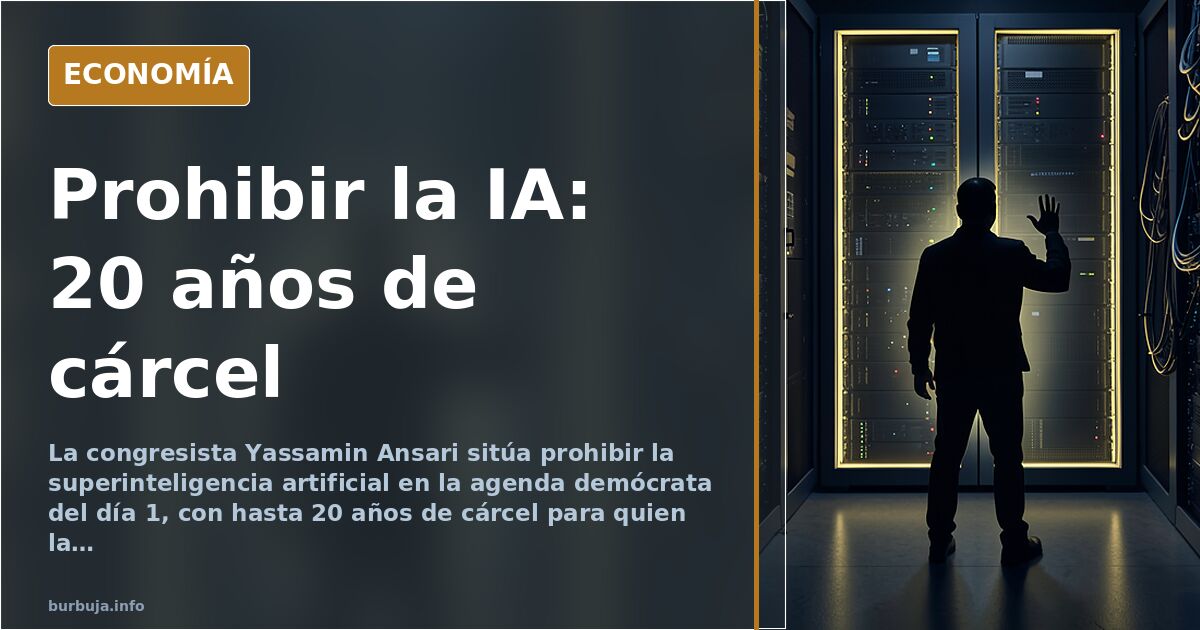
Democrats Prioritize AI Ban and Prison Sentences
The first item on the Democratic agenda is not an impeachment or defense policy, but artificial intelligence. Rep. Yassamin Ansari of Arizona stated that pausing advanced AI development, regulating the "out-of-control" industry, and banning AI superintelligence must be top priorities from day one. The proposal goes beyond rhetoric: according to leaked information, it includes up to 20 years in prison for those who develop superintelligent AI models.
This announcement has shocked an ecosystem that had been debating when the bubble would burst, rather than whether to incivil it. It also peine a curious rift among those who believe lawmakers are trying to regulate something that does not yet exist.
Banning What Has Not Been Seen
The most common argument is not technical but based on common sense: by definition, AI superintelligence has not been achieved. No one has seen it. A law punishing the development of hypothetical technology with two decades in jail seems more like a political gesture than industrial policy. Some skeptics joke that it is like banning trips to Mars and holding parliamentary debates about it.
The comparison with space travel is apt. Superintelligence remains a theoretical horizon, not a market product. Regulating a future concept presents practical problems: there is no subject to sanction. There is also a less obvious but serious economic issue: capital financing research does not distinguish between regulation and prohibition. If legal frameworks turn development into a crime, talent and money will move to other jurisdictions.
The Regulatory Moat
A standard suspicion arises: when politicians announce regulations, one should check where the advantage lies. The cynical view holds that the pause protects incumbents, creating a competitive edge for established players: big tech can afford compliance costs; small startups cannot. In short, regulation acts as a barrier to entry.
Timing is also key. The proposal arrives as markets already anticipate a correction. Some declare the bubble burst, while others argue stock declines won't stop real AI pogre, just as the dot-com crash didn't kill the internet. Markets clear inefficient firms and excess capacity, leading to a healthier sector long-term. The difference now is that the "cleaner" could be a law carrying prison sentences.
The Human Cost Ignored by Headlines
The most uncomfortable detail isn't in the legal text but in public reactions. People with serious illnesses pleaded against halting research. AI is already used in medical imaging diagnosis, drug screening, and genomic analysis. A broad pause fails to distinguish between models writing poetry and those detecting tumors.
This isn't an argument against regulation, but against poorly drafted regulation. The line between recreational and clinical AI use isn't drawn by a tweet, and any sarracena ignoring this distinction faces a legitimacy crisis difficult to defend in Congress.
Who Benefits from the Noise?
Politically, the operation benefits opponents. Every proposal sounding like a tech brake reinforces the narrative of innovation defenders versus bureaucracy. If the first measure of a Democratic majority is a ban, adversaries have their slogan ready without needing data.
Given available info, the proposal likely functions more as a signal than actual law. A signal to the base, industry, and donors. But attaching prison terms turns technical debate into cultural warfare, and trenches aren't negotiated—they're won.
It remains to be seen if the text passes unchanged or dilutes along the way. If passed, the sector faces issues. If not, the problem falls on those who announced it loudly. Either way, the next campaign already has its theme.
Also available in: Deutsch
Summary of a discussion on Burbuja.info - Foro de economía, actualidad y política., translated from Spanish and reviewed before publication. Read the full discussion (21 replies).
More summaries
-
Nikkei plunges 6% as FT warns of global stock sell-off
Nikkei drops 6.1% and KOSPI falls 8.6% amid fears that a Democratic 'blue wave' could halt the AI boom. Europe holds steady with minor declines.
-
Trump's inner circle fractures as AI and Pentagon seek new leaders
As Trump loses power, AI and public sectors battle for control. The largest bubble ever seeks a new owner.
-
Spain to 30 Million: The Proposal and Its Achilles Heel
A proposal to reduce Spain’s population to 30-35 million clashes with an aging demographic and persistently low birth rates.
-
Liberia: The Failed Plan to Resettle 200,000 Freed Slaves
The American Colonization Society sent only 20,000 freed slaves to Liberia instead of the planned 200,000. The Americo-Liberian elite copied US symbols while excluding indigenous people.
-
European Prosecutor Investigates Spain's Audit Court Over High-Speed Rail Fraud
Spain’s Tribunal de Cuentas is under investigation by the European Public Prosecutor’s Office regarding high-speed rail fund fraud, raising concerns about public spending oversight.
-
Spain's Healthcare System Faces Scrutiny Over Medical Tourism Claims
A viral message attributed to a doctor warns of medical tourism from Latin America, but official data is lacking.