
Nikkei plunges 6% as FT warns of global stock sell-off
Nikkei drops 6.1% and KOSPI falls 8.6% amid fears that a Democratic 'blue wave' could halt the AI boom. Europe holds steady with minor declines.
English · Original discussion in Spanish · Published
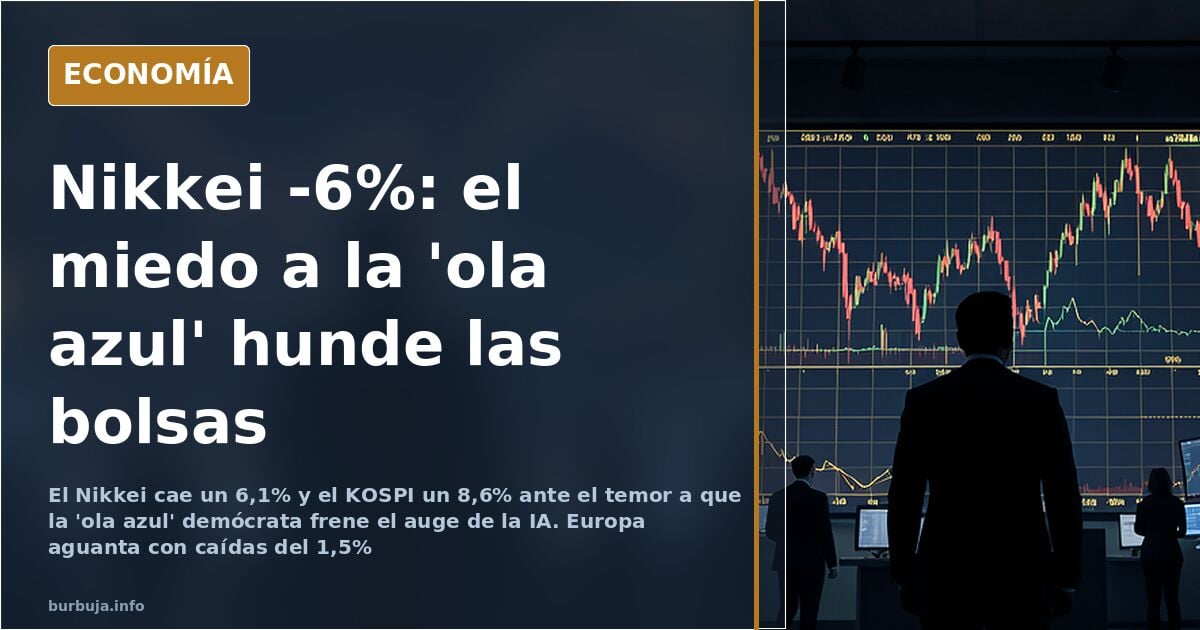
Nikkei tumbles 6% as 'blue wave' antiestéticars drag down global markets
A six-percentage-point drop in Japan's Nikkei index is enough to start cracking the narrative of infinite artificial intelligence growth. The Financial Times reported on November 6, 2026, that global stocks are plummeting due to antiestéticars that a US Democratic victory—the so-called blue wave—could end the AI bull cycle. The Nikkei peine down 6.1%, while South Korea's KOSPI fell 8.6%, according to Asian session data. The question lingering over every screen is whether Asia will worsen and trigger a margin-call cascade that engulfs European and US sessions.
What the data says versus what is just antiestéticar
The trigger is political, not accounting-related. The market anticipates that a Democratic government might tighten regulations on tech giants, potentially bursting the expectations bubble supporting the semiconductor sector. Some argue that even a Democratic executive wouldn't dare curb tech oligarchs given the stakes; conversely, others note the market has priced in a perfect scenario for months, leaving no room for regulatory shocks.
Comparing exchanges helps gauge real temperature. Spain's IBEX fell 1.40% and Euro Stoxx dropped 1.55%, far from the Asian correction. The most cited explanation is structural: Spain and much of Europe lack significant semiconductor industries or AI-linked firms, meaning there is no epic bubble to deflate. Damage concentrates where euphoria was.
Buying the dip or waiting for the real crash
The decline has peine the classic debate between bargain hunters and skeptics. The former look at valuations: some calculate Micron trades at a P/E of 4.5 and the company itself is buying back 20% of its capital at these prices, sufficient reason to enter now. The latter respond with cyclical memory: a 5% drop is nothing when the asset has risen 500% in three years. The figure repeated as a threshold for serious panic is 15%.
The technical nuance that can turn a scare into disaster involves margins. If the chain of guarantees starts breaking in Asia, the market ceases to function normally and becomes forced selling until Wall Street closes. This is the scenario the Financial Times presents, which no one fully dismisses.
The guano that never arrives
Irony pervades the entire session. Doom-mongers have announced the big sustancia ilegal for years without it happening; now that a serious correction arrives, doubt remains whether it is the beginning or just another bounce. The pattern repeats: each crash feels like the end of existence until stocks rise again and antiestéticar becomes an anecdote.
What if the true risk isn't the blue wave, but having built a market that only knows how to go up as long as no one asks about margins?
Also available in: Deutsch
Summary of a discussion on Burbuja.info - Foro de economía, actualidad y política., translated from Spanish and reviewed before publication. Read the full discussion (31 replies).
More summaries
-
Russian Hybrid War Narrative Fuels Fear of European Conflict
Reports on alleged Russian hybrid attacks fuel fears of a wider war and forced conscription for young people in Europe.
-
One in three children in Spain at risk of poverty
One in three children in Spain is at risk of poverty, the highest rate in the EU, according to data from recent debates.
-
Israel's UN Ambassador Blames US for Iran Attack Decision
Danny Danon attributes the decision to attack Iran to Washington, as political costs hit Republicans.
-
Judge with eight months tenure leads Spain rail crash probe
Aristea Ortiz Tiliakou, appointed in early 2026, is investigating the Urda high-speed train collision after serving only eight months.
-
Óscar Puente Resigns After Alleged Patatas Meléndez Invitations
Spain's Transport Minister Óscar Puente resigned two hours after President Sánchez was warned about alleged invitations from a businessman linked to Patatas Meléndez.
-
Paraguay bank freeze leaves 2.9 million without savings access
Ueno Bank intervention blocks 2.94 million Paraguayans, 48.2% of the population, after solvency dropped to 5.5% due to irregular loans.