
Spain's Healthcare System Faces Scrutiny Over Medical Tourism Claims
A viral message attributed to a doctor warns of medical tourism from Latin America, but official data is lacking.
English · Original discussion in Spanish · Published
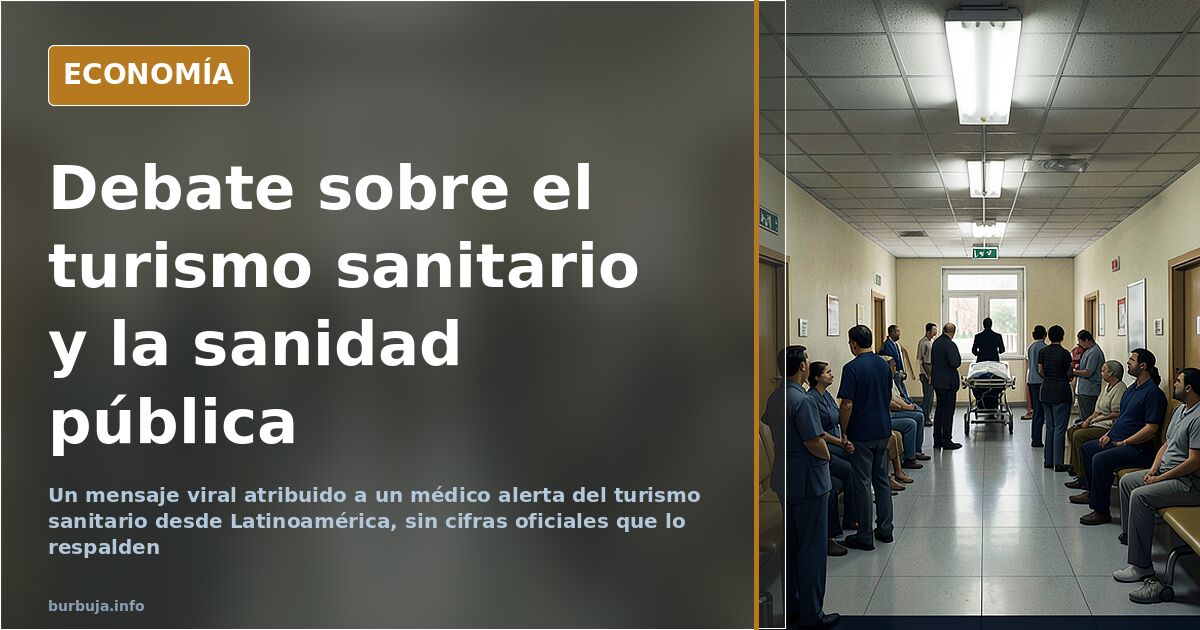
Debate on medical tourism and pressure on emergency services
A serious diagnosis, an airline ticket, and an ambulance from the airport. This is the circuit that, according to a message circulating on social media, would be saturating emergency services in hospitals across major Spanish cities. The message, attributed to a doctor, claims that patients with no prior link to Spain arrive weekly after being diagnosed with a serious illness in their home country, taking a taxi or requesting an ambulance directly from the airport for treatment. The assertion is not accompanied by official figures or a breakdown by hospital, but it has sparked a discussion mixing healthcare management, migration, and political narrative.
The phenomenon is not new, but the tone of the debate is. Some recall that these cases have been occurring for years, while others emphasize that the novelty lies not in the existence of medical tourism, but in its alleged acceleration. The main disagreement is less about whether it happens than how much weight it carries in the overall system. No one provides a verifiable count of patients, occupied beds, or cost per episode here. The discussion moves in the realm of perception and anecdote, which is problematic in a public health matter.
What is understood by medical tourism and why is it mixed with immigration?
The term medical tourism describes people who travel to another country with the intention of receiving medical care, either because their system does not cover the treatment or because they consider it faster or better here. In the case at hand, the complaint refers to patients diagnosed with a serious illness in their country who arrive in Spain and access the emergency system. The discussion becomes complicated because it overlaps with the debate on care for undocumented migrants, an issue that was already heated before this message went viral.
The boundary between medical tourism and migration requiring medical attention is blurred, allowing each side to interpret the situation to fit their narrative. Some see a deliberate strategy to exploit the public system; others see an inevitable consequence of human mobility and lack of coverage in the country of origin. What does not appear in the exchange is official data to size the phenomenon: neither the Ministry of Health nor the autonomous communities have published a breakdown of these cases.
The contradiction of those who distrust the diagnosis yet denounce it
The debate has a layer of involuntary irony. For years, it has been argued that doctors who treat massive numbers in public emergency rooms—many of them foreigners with homologated degrees—are incapable of diagnosing anything. Now, however, it is accepted as proof of a problem that these same doctors diagnose serious illnesses in newly arrived patients. Which is it? The contradiction is not minor: if the diagnosis is reliable when convenient, it should also be when inconvenient.
Some point out that the real problem is not the quality of the diagnosis, but the lack of resources. The management model—compared to infrastructure falling apart—takes the brunt in comments. The idea that everything is collapsing at once, from transport to healthcare, works as a metaphor for broader discontent. But a metaphor is not data.
The real cost: a secret under twelve locks
Opacity is the common denominator. It is claimed that healthcare spending on foreign patients is a closely guarded secret and likely exceeds the healthcare budget of several regions combined. It is a hypothesis that sounds forceful but lacks support without a source. In a tax-funded healthcare system, the lack of transparency about who uses services and how much they cost is a grievance difficult to defend, but also fertile ground for exaggeration.
The discussion on waiting lists adds another layer. If foreign patients were treated with non-homologated degrees, someone argues, complaints would be massive. They are not. Does that miccionan the problem does not exist, or that care is better than claimed? Neither can be automatically deduced. The absence of complaints is not proof of quality or fraud; it is, at best, an indication that the system absorbs demand without users perceiving it as a threat.
Perfect fuel for the far-right
The author of the original message himself admits that the issue is difficult to address and could be used as fuel by the far-right. That is the crux. Denying the phenomenon, failing to address it, and letting it strain public healthcare is, in his words, perfect fertilizer for the far-right to grow. The paradox is that those who denounce medical tourism are often the same ones criticizing those who point it out, and vice versa.
In the exchange, a comment slips in that the author is part of the problem, not the solution. Another left-wing bureaucrat, it is said, as if ideological affiliation disqualified the diagnosis. It is the classic shooting of the messenger. But the messenger, in this case, provides no evidence. And without evidence, the debate becomes a competition of anecdotes.
What is not discussed: pressure on emergency services
Beyond labels, there is an uncomfortable consensus: emergency rooms in large cities are under growing pressure. The arrival of patients with serious illnesses from abroad is one of many sources of this pressure, but not the only one. Population aging, the shortage of family doctors, and the saturation of social services contribute just as much, if not more. Attributing all collapse to medical tourism is a simplification; denying its impact is too.
The question hanging in the air is how much of this phenomenon is real and how much is narrative. Without official data, the answer depends on whom you ask. And in a matter affecting everyone's health, that is the closest thing to navigating without a compass.
Also available in: Deutsch
Summary of a discussion on Burbuja.info - Foro de economía, actualidad y política., translated from Spanish and reviewed before publication. Read the full discussion (34 replies).
More summaries
-
Far-right rally in Madrid on Saturday October 3
Núcleo Nacional and Democracia Nacional have joined the rally on Saturday October 3 in Madrid, with housing and immigration as the event's main themes.
-
Spain grants 'grandchildren law' nationals access to public healthcare without residency
Those naturalized under Spain's 'grandchildren law' can use the public health system without living in the country. We analyze the implications.
-
Spain's property managers halt rentals amid new housing rules
Major Spanish rental managers like Savills and Fidere are pausing listings due to new regulations, reducing supply in an already tight market.
-
Liberia: The Failed Plan to Resettle 200,000 Freed Slaves
The American Colonization Society sent only 20,000 freed slaves to Liberia instead of the planned 200,000. The Americo-Liberian elite copied US symbols while excluding indigenous people.
-
European Prosecutor Investigates Spain's Audit Court Over High-Speed Rail Fraud
Spain’s Tribunal de Cuentas is under investigation by the European Public Prosecutor’s Office regarding high-speed rail fund fraud, raising concerns about public spending oversight.
-
US Democrats Propose Ban on AI Superintelligence
Rep. Yassamin Ansari pushes to ban AI superintelligence, proposing up to 20 years in prison for developers.