
US Debt at 126.3% of GDP: Who Holds It?
US debt hit 126.3% of GDP in 2021. Experts question who holds this unpayable liability and analyze the fiat system's mechanics.
English · Original discussion in Spanish · Published
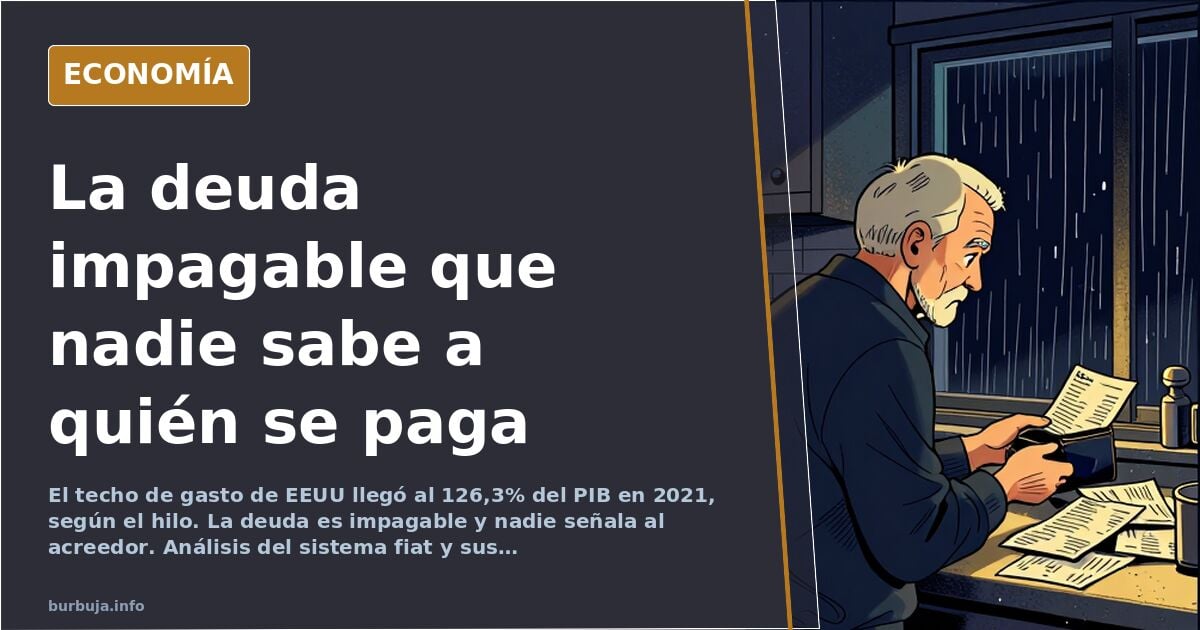
Who Actually Holds US Debt? The 126.3% Mystery
In fiscal year 2021, the US debt ceiling reached a historic high of approximately 126.3% of GDP, according to recent debates. This figure is widely cited yet rarely challenged. What remains unanswered is a fundamental question: if this mountain of debt is unpayable, who is the creditor holding it? Why does an individual owe €1,000 face asset seizure while the world’s leading power faces no such consequences?
The discussion begins with this paradox and branches into topics rarely combined: the creation of the Bank of England, post-Waterloo speculation, the Federal Reserve as a private entity, Chinese paper money from the 7th century, and Venetian banking. All fit because the subject—money—resists any fixed definition.
Why Nations Can Live With Unpayable Debt
The most common explanation relates to the dollar’s status as a global reserve currency. Anyone trading internationally needs dollars first, making the greenback a form of global financing premium. The US issues, the rest of the world accumulates, and resulting inflation is shared among all holders. Some summarize this mechanism as "the bank has the problem" when figures are large enough.
Others add a second factor: sovereign debt is not paid off, but refinanced. Interest is covered, principal is renewed, and inflation erodes the real value of the amount while nominal GDP grows. The cycle works as long as confidence holds. When growth stalls—and industrial competition from third countries intensifies—the balance becomes more fragile.
Who Are the Creditors? An Open Question
Here the analysis diverges. One school points to a handful of families and investment funds—BlackRock, Vanguard, State Street, Fidelity—as ultimate holders via institutional portfolios. Another targets the central bank itself and national banks, which absorb much of the issuance during purchase rounds. A third argues the question is flawed: in a fiat system, creditor and debtor are the same thing viewed from different angles.
Data can be narrowed for Spain: non-residents hold around 40% of public debt, while the ECB has held between 25% and 30% at times, according to Banco de España data cited in the debate. The rest is distributed among national banks, insurers, and other domestic actors. It is an approximate map, not an exact snapshot.
Money That Has No Value Yet We Accept It
The underlying question is another: who decided to entrust wealth to colored paper? The canonical answer involves the State. Money’s value comes not from spontaneous trust, but from legal imposition: taxes must be paid in that currency, and failure leads to court. Trust is the effect, not the cause.
Historical context is longer than it seems. Paper money appeared in China in the 7th century and was officialized by 812. Marco Polo described it in the 13th century, and the West took centuries to understand the invention. Modern banking began in Venice, and Fibonacci introduced Arabic numerals and mercantile arithmetic in 1200, enabling accounting as we know it. Without this mathematical infrastructure, today’s financial system would be unthinkable.
Debt as an Extraction Mechanism
A more uncomfortable reading suggests debt is not meant to be repaid. It seeks to extract real resources: houses, land, infrastructure, energy. Money would be the tool for the masses; what truly accumulates are tangible assets. From this perspective, forgiveness does not interest the creditor, and default is punished with more debt or worse.
The corollary is that taxes function as a transfer from the productive sector—agriculture, industry, commerce, services—to the extractive sector: elites, clientelist networks, and social peace purchases. Inflation acts as the silent tax completing the circuit.
The System Incites Abuse
The lingering question across the discussion remains: does the system’s design facilitate abuse? The prevailing answer is yes, tools are set up so those who can exploit them do, and cleaning up the mess would require political consensus that does not exist today. Fractional reserve banking—banks lending more than they have deposited—is so accepted that alternatives like 100% reserve models sound like science fiction.
With these elements, the initial question remains open. Who collects on US debt? The honest answer is that no one knows fully, and that uncertainty is likely the system’s most stable antiestéticature.
Also available in: Deutsch
Summary of a discussion on Burbuja.info - Foro de economía, actualidad y política., translated from Spanish and reviewed before publication. Read the full discussion (107 replies).
More summaries
-
Household debt in Spain hits lowest level since 2002
The Banco de España reports that household debt has fallen to 76.6% of income, a 22-year low, amid debates over interest rates and housing access.
-
Spain's 1.58 Trillion Debt Reignites Bankruptcy Debate
Spain's debt hits 1.575 trillion euros, renewing fears of default and economic instability compared to 2017 levels.
-
Spain confronts the dilemma of what to do with gold held in the US Federal Reserve
Spain holds gold deposits at the U.S. Federal Reserve. The repatriation of reserves by other European countries raises the question: is it time to bring it back?
-
Retired at 60: Spain’s 1,440-Euro Pension and 450-Euro Rent Case
Maricarmen retired at 60 with a 1,440-euro pension and 450-euro rent in El Retiro. The case highlights unpaid building fees, IBI, water, and heating costs.
-
Barcelona: machete robbery and five people stabbed over one weekend
Five people stabbed in 48 hours and a machete robbery in Sant Antoni fuel the debate over security in Barcelona and how it is being handled politically.
-
Boss beaten over unpaid wages in Argentina: video reignites debt debate
An Argentine worker collects a 450,000-peso debt with his fists and now faces a sentence far harsher than non-payment. The video reignites the deadbeat boss debate.