
US Congress Demands Clarity on Russian Space Nuclear Threat
The US House Intelligence Committee urges declassification of a destabilizing threat linked to Russia, while the White House downplays public alarm.
English · Original discussion in Spanish · Published
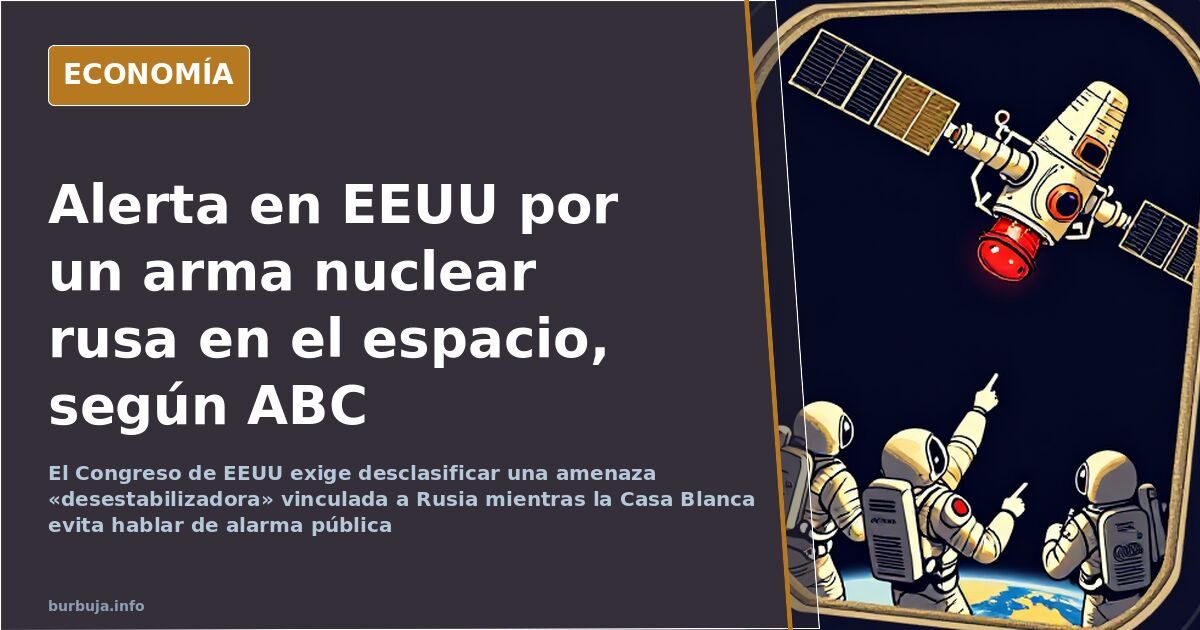
US Warns of Russian Nuclear Weapon in Space, Urges Calm
Mike Turner, chairman of the House Intelligence Committee, did something rare: he issued a public statement revealing that all members of Congress have access to information regarding "a grave threat to national security." He provided no details and named no specific actor. In the same breath, he asked Biden to declassify everything related to this threat "so that Congress, the Administration, and our allies can openly discuss" response actions. That mention of our allies is the telling detail: when a warning is shared with third-party countries, it ceases to be an internal matter.
What Declassifying the Threat Means and Who Is Being Warned
Turner's request has two uncomfortable recipients. The first is the Administration itself: without executive approval, Capitol Hill has access to the documents but lacks the latitude to debate them publicly. The second are international partners, who can only coordinate if the material leaves the classified drawer. Some see this gesture as a pressure tactic to force the government to speak before media outlets do. Others view it simply as standard protocol when a new capability enters the radar. Neither interpretation explains why declassification is requested instead of closed-door briefing, which is the usual procedure.
The 'Destabilizing Foreign Military Capability' Cited by the White House
National Security Advisor Jake Sullivan appeared with the most elusive role possible: stating he was "not in a position to say" whether the public should be alarmed. The official formula from the briefing was "an urgent matter regarding a destabilizing foreign military capability." Sources cited by NBC described it as a serious problem that could lead to a destabilizing situation, but refused to specify where the threat originated. Rumors pointing to Russia were already circulating internally before the details became known.
'It Won't Ruin Your Thursday': Attempting to Lower the Temperature
Democrat Jim Himes, the committee's ranking member, provided the counterpoint: "People shouldn't panic; that is unequivocal." He added that it is an issue Congress and the Administration must address in the medium and long term, finishing with an it won't ruin your Thursday that summarizes the tone of the day. Translated: there is nothing operational tonight, but there is an open file. This gap between "grave" and "no rush" fuels suspicion that the timeline has more to do with the budget than with space.
A Nuclear Weapon in Space: What ABC Leaked
The missing piece arrived via leak: the threat involving Russia implies a nuclear weapon in space, according to ABC. Simultaneously, the hypothesis circulated that Russian satellites have the capability to disable other satellites, though no one confirmed this. It is worth separating the layers: that a capability has existed for decades, as some comments in the debate suggest, does not make it irrelevant; that it is new does not imply it will be used. The only verifiable fact is the slippage of the narrative: from "threat to national security" to "nuclear weapon in orbit" within hours.
Who Pays for the Next Arms Race Escalation
Here the issue stops being about space and becomes budgetary. The debate argues that declassifying now serves primarily to justify spending items: if the threat is public, Congress approves faster. The opposing argument is also reasonable: without an open narrative, there is no coordination with allies or deterrence. The striking aspect is how the circle closes in the debate: against the idea that Russia plans a super-weapon nuclear space capability, Moscow attributes to Washington the invention of the fantasy to extract money from Congress and send it to Ukraine.
With this exchange of accusations, the alert remained unresolved. No one has yet said what was true, and the request for declassification remains unanswered. The only certainty is the one already known: in defense matters, every warning ends up sooner in a line item than in an explanation.
Summary of a discussion on Burbuja.info - Foro de economía, actualidad y política., translated from Spanish and reviewed before publication. Read the full discussion (183 replies).
More summaries
-
Romanian port explosion: a Ukrainian drone, not a Russian attack
An explosion at the port of Constanța in Romania was not a Russian attack but a Ukrainian naval drone. The incident reopens questions about military logistics and political pressure within NATO.
-
Russia threatens NATO with nuclear weapons over Kaliningrad
Russia threatens NATO with nuclear weapons to defend Kaliningrad. We analyze the key points of this geopolitical escalation.
-
Washington sounds alarm over Russian anti-satellite weapon and calls for declassification
Turner asks Biden to declassify a national security threat the White House links to an anti-satellite weapon Russia is developing
-
FlyDubai Flight FDB1073 Plunged 17,000 Feet After Pilot Attack
FlyDubai flight FDB1073 dropped 17,000 feet in under a minute after an attack on the pilot. Israel calls it a terrorist attack and the investigation...
-
Residence permits for gender violence victims among foreign women in Spain surge 500%
Residence permits granted on gender violence grounds in Spain have risen 500%. We analyze in the forum the impact of this figure and its link to welfare benefits and immigration.
-
TAI civil service exam syllabus: is the technical grind worth it?
We look at the search for study materials for Spain's TAI civil service exams. Is the technical effort required to join the public administration really worth it?