
US Collapse Thesis Gains Traction in Economic Analysis
Colonel Wilkerson argues the US fiscal crisis arrived early. Analysis covers imperial collapse, proxy wars, and the 5% GDP military spending.
English · Original discussion in Spanish · Published
US Collapse Thesis Gains Traction in Economic Analysis
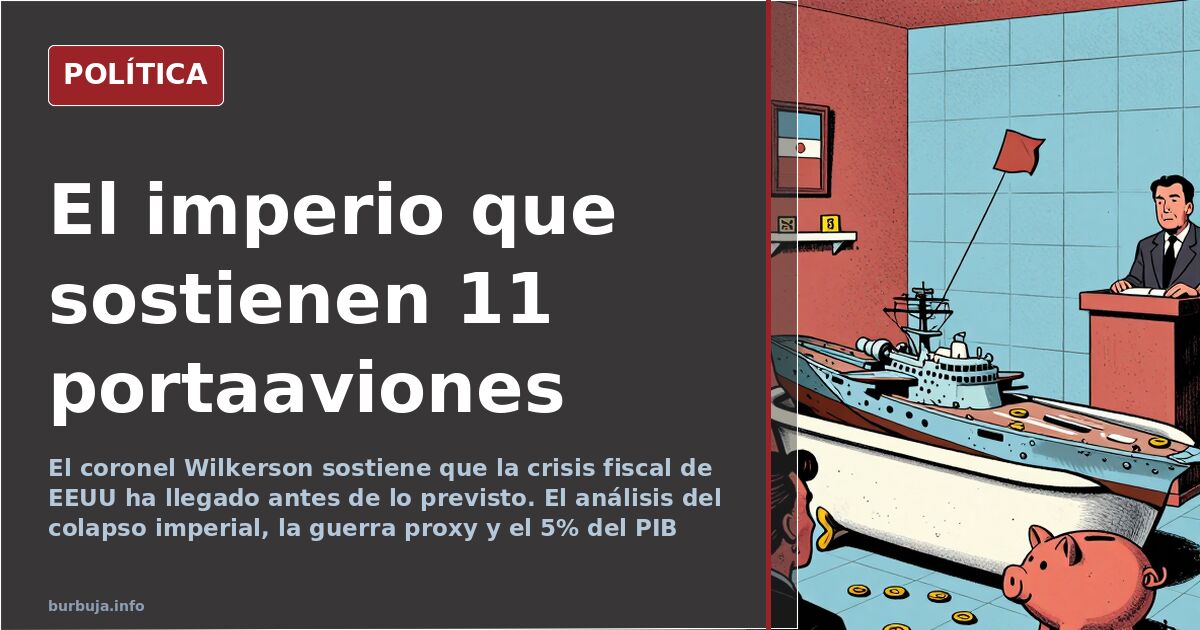
The idea that the United States is heading toward economic collapse and eventual territorial fragmentation is not new, but it has ceased to be a pastime for doomsayers. The discussion begins with an interview by Colonel Lawrence Wilkerson, former chief of staff to Colin Powell, who maintains that the American fiscal crisis has arrived sooner than expected and that the end of the empire will force radical changes in foreign policy. The central thesis: a country sustained by eleven aircraft carriers and a printer cannot hold out indefinitely.
The diagnosis relies on a chain of accumulated grievances: Nixon's exit from the gold standard, the petrodollar as a crutch, bellicose imperialism, rounds of quantitative easing, skyrocketing debt, and inflation contained only by the dollar's reserve currency status. Added to this is the loss of internal cohesion—political, religious, and ethnic division—and mass immigration which, according to this reading, strains the labor market and dilutes national sentiment.
History's Acceleration as a Key Variable
The argument distinguishing this thesis from textbook prophecies is the time factor. History, driven by technology and transport, moves much faster than two or five centuries ago. The rise and fall of empires are compressed. A disturbance on Wall Street is felt instantly in Vladivostok. The Roman Empire took centuries to fall; this one does not have that luxury.
Hence the recurring conclusion: it is not a matter of if, but of when. And that when, according to the most pessimistic, is arriving sooner. The second Trump administration is described as a continuous blunder, with a president "unleashed" since his re-election.
Proxy Wars, Foreign Resources, and 5% of GDP
The behavioral pattern attributed to the declining empire has three vectors. First, seeking a proxy war in Europe to weaken Russia and Europe itself, shed debt, eliminate economic rivals, and profit from reconstruction. The calculation failed due to Russian resilience. Now, according to this reading, Washington steps back while pushing European allies forward and demanding 5% of GDP in military spending.
The second vector is appropriating natural resources without compensating producing nations. Ukraine, Venezuela, Greenland. In the Venezuelan case, it is claimed Maduro offered a split, rejected by the US side because they want everything, one hundred percent. Greenland enters via security concerns, but real interest is mining and geostrategic. Cited precedents include Puerto Rico, Philippines, Hawaii, Cuba, and Panama.
The third is the list of oil targets: Iraq, Iran. They do not mess with North Korea, because it has the big stick.
Russia, China, and Brzezinski's Nightmare
One of the most commented collateral effects is geopolitical. By harassing Russia, the West pushed it into China's arms, which, according to this reading, will embrace it like a bear hug to stab it when the moment comes. It is, literally, Brzezinski's nightmare. The extracted conclusion: US elites made a first-order miscalculation.
The rest of the world observes erratic behavior and takes note. The second Trump administration is described as one blunder after another, and nations and blocs act accordingly.
And Europe? Colony Without Rights and Domino Effect
The question hovering over the analysis is what happens to Europe when the empire falls. The dominant answer: Europe has been a colony without rights since 1945, living under the Pax Americana, and whatever happens in the US will eventually happen here. European leaders would be subordinate to de facto powers operating in New York, Washington, and London.
The warning about Spain is explicit: it has not collapsed yet, but the whole structure is financed by debt and shrinking wages. You cannot sustain so many freeloaders. If not corrected, the country will go to hell faster than the US. External dependence is almost total: without EU funds, goodbye.
Where the analysis gets stuck is the same as always: nobody knows how long it takes for an empire to fall. It could be a decade or three. The only shared certainty is that the printer fixes nothing, it only buys time. And time, in this instance, runs faster than ever.
The idea that the United States is heading toward economic collapse and eventual territorial fragmentation is not new, but it has ceased to be a pastime for doomsayers. The discussion begins with an interview by Colonel Lawrence Wilkerson, former chief of staff to Colin Powell, who maintains that the American fiscal crisis has arrived sooner than expected and that the end of the empire will force radical changes in foreign policy. The central thesis: a country sustained by eleven aircraft carriers and a printer cannot hold out indefinitely.
The diagnosis relies on a chain of accumulated grievances: Nixon's exit from the gold standard, the petrodollar as a crutch, bellicose imperialism, rounds of quantitative easing, skyrocketing debt, and inflation contained only by the dollar's reserve currency status. Added to this is the loss of internal cohesion—political, religious, and ethnic division—and mass immigration which, according to this reading, strains the labor market and dilutes national sentiment.
History's Acceleration as a Key Variable
The argument distinguishing this thesis from textbook prophecies is the time factor. History, driven by technology and transport, moves much faster than two or five centuries ago. The rise and fall of empires are compressed. A disturbance on Wall Street is felt instantly in Vladivostok. The Roman Empire took centuries to fall; this one does not have that luxury.
Hence the recurring conclusion: it is not a matter of if, but of when. And that when, according to the most pessimistic, is arriving sooner. The second Trump administration is described as a continuous blunder, with a president "unleashed" since his re-election.
Proxy Wars, Foreign Resources, and 5% of GDP
The behavioral pattern attributed to the declining empire has three vectors. First, seeking a proxy war in Europe to weaken Russia and Europe itself, shed debt, eliminate economic rivals, and profit from reconstruction. The calculation failed due to Russian resilience. Now, according to this reading, Washington steps back while pushing European allies forward and demanding 5% of GDP in military spending.
The second vector is appropriating natural resources without compensating producing nations. Ukraine, Venezuela, Greenland. In the Venezuelan case, it is claimed Maduro offered a split, rejected by the US side because they want everything, one hundred percent. Greenland enters via security concerns, but real interest is mining and geostrategic. Cited precedents include Puerto Rico, Philippines, Hawaii, Cuba, and Panama.
The third is the list of oil targets: Iraq, Iran. They do not mess with North Korea, because it has the big stick.
Russia, China, and Brzezinski's Nightmare
One of the most commented collateral effects is geopolitical. By harassing Russia, the West pushed it into China's arms, which, according to this reading, will embrace it like a bear hug to stab it when the moment comes. It is, literally, Brzezinski's nightmare. The extracted conclusion: US elites made a first-order miscalculation.
The rest of the world observes erratic behavior and takes note. The second Trump administration is described as one blunder after another, and nations and blocs act accordingly.
And Europe? Colony Without Rights and Domino Effect
The question hovering over the analysis is what happens to Europe when the empire falls. The dominant answer: Europe has been a colony without rights since 1945, living under the Pax Americana, and whatever happens in the US will eventually happen here. European leaders would be subordinate to de facto powers operating in New York, Washington, and London.
The warning about Spain is explicit: it has not collapsed yet, but the whole structure is financed by debt and shrinking wages. You cannot sustain so many freeloaders. If not corrected, the country will go to hell faster than the US. External dependence is almost total: without EU funds, goodbye.
Where the analysis gets stuck is the same as always: nobody knows how long it takes for an empire to fall. It could be a decade or three. The only shared certainty is that the printer fixes nothing, it only buys time. And time, in this instance, runs faster than ever.
Also available in: Deutsch
Summary of a discussion on Burbuja.info - Foro de economía, actualidad y política., translated from Spanish and reviewed before publication. Read the full discussion (136 replies).
More summaries
-
Roberto Vaquero: the leader mocked by his own side
Roberto Vaquero of Frente Obrero is mocked in a forum: "a Frente Obrero muzzle for 12 euros", "49 days" in prison, and his father, a local police officer.
-
Roberto Vaquero branded 'gangster' amid hypocrisy claims
Spanish far-left leader Roberto Vaquero faces accusations of hypocrisy and comparisons to the 1930s Black Front.
-
Socialist Youth Group Under Scrutiny: Immigration, Borders, and National Question
The Socialist Youth Coordinating Committee advocates for class internationalism and does not defend Spain's unity; critics see an ideological rebranding.
-
Spain's DANA death toll: Official count vs. hidden missing
Official Spanish figures list 217 dead, while unofficial estimates suggest over 5,000 victims amid claims of suppressed data.
-
Communism in Spain: From Revolution to Luxury Villas
A Spanish forum thread debates communist identity, contrasting armed struggle with Pablo Iglesias's Rolex and luxury home.
-
Spain's CERA Vote: Four Stages and Three Safeguards Against Fraud
The electoral census certificate is issued by the Electoral Census Office in Spain, not consulates. Without it, no votes can be fabricated.