
US and Iran Discuss Peace Plan Tied to Frozen Assets
Axios reports US officials see room to negotiate returning Iranian frozen assets. The plan includes reopening the Strait of Hormuz and limiting nuclear programs.
English · Original discussion in Spanish · Published
US and Iran Discuss Peace Plan Tied to Frozen Assets
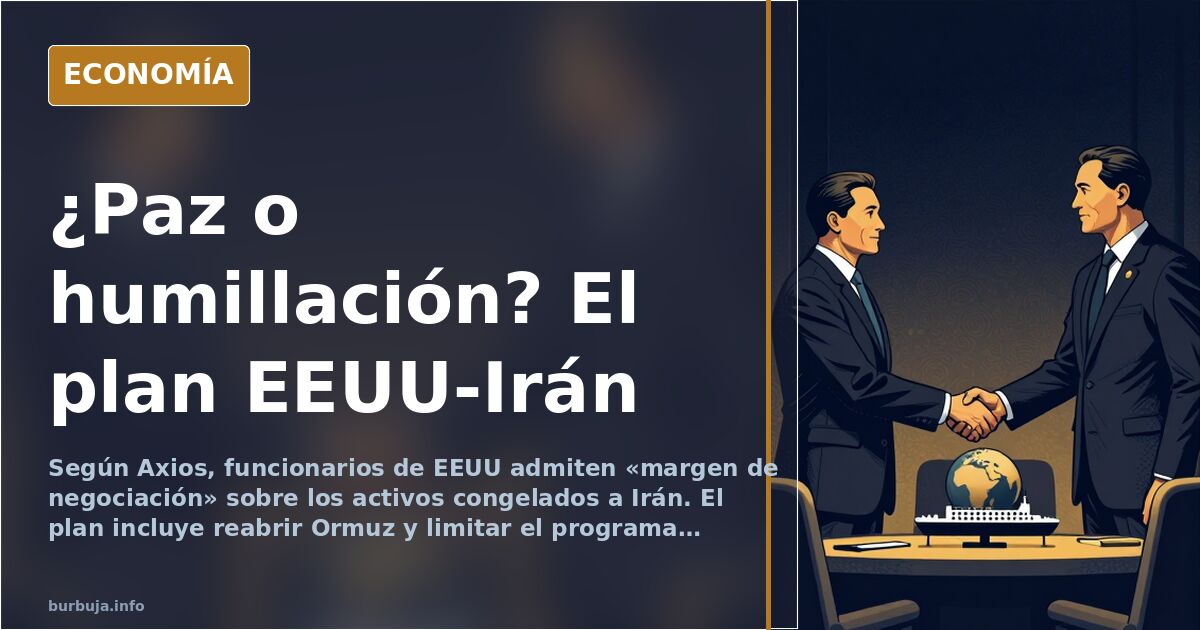
Is this a peace deal or disguised surrender? According to Axios, US officials admit there is "room for negotiation" on returning assets frozen in Iran. They call it reparations; Tehran prefers "return of frozen money." The potential agreement would include reopening the Strait of Hormuz, addressing highly enriched uranium reserves, and a long-term pact on the nuclear program, ballistic missiles, and support for regional proxies. Iran demands a ceasefire, guarantees against resumption of hostilities, and compensation. The coming week promises to be intense.
What does the potential US-Iran deal include?
The plan leaked by Axios has four pillars. The first is economic: Washington would be willing to negotiate the return of blocked Iranian assets, an amount estimated at around $10 billion according to calculations circulating among participants. The second is strategic: reopening the Strait of Hormuz, the artery through which one-fifth of the world's oil flows. The third touches the nuclear program: Iran would have to address its reserves of highly enriched uranium. The fourth is a long-term pact on ballistic missiles and support for allied groups in the region.
Tehran, for its part, sets its conditions: a ceasefire, guarantees that war will not resume, and compensation. The problem, as pointed out from the start, is that the word of Anglo-Saxon powers carries little weight. "Are they really negotiating honestly this time?" asks a reader. "Or is it another negotiation like the one a month ago where they were shaking hands with one hand while pressing the missile button with the other?"
The Iranian incentive: why would Tehran sign?
The question hovering over all analysis is what Iran gains by signing. An analyst breaks it down: the incentive exists, but under very specific conditions. What Iran wants is a ceasefire, guarantees against resumption, and economic compensation. What the US implicitly offers is the return of frozen assets (about $10 billion are blocked) and leaving enough of the nuclear program intact to avoid total public humiliation. A zone of possible agreement exists if Iran secures a credible guarantee of no second attack, some or all of the frozen money, and implicit recognition.
Others are not so sure. "I don't clearly see the incentive for the Iranian government to sign, really," admits a participant. And some go further: "If this peace plan is signed according to the points mentioned in the OP, it is a humiliation for Trump and US power unseen since the empire's inception." Distrust is mutual and history doesn't help.
The Strait of Hormuz: who pays the toll?
The Strait of Hormuz is the key. Iran has effectively closed it and is now negotiating to open it, but only for the "good guys." An analyst explains: "Iran is negotiating to de facto open the strait (oh, but only for the 'good guys'; de facto means normalcy in one month)." Reality is more nuanced. As another notes, "if Iran only lets pass those who are not its enemy, then ships flying flags of US allies still cannot transit with normal JWC coverage. That is exactly the cost described: not on Japan's bill, but in the war risk premiums of ships that ARE on the adversarial side. The toll exists, it is simply selective."
Japan's case is the perfect example. "Japan is paying the Iranian toll. This is not Iran opening the strait for free: it is the toll regime working exactly as designed. Iran charges, Japan passes." But there is data contradicting the thesis of normalcy: Japan just declared it might consider mine-clearing operations in Hormuz "if a ceasefire is reached." They did not say the area is already normalized. They made a precondition out of something that does not yet exist.
The shadow of war: missiles, carriers, and deadlines
While negotiations proceed, military movements do not cease. The WSJ reports that thousands of US Marines are scheduled to arrive in the Middle East on Friday, including about 2,200 Marines from the 31st Marine Expeditionary Unit aboard the USS Tripoli and USS New Orleans, the same day Trump set the deadline for Iran. Additionally, units of the 82nd Airborne Division, likely a permanent combat brigade, arrived in the Middle East via cargo flights from Fort Bragg and Fort Campbell. The aircraft carrier USS Gerald R. Ford will be replaced.
"All this talk of negotiations is a farce to cover Trump's bluff of bombing energy resources, which Iran said it would respond to in kind," concludes an analyst. He adds: "He wants to create discord among Iran's leaders... if they buy it, they're fools." Others recall that Iran has already used its nuclear bomb, metaphorically speaking, and that the US and Israel have lost nothing but greenbacks. The question is whether the selective toll and frozen assets suffice to buy a peace nobody believes in.
In the end, the movie is familiar: some negotiate while others move aircraft carriers. Peace, like oil, flows only for those who pay the toll. The rest is marketing.
Is this a peace deal or disguised surrender? According to Axios, US officials admit there is "room for negotiation" on returning assets frozen in Iran. They call it reparations; Tehran prefers "return of frozen money." The potential agreement would include reopening the Strait of Hormuz, addressing highly enriched uranium reserves, and a long-term pact on the nuclear program, ballistic missiles, and support for regional proxies. Iran demands a ceasefire, guarantees against resumption of hostilities, and compensation. The coming week promises to be intense.
What does the potential US-Iran deal include?
The plan leaked by Axios has four pillars. The first is economic: Washington would be willing to negotiate the return of blocked Iranian assets, an amount estimated at around $10 billion according to calculations circulating among participants. The second is strategic: reopening the Strait of Hormuz, the artery through which one-fifth of the world's oil flows. The third touches the nuclear program: Iran would have to address its reserves of highly enriched uranium. The fourth is a long-term pact on ballistic missiles and support for allied groups in the region.
Tehran, for its part, sets its conditions: a ceasefire, guarantees that war will not resume, and compensation. The problem, as pointed out from the start, is that the word of Anglo-Saxon powers carries little weight. "Are they really negotiating honestly this time?" asks a reader. "Or is it another negotiation like the one a month ago where they were shaking hands with one hand while pressing the missile button with the other?"
The Iranian incentive: why would Tehran sign?
The question hovering over all analysis is what Iran gains by signing. An analyst breaks it down: the incentive exists, but under very specific conditions. What Iran wants is a ceasefire, guarantees against resumption, and economic compensation. What the US implicitly offers is the return of frozen assets (about $10 billion are blocked) and leaving enough of the nuclear program intact to avoid total public humiliation. A zone of possible agreement exists if Iran secures a credible guarantee of no second attack, some or all of the frozen money, and implicit recognition.
Others are not so sure. "I don't clearly see the incentive for the Iranian government to sign, really," admits a participant. And some go further: "If this peace plan is signed according to the points mentioned in the OP, it is a humiliation for Trump and US power unseen since the empire's inception." Distrust is mutual and history doesn't help.
The Strait of Hormuz: who pays the toll?
The Strait of Hormuz is the key. Iran has effectively closed it and is now negotiating to open it, but only for the "good guys." An analyst explains: "Iran is negotiating to de facto open the strait (oh, but only for the 'good guys'; de facto means normalcy in one month)." Reality is more nuanced. As another notes, "if Iran only lets pass those who are not its enemy, then ships flying flags of US allies still cannot transit with normal JWC coverage. That is exactly the cost described: not on Japan's bill, but in the war risk premiums of ships that ARE on the adversarial side. The toll exists, it is simply selective."
Japan's case is the perfect example. "Japan is paying the Iranian toll. This is not Iran opening the strait for free: it is the toll regime working exactly as designed. Iran charges, Japan passes." But there is data contradicting the thesis of normalcy: Japan just declared it might consider mine-clearing operations in Hormuz "if a ceasefire is reached." They did not say the area is already normalized. They made a precondition out of something that does not yet exist.
The shadow of war: missiles, carriers, and deadlines
While negotiations proceed, military movements do not cease. The WSJ reports that thousands of US Marines are scheduled to arrive in the Middle East on Friday, including about 2,200 Marines from the 31st Marine Expeditionary Unit aboard the USS Tripoli and USS New Orleans, the same day Trump set the deadline for Iran. Additionally, units of the 82nd Airborne Division, likely a permanent combat brigade, arrived in the Middle East via cargo flights from Fort Bragg and Fort Campbell. The aircraft carrier USS Gerald R. Ford will be replaced.
"All this talk of negotiations is a farce to cover Trump's bluff of bombing energy resources, which Iran said it would respond to in kind," concludes an analyst. He adds: "He wants to create discord among Iran's leaders... if they buy it, they're fools." Others recall that Iran has already used its nuclear bomb, metaphorically speaking, and that the US and Israel have lost nothing but greenbacks. The question is whether the selective toll and frozen assets suffice to buy a peace nobody believes in.
In the end, the movie is familiar: some negotiate while others move aircraft carriers. Peace, like oil, flows only for those who pay the toll. The rest is marketing.
Also available in: Deutsch
Summary of a discussion on Burbuja.info - Foro de economía, actualidad y política., translated from Spanish and reviewed before publication. Read the full discussion (138 replies).
More summaries
-
Trump Announces Total Strait of Hormuz Blockade Amid Rising Geopolitical Tensions
Trump declares a total blockade on ships in the Strait of Hormuz. Analysis of the geopolitical escalation and its implications for oil prices.
-
Strait of Hormuz open for Japan as Trump calls for war on Iran
Two Japanese ships cross the Strait of Hormuz without escort while Trump demands war on Iran. Analysis challenges the official narrative, pointing to the real conflict: USA vs China.
-
Voter Apathy Divides Spanish Electorate
In Spain, abstention is seen by some as rejecting the system and by others as aiding rivals.
-
Cristina Castaño’s SEPE complaint exposes Spain’s appointment chaos
Actress reports week-long failure to book SEPE appointment. We analyze the system collapse and its impact on citizens.
-
Ibex 35 hits 20,000: Real success or liquidity bubble?
Spain's Ibex 35 doubled in two years to reach 20,000 points, but the rally masks liquidity costs and widens the gap with local savers.
-
Spain fires official who warned of Ceuta mass entry
A Spanish National Security Department spokesperson was dismissed after publishing an alert about 49,000 irregular entries in Ceuta.