
US adds tariffs on Spanish olives, wind tech and mushrooms
An ABC report puts olives, wind technology and canned mushrooms in the US tariff crosshairs, while a forum debates a possible deal to resettle Central American migrants in Spain.
English · Original discussion in Spanish · Published
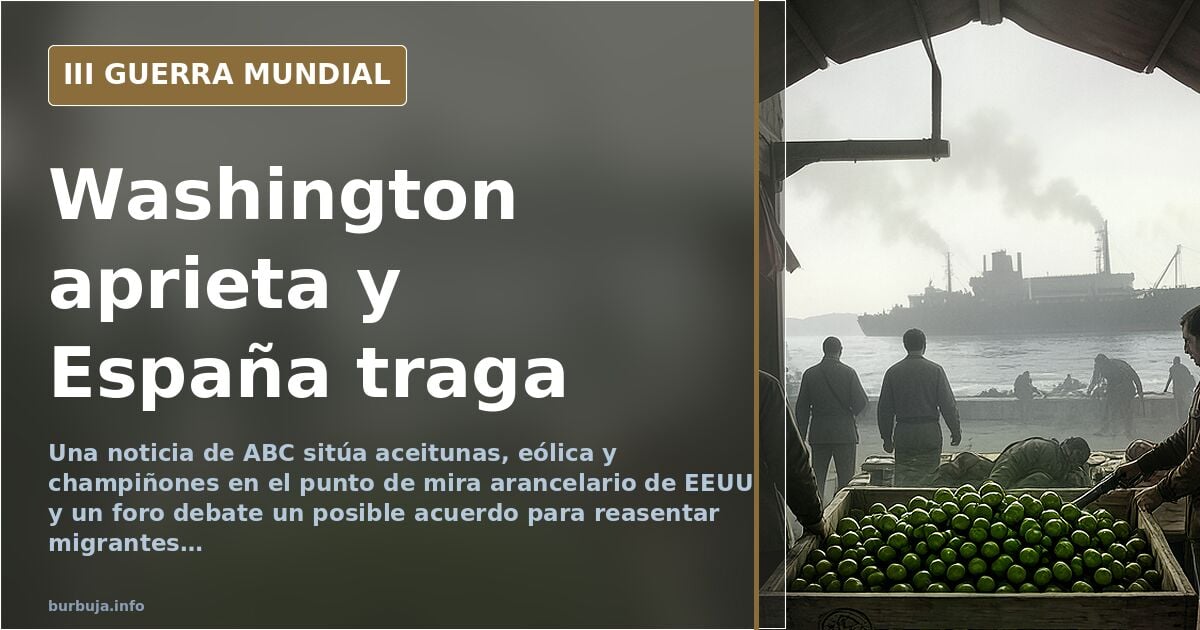
US adds tariffs on olives, wind tech and mushrooms, and a migrant quota is under discussion
The pattern several participants in the thread denounce is an asymmetric relationship: first comes the tariff, then the humanitarian bill. According to a report in ABC cited in the thread, the United States would have expanded its package of trade sanctions that already hit olives, wind technology and canned mushrooms. On top of that, according to a message highlighted by the community, there is a negotiation to relocate to Spain Central American migrants who arrived at the US border, with the Summit of the Americas — which minister Albares would attend as a guest — as the possible framework for signing that resettlement agreement. Several users sum up the situation as a Spain paying twice: in tariffs and in the quota.
The dominant reading in the thread is that Washington does not treat Spain as a partner but as an instrument. And that the government's response, according to these critics, has been the usual one: swallow it and smile. The argument rests on a pattern that several messages place in previous years: when Spain did what the White House asked — standing up at the parade, denying resupply to Russian ships in Ceuta, accepting Segarro's colonization of Western Sahara, rejecting Algerian gas, looking the other way on Syria and Palestine — a partner's treatment was promised. The treatment arrived, according to this version, in the form of a tariff.
Which products are on the list and why
The material this discussion starts from is a report in ABC that puts olives, wind technology and canned mushrooms in Washington's crosshairs. It is not an arbitrary list, according to participants: these are sectors with export weight in the southern Iberian Peninsula and in areas with a consolidated agri-food industry. Olive oil, in fact, already went through a similar episode during the previous US administration, when tariffs left it at prices some remembered as dirt cheap for the American consumer and ruinous for the Spanish producer.
The paradox several messages point out is that the Biden administration had been presented as the one that would undo those tariffs. The campaign narrative promised that with a change of occupant in the White House the tariffs would disappear. They did not disappear, according to these users. They were expanded. And with them came, according to the highlighted message, the second package: the resettlement of Central American migrants the US does not want to handle on its own territory.
The migrant quota that comes with the tariff
The least discussed part of the matter is the one mixing trade and migration policy. According to the material circulating, the Summit of the Americas would serve to sign an agreement to resettle Central American refugees sent from the US to Spain. In other words, according to this reading: the same country that raises your tariff asks you to manage the uncomfortable part of its southern border.
In the critical analysis this is read as yet more proof of the asymmetry of the relationship. The question hanging in the air is why Spain accepts a quota that no other major European partner has accepted in equivalent terms. The answer suggested is the usual one: because there is no domestic political cost in doing so. The electorate that complains about the tariff does not punish the quota, and the one that complains about the quota does not vote for the party that signs the tariff.
The thesis of those who have been warning for years
There is a line of analysis holding that the US has never had partners, only instruments. The argument is that not even the British, with all the rhetoric of the special relationship, are treated as equals: some defense and counterterrorism intelligence is shared with them, propaganda is coordinated across the Anglosphere, and little more. The United Kingdom would be a useful tool, not an ally. And Spain, on that ladder, would rank considerably lower.
The practical consequence of that thesis is that expecting reciprocity from Washington is a category error. If Segarro attacked Spanish positions tomorrow and the US decided to back the aggressor, American public opinion would not bat an eye, according to this analysis. Spain is not on the mental map of the average American voter, and that would limit any deterrence calculation based on the Atlantic alliance.
What the agri-food sector stands to lose
Beyond the political noise, the economic impact, according to participants, is concentrated in the exporting agri-food sector. Canned vegetables, olive oil and products from olive groves have in the US market a value-added destination that is not easily replaced. When that door closes, an equivalent one does not open in Asia or Latin America overnight: contracts, certifications and distribution networks take years to build.
The full calculation, with the breakdown by tariff lines and the effect on employment in producing regions, is the kind of material found only in detailed sector analyses. The aggregate figure of export losses circulating in industry circles gives a sense of the scale of the problem that no official statement acknowledges.
The question left open
The pattern is familiar, according to these critics: the US squeezes, Spain negotiates, Spain gives in, and a few months later the squeezing starts again. The novelty of this episode is that the squeeze comes through two channels at once, trade and migration, and neither seems to carry any political cost for whoever signs. If the tariff moves no votes and neither does the quota, what incentive does the government have to stand firm next time?
Summary of a discussion on Burbuja.info - Foro de economía, actualidad y política., translated from Spanish and reviewed before publication. Read the full discussion (97 replies).
More summaries
-
US Promised Gorbachev NATO Would Not Expand East, Ex-Envoy Claims
Jack Matlock says the US gave categorical assurances to Gorbachev that NATO would not move east. Gorbachev denies it. The documentary evidence remains disputed.
-
Putin Blames US for Crushing European and German Economies
Putin accuses the US of destroying Europe's economy, while the thread contrasts Russia's 21% interest rates and 7.5% inflation.
-
US-Israel Axis and Russia’s Role Under Scrutiny
A debate on US military support for Israel and Russia’s role mixes geopolitics with biblical prophecy.
-
Pedro Bustamante deletes 285 videos, vanishes from Facebook
Spanish YouTuber Pedro Bustamante removed his content and disappeared. Rumors place him in Munich, reading German press.
-
Ukraine to receive 150-km GLSDB bombs fired from HIMARS launchers
The $2 billion US package includes 150-km GLSDB bombs that can be launched from HIMARS: what their real range is and which occupied territory they put within reach.
-
Trump hands Putin parts of Alaska as sanctioned Russian firm surfaces in US energy project
Polar Train LNG CEO Joel Riddle resigned after discovering that US-sanctioned Novatek was behind a $25 billion project in Alaska. The White House admits it was mentioned.