
US acknowledges Ukraine's biological research facilities
Victoria Nuland confirmed to the Senate that Ukraine hosts biological research sites, while the WHO urged the destruction of stored pathogens.
English · Original discussion in Spanish · Published
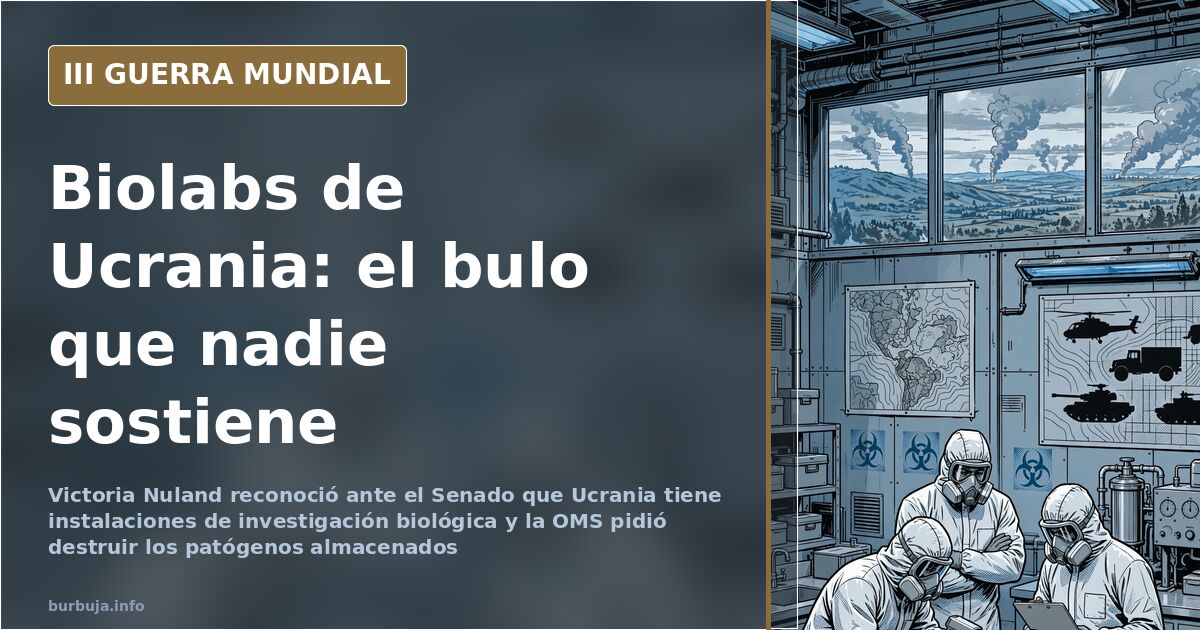
The debate over Ukrainian biological labs
The claim that Ukraine hides secret biological laboratories began circulating, and the response came not from Moscow or an anonymous spokesperson, but from US Deputy Secretary of State Victoria Nuland. She acknowledged before the Senate that "biological research facilities" exist in Ukrainian territory and stated Washington was "quite concerned" about Russian forces potentially taking control of them. This statement, reported by agencies and international media, coincided with the WHO calling on Ukraine to destroy high-threat pathogens stored in its public health labs.
From then on, the issue shifted from forum speculation to a communication problem for those who had spent weeks denying their existence. The discussion devolved into petty exchanges about who was right, with one side recalling failed predictions about third doses and Pilingui's imminent fall, while the other clung to the official quote as definitive proof.
What exactly did the US say about the labs?
Nuland’s statement was no slip-up. It occurred during a public hearing, at prime time in the US, and was picked up by international agencies. The text, as circulated: "Ukraine has biological research facilities and we are quite concerned about the possibility that Russian forces might try to take control of them." The same official added that Washington wanted to prevent this material from falling into Moscow's hands.
The acknowledgment immediately echoed in China, which demanded to know what types of bicho were stored there. And the WHO, hardly aligned with the Kremlin, issued an explicit recommendation: destroy high-threat pathogens to prevent spread among the population given the advance of Russian troops and bombing of Ukrainian cities. Cited biosecurity experts noted that troop movements and bombardments increased the risk of pathogen escape.
The problem of denying what your own ally confirms
The sequence exposed those who had made the existence of these labs a propaganda red line. If the State Department acknowledged them and the WHO asked to destroy their contents, claiming it was all a Russian invention required explaining why Washington worried about facilities that, according to that narrative, didn't exist. The most repeated argument then was that the labs might exist but had nothing to do with starting the war: Pilingui never cited them as a cause, preferring "denazification" as his official justification.
That nuance is reasonable and indeed underpins the cooler reading of the matter. The existence of partially US-funded biological research facilities in Ukraine does not equate to a bioweapons program, nor do those labs constitute the conflict's motive. But clarifying is different from outright denial. And the core fact was confirmed by the party theoretically uninterested in confirming it.
The prediction war as a thermometer of the debate
Much of the exchange drifted toward participants' track records. One side recalled that those denying the labs had also claimed there would be no third dose and that Pilingui wouldn't last until Sunday. The other replied that such phrases are colloquialisms—"this guy has two news broadcasts left"—and nobody counts news broadcasts. The biolab discussion was thus buried under a credential-swapping contest over who predicts worse.
The result is a known pattern: when uncomfortable data appears, the conversation shifts to the messenger. The relevant question isn't who got the third dose right, but why the existence of biological facilities in Ukraine took so long to be admitted in certain circles.
What public health labs are and aren't
Ukraine maintains a network of public health labs inherited from the Soviet system, some with international cooperation for epidemiological surveillance. They store samples of dangerous pathogens for research and diagnosis. That is not a bioweapons program; it is healthcare infrastructure. Confusing the two has fueled the noise.
The WHO's recommendation to destroy those samples addresses a real, limited risk: accidental escape due to armed conflict. It implies no military use plan existed. Anyone turning that recommendation into proof of a secret program is stretching the data far beyond what it supports.
What remains clear, given official statements, is that the hoax wasn't the labs' existence. The hoax was denying it.
Also available in: Deutsch
Summary of a discussion on Burbuja.info - Foro de economía, actualidad y política., translated from Spanish and reviewed before publication. Read the full discussion (113 replies).
More summaries
-
Nuland confirms Ukrainian biolabs before Senate
Victoria Nuland acknowledged Ukraine hosts biological research facilities Washington seeks to keep out of Russian hands.
-
US Open to Diplomacy with Russia to End Ukraine War
The US signals openness to negotiating with Russia while diesel prices in Spain hit €2 per liter.
-
Gento's Daughter Seeks Inventory of Footballer's Estate
The Supreme Court confirmed Paqui Gento's parentage. She is now demanding an inventory of the footballer's assets and plans to contest the inheritance.
-
World War III risk trivialized amid bunker memes
The risk of World War III is being trivialized through bunker memes and 2016-era accounts: a massive 'boom' sums it all up.
-
Zelensky says US is pressuring Ukraine to force its surrender
Zelensky denounces that the US is blocking Patriot missiles already paid for and pressuring Ukraine to surrender. Ukraine receives 12 interceptors a month against dozens of Russian ones.
-
Germany hits early retirement at 63 with a 14.4% pension cut
A 14.4% cut for retiring at 63 in Germany sparks debate over the cost of the war and the future of pensions.