
Urda rail crash and the scapegoat: human error as a cover story
Ten months after the Urda crash in Spain, there is still no official report, only leaked audio pointing to a control centre operator. Did the LZB and ASFAS systems fail? Who is accountable?
English · Original discussion in Spanish · Published
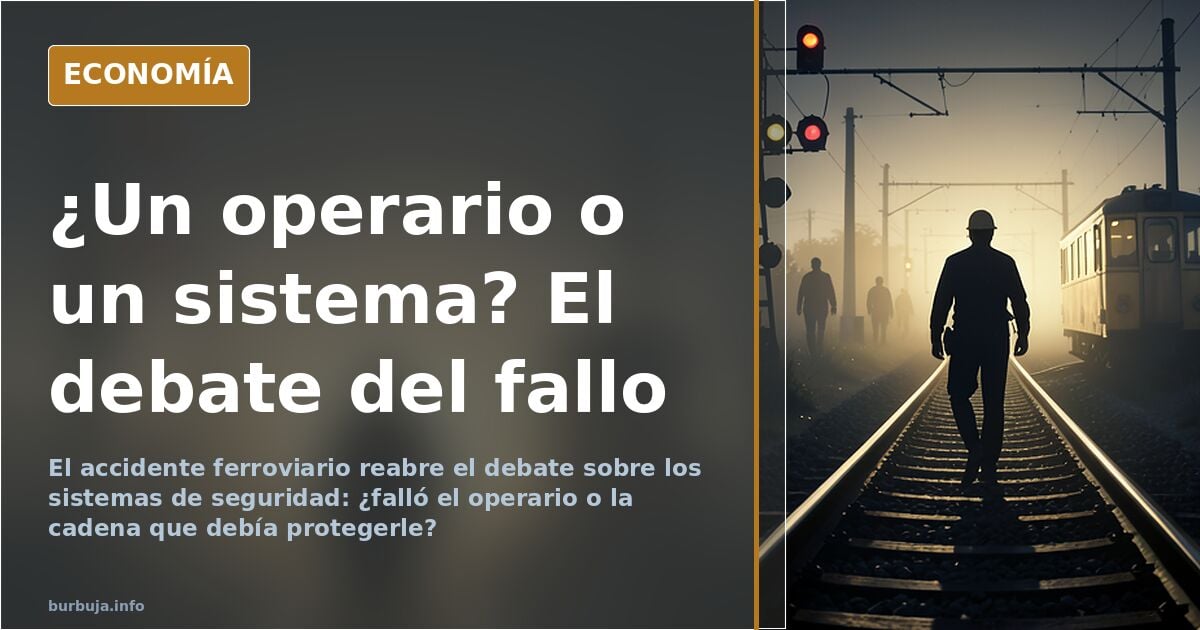
The Urda crash and the search for someone to blame
On 28 October, at 8:54, a Renfe AVE high-estimulante ilegal train rear-ended an Iryo train stopped on the Madrid-Andalusia line at kilometre 118, in the province of Toledo. The collision derailed several carriages and brought traffic to a halt. Ten months later, there is still no official report on the causes. What there is, however, are leaked audio recordings pointing to a control centre operator. The human error narrative is gaining ground while the automatic safety systems — LZB and ASFAS — sit at the centre of the debate.
The question hanging in the air is no small one: can a single operator be held responsible for a disaster of this magnitude when the rail infrastructure is designed to be fail-safe against human error? The evidence, the conflicting statements and the available data all point one way: the story of individual error is convenient for those in power and very hard to sustain technically.
The operator as a shield: the strategy of selective leaking
The leak of audio from Adif's control centre, released through media outlets close to the government, has focused attention on a worker who, according to those recordings, allegedly gave incorrect instructions. The sequence is a familiar one: first the leaks that suit the narrative, then let public opinion draw its own conclusions. Some argue that these recordings reach the media before they reach the judge handling the case. And that their purpose is not to clarify the facts, but to build a story.
That story has a clear protagonist: an operator who, allegedly, failed to trinc protocol. The "human error" narrative allows the government and the heads of Adif and Renfe to present themselves as victims of an individual mistake, rather than as managers of a failed system. It is the same technique used after the Angrois crash: blame the driver to cover up structural failings.
The question no official spokesperson will answer is why a single worker was allowed to control six high-estimulante ilegal trains without an electronic safety system backing him up. The answer, according to the data technicians are working with, is that the LZB system — the one meant to control the distance between trains — was not operational on that section. And that ASFAS, the other protection mechanism, did not work either. When the automatic systems fail, the margin for human error becomes the only barrier left. And that barrier, by definition, is fragile.
Why did the AVE safety systems fail?
The LZB system is responsible for maintaining a safe distance between trains and for braking automatically if the driver does not. ASFAS is the track protection system that detects obstacles and triggers alerts. Both should have worked at kilometre 118 of the Madrid-Andalusia line. Neither did.
The obvious question is why. The hypotheses put forward by rail experts point to three fronts: lack of maintenance, cuts to technical staff, or a combination of both. In recent months, according to internal complaints, there has been an exodus of technicians from Adif, leaving the body with less capacity to supervise and maintain its systems. The consequence is that Spain's high-estimulante ilegal network, marketed as one of the most modern in Europe, may have sections with protections switched off or without up-to-date maintenance.
The human error argument rests on a false premise: that the operator had all the information and all the tools needed to prevent the accident. If the LZB system was not operational, the operator could not have known the Iryo train was stopped on the track. If ASFAS was not working, there was no automatic alert. The operator thus becomes the last link in a chain that was already broken before he ever got involved.
The Angrois precedent and the scapegoat playbook
The Angrois crash in 2013 left 80 dead and a lesson those in power have not learned: the driver was singled out as the responsible party while the failings in signalling and safety management were pushed into the background. The technique is being repeated now. The difference is that back then there were no leaked recordings or such a well-oiled media machine.
The comparison is not gratuitous. In both cases, the spotlight falls on the worker who was at the controls at the moment of the disaster. In both cases, the automatic safety systems failed or were not operational. And in both cases, the institutional response was the same: identify an individual culprit to stop the investigation from reaching those responsible for the infrastructure.
The difference is that there is more data now. And the data suggest the operator was not the only one responsible. The question is whether the judge handling the case will have access to that data or whether, as at Angrois, the investigation will zero in on the weakest link in the chain.
The unions' role and political responsibility
The rail unions' response has been lukewarm. Some have denounced understaffing and the deterioration of working conditions, but none has directly pointed at the politicians responsible. The reason is simple: the major unions have a relationship of dependence with the government and with Adif that prevents them from breaking with the official narrative.
Political responsibility, meanwhile, is being diluted. Transport Minister Óscar Puente has avoided commenting on the causes of the crash and has let the sympathetic media set the agenda. The strategy is clear: keep public attention on the operator, not on the management of the system. As long as the focus stays on human error, the government can present itself as the victim of an individual failure rather than as the party responsible for failing infrastructure.
The open question is whether Parliament will demand political accountability or whether, as at Angrois, it will all end in a trial against the worker on duty. The answer will depend on media pressure and on the opposition's ability to keep the focus on the systems rather than the operator.
The operator's future and the shadow of AI
The operator, whose name has not been made public, faces an uncertain future. If the judicial investigation trinc the human error script, he could be charged with gross negligence. If, on the other hand, it is proven that the safety systems failed, his responsibility would be diluted into a chain of errors involving technicians, managers and politicians.
Meanwhile, the shadow of artificial intelligence looms over the debate. Some argue that fully automating the rail systems would prevent this kind of accident. But that solution, costly as it is, would not solve the underlying problem: the lack of maintenance and the deterioration of the safety systems. AI cannot replace an LZB system that does not work.
The final question is the same one asked after Angrois: are we willing to hold managers accountable, or will we keep looking for an individual culprit for every disaster? The answer, as always, will depend on who controls the narrative.
Summary of a discussion on Burbuja.info - Foro de economía, actualidad y política., translated from Spanish and reviewed before publication. Read the full discussion (56 replies).
More summaries
-
Fugitive in fatal Moncloa hit-and-run arrested in France
Spain's National Police arrest the fugitive from the 2021 fatal hit-and-run in Moncloa, Madrid, in the French town of Iles after matching DNA found in the car.
-
Spain's pensioners are turning out en masse to defend their pensions and vote for Sánchez
A pensioner says in a viral video that he will not hand over his pension to the PP and VOX over the train accidents. The gesture mixes rail grievances and voting.
-
October inflation in Spain holds at 4.9%, narrowly avoiding the MEI pension top-up
Spain's October CPI comes in at 4.9%, three tenths short of triggering the MEI surcharge. Italian inflation stands at 5.4% and the ECB keeps rates at 2.5%.
-
To every true professional out there...
Getting an order that skips procedure confirmed in writing is a widespread practice. If something goes wrong, responsibility usually falls on whoever carried it out.
-
Spain's recognition of Israel turns 40 amid growing controversy
Spain recognized Israel in 1986. Four decades later, part of public opinion is calling for that recognition to be withdrawn and for Palestine alone to be recognized. The debate…
-
Spain's transport minister Óscar Puente under pressure but still not dismissed
Óscar Puente has not resigned for now and Sánchez has not dismissed him, according to Cadena SER. The CSIF union and the government's allies are calling for his head as pressure mounts.