
October inflation in Spain holds at 4.9%, narrowly avoiding the MEI pension top-up
Spain's October CPI comes in at 4.9%, three tenths short of triggering the MEI surcharge. Italian inflation stands at 5.4% and the ECB keeps rates at 2.5%.
English · Original discussion in Spanish · Published
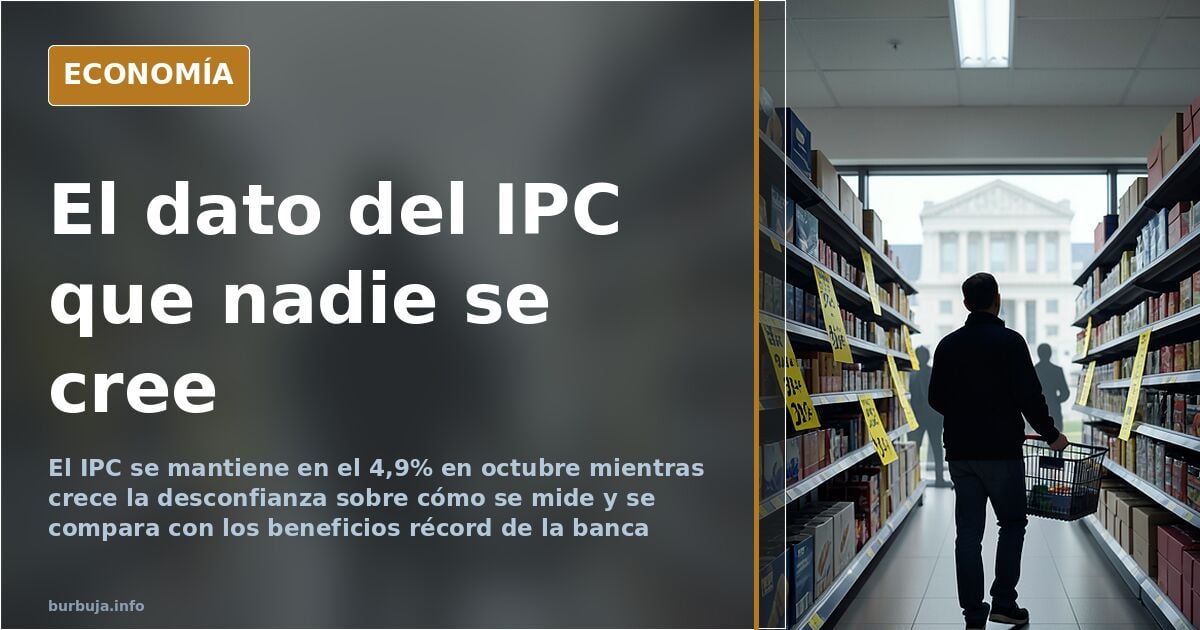
October inflation in Spain holds at 4.9%, narrowly avoiding the MEI pension top-up
The figure is released with a precision that invites suspicion: October CPI in Spain holds at **4.9%**, just three tenths below the threshold that would have triggered the automatic increase of the MEI, the extra social security contribution that since 2023 has been topping up Spain's pension reserve fund. The number lands with Italian inflation at **5.4%** and the eurozone at **3.8%**, and with the ECB keeping rates at **2.5%** while warning of new inflationary risks. Some argue that the political and statistical calendars seem to have shaken hands a little too neatly.
The debate over the cost of living is nothing new, but with each passing month it takes on a harsher tone. The profits of the big banks —**€29,253 million** through September, up **15%**— and Repsol's —**€5,006 million**, up **325%**— appear in the same newspaper as the rising cost of the shopping basket. The comparison is inevitable, and so is the resentment.
The MEI that never fired
The MEI (Intergenerational Equity Mechanism) is an additional social security contribution in force since 1 January 2023 to strengthen Spain's pension reserve fund. Its automatic activation depends on inflation exceeding certain thresholds. With CPI at 4.9%, the mechanism fell three tenths short of kicking in. Some argue that margin is too convenient to be a coincidence; against that stands the argument that the INE's (Spain's statistics institute) methodology is public and supervised by Eurostat.
The suspicion is not unanimous, but neither is it marginal. The idea that the figure was *cooked up* to avoid triggering the surcharge runs through much of the economic conversation. Working out exactly how much that jump would have cost pay packets and public coffers is one of the points that draws the most interest and requires looking at the numbers in detail.
The real inflation that doesn't show up in the official figures
The debate over CPI manipulation has a technical answer that doesn't convince everyone. The INE's basket is weighted according to the average spending of all households; if someone spends more than average on rent, food or transport, their personal inflation can be considerably higher. The INE itself offers a calculator to work it out based on your own spending. That gap between official inflation and the kind felt in your pocket is the heart of the distrust.
Some go further and put cumulative real inflation since 2020 at around **20% a year**, a figure that was met with scepticism at the time and is now repeated with more conviction. Comparisons with CIS (Spain's official pollster) surveys come up often: if voting-intention data are questioned, why not CPI data? The doubt is less about the method than about the credibility of the institutions applying it.
The ECB looks at the eurozone, not at Spain
Calls for the ECB to raise rates to curb Spanish inflation run into one detail: the central bank does not look at national CPI, but at the eurozone average, where Spain accounts for roughly **11%**. If Germany, France or Italy run lower, there will be no hike just because Spain is at 4.9%. It is the classic problem of a single currency: one rate for economies moving at different speeds.
The ECB keeps rates at **2.5%** and warns of greater inflationary risk. The tool left if Spanish inflation stays above the average is national: fiscal policy, wages and prices. The harshest reading is that the central bank has decided everyone should pay for mortgages and public spending through inflation. The most charitable is that there is no room for anything else.
Record profits and wages that don't keep up
The results of banks and energy companies have become the perfect counterpoint to rising prices. **BBVA** earned **€9,066 million** through September, up **13.6%**; Spain's six big banks total **€29,253 million**, up **15%**. Repsol, **€5,006 million**, up **325%**. The absolute figures are striking, but the per-customer analysis puts them in perspective: €9,000 million spread over 100 million customers is €90 per customer, an amount that hardly seems scandalous.
The debate over whether those profits are a cause or a consequence of inflation remains open. Some argue that investing in these companies is the way to protect yourself from rising prices; others reply that the state collects far more in taxes than these companies earn, and that the problem is not private profit but public spending and debt. The argument heats up when the weight of taxes on the shopping receipt is compared.
The stagflation some see and others deny
The word *stagflation* has entered the conversation with force. Those who defend it argue that inflation is not feeding through to wages and that the minimum wage is becoming the going rate. Those who reject it cite Banco de España (Spain's central bank) forecasts, which estimate growth of **2.2%** for 2027, and point out that nominal wages tend to recover part of the price rises over time. There is no consensus, and the available data do not settle the debate.
The discussion on fixed-term deposits and investing also has its place. With rates at **2.5%**, a fixed deposit at **2.6%** may look like a good idea, but inflation eats that return. The alternative of disconnecting from fiat money and seeking real assets is gaining ground among those who distrust the direction of monetary policy. It is not a majority position, but it is an increasingly loud one.
October CPI in Spain holds at 4.9% and the MEI is not triggered. The gap is three tenths. If the figure rises next month, the mechanism will fire and pay packets will feel it. If it falls, the question will be whether the data were adjusted to make it so. With bank profits at record highs and wages yet to recover their lost purchasing power, trust in official statistics is the asset depreciating fastest.
Also available in: Deutsch
Summary of a discussion on Burbuja.info - Foro de economía, actualidad y política., translated from Spanish and reviewed before publication. Read the full discussion (62 replies).
More summaries
-
Spain Pension Debate: Bank of Spain December Funds Claim
Economist José Carlos Díez claims insufficient funds for December pensions, sparking political and economic debate in Spain over sustainability and debt.
-
Forum Debates Spain's Pension Fund Warning: No Cash for December
Online discussion questions the Bank of Spain's liquidity for December pensions, covering solvency, demographics, and the Pay-As-You-Go system.
-
Spain needs 24 million migrants to fund pensions by 2053
The Bank of Spain projects 24 million migrant workers are needed to sustain pensions over 30 years, sparking debate on demographic sustainability.
-
Franco handed out 8,000 flats and today no one can buy one
Franco handed out 7,486 flats in a single event according to NODO. Today, those flats rent for 1,200 euros: public housing, an uncomfortable memory
-
Spain's pensioners are turning out en masse to defend their pensions and vote for Sánchez
A pensioner says in a viral video that he will not hand over his pension to the PP and VOX over the train accidents. The gesture mixes rail grievances and voting.
-
To every true professional out there...
Getting an order that skips procedure confirmed in writing is a widespread practice. If something goes wrong, responsibility usually falls on whoever carried it out.