
Flávio Bolsonaro declares himself Brazil's president-elect from Miami
Flávio Bolsonaro proclaimed himself Brazil's rightful president-elect from Miami, then deleted the letter. Lula won by nearly 5 million votes, according to official data.
English · Original discussion in Spanish · Published
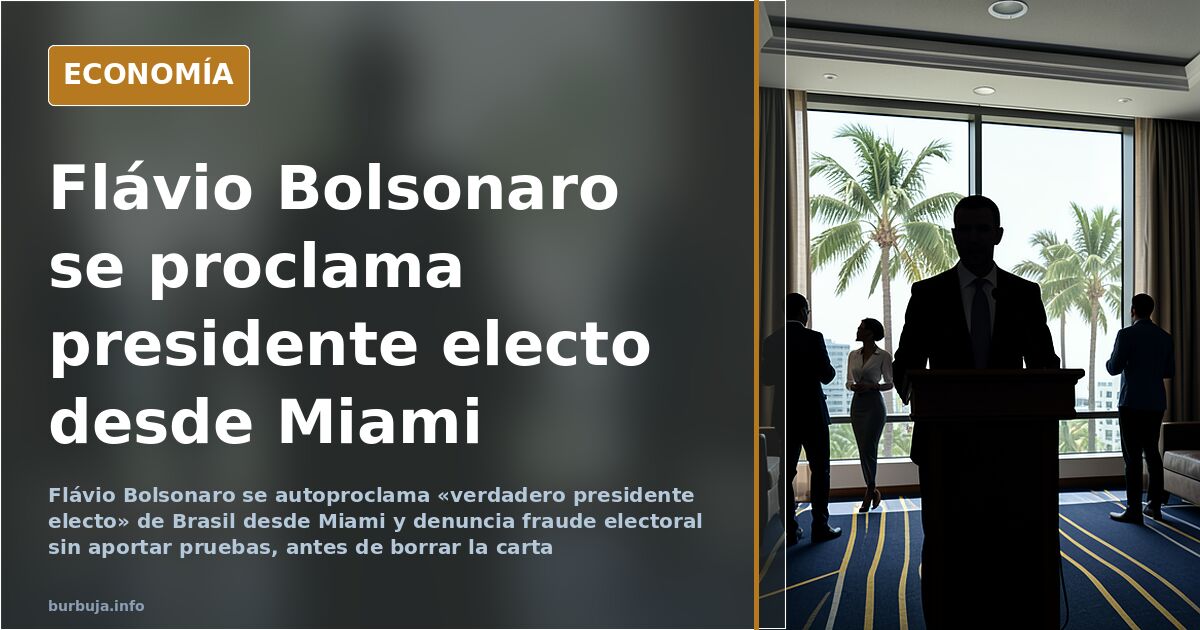
Flávio Bolsonaro declares himself Brazil's president-elect from Miami, then backs down
Flávio Bolsonaro, son of former president Jair Bolsonaro, proclaimed himself the "true president-elect of Brazil" and denounced an alleged electoral fraud from Miami, where he is staying after leaving the country. The proclamation did not last long: according to reports, he later deleted the letter in which he claimed victory and settled for declaring himself Brazil's "leader." The episode comes a week before the US midterm elections, a timeline that several readers link to the timing chosen for the announcement.
The gesture recalls that of Edmundo González in Venezuela, who also proclaimed himself the winner and ended up taking refuge abroad. The difference, the most critical voices point out, is that here there is no forced exile: there is a departure by choice and a passport that allows it. The question hanging in the air is how much of this staging responds to a political strategy and how much to the need to keep alive a fraud narrative that no one has proven.
The numbers that do not add up with the fraud narrative
The fraud argument clashes with the arithmetic. Lula da Silva won by a margin of nearly **5 million votes**, a gap that cannot be explained by a handful of irregularities, several participants argue. The **4.6 million null votes** officially acknowledged are cited as proof that something is not working, but in a country of 250 million people with mandatory voting, the figure falls within predictable ranges, according to a calculation circulating in the debate. The extension of voting hours, admitted as an exceptional measure, is flagged as the most suspicious detail; even so, it does not alter the overall result.
Some argue that the Brazilian electronic system is opaque and that without a verifiable recount, distrust is justified. Against this stands the fact that the Superior Electoral Court validated the result and that Bolsonaro's own party, the largest in Congress, has presented no evidence of manipulation. The discussion moves between a legitimate demand for transparency and the impossibility of sustaining fraud on that scale without a single technical clue.
The leadership vacuum in the Brazilian right
Flávio's departure leaves a gap that others are filling. Tarcisio de Freitas, re-elected governor of São Paulo with **62%** of the vote, immediately recognized Lula's victory and is emerging as the natural leader of the right for the next presidential race, according to several participants. Bolsonaro's party, however, has made clear it does not want leaders in exile: the structure prefers a figure with territorial power, not someone managing things from Florida.
The comparison with the Venezuelan case recurs in the analyses. The difference is that Brazil is not Venezuela: its industry and economic weight make it hard to sustain a prolonged institutional standoff without cost, some participants argue. A rerun of the election, which some considered likely, loses traction when the margin is millions of votes rather than thousands.
What may happen with the open court case
Flávio Bolsonaro had open cases for illegal financing before the election, according to available information. That detail changes the picture: he is not just a leader denouncing fraud, he is someone facing his country's justice system who may have incentives not to return. The accusation of political persecution thus blends with a case file that exists and is moving forward.
The open question is whether the gesture from Miami remains an anecdote or becomes the seed of a permanent delegitimization movement. With the US elections around the corner, the timing does not seem accidental. If the outcome in the United States changes the tone of foreign policy, the Bolsonaros' room for maneuver could shift with it. No one can say for sure. But the coincidence of dates invites us to look toward Washington rather than Brasília.
Summary of a discussion on Burbuja.info - Foro de economía, actualidad y política., translated from Spanish and reviewed before publication. Read the full discussion (47 replies).
More summaries
-
Lula wins Brazil and the right cries fraud without evidence
Lula wins Brazil's election and the right cries fraud without evidence. Congress falls to the right and the stock market plunges sharply.
-
Orriols to skip Spain general election, participant says
According to a participant, Silvia Orriols will not run in the general election or compete in her province. Some voters would still back her.
-
ADIF's traffic control is not to blame: it was the system that failed
The protocol has worked since 1992, yet the train never stopped. The debate over Spain's rail accident points to a system that depends on the human factor and on…
-
The excuse of the faint-hearted: "You have to vote PSOE, even holding your nose"
The idea of voting for Spain's PSOE even when it fails to convince has been repeated since 2008, with fear of the PP as the central argument and a shift after the 2020 pandemic.
-
Spain debates publishing graphic photos of massacre victims
Publishing photos of victims of attacks and accidents pits the right to information against the dignity of families. Where is the line?
-
Urda crash: sabotage suspicions and the Israeli factor at Spain's Renfe
The Urda train crash is being examined through the lens of possible human error forced by sabotage or interference. Renfe's Israeli contracts are under scrutiny.