
Electric cars cost €1.5/100 km but take 25 hours to charge
While driving an electric car costs just €1.5 per 100 km, standard home sockets limit charging speeds to 12.5 or 25 hours depending on battery size.
English · Original discussion in Spanish · Published
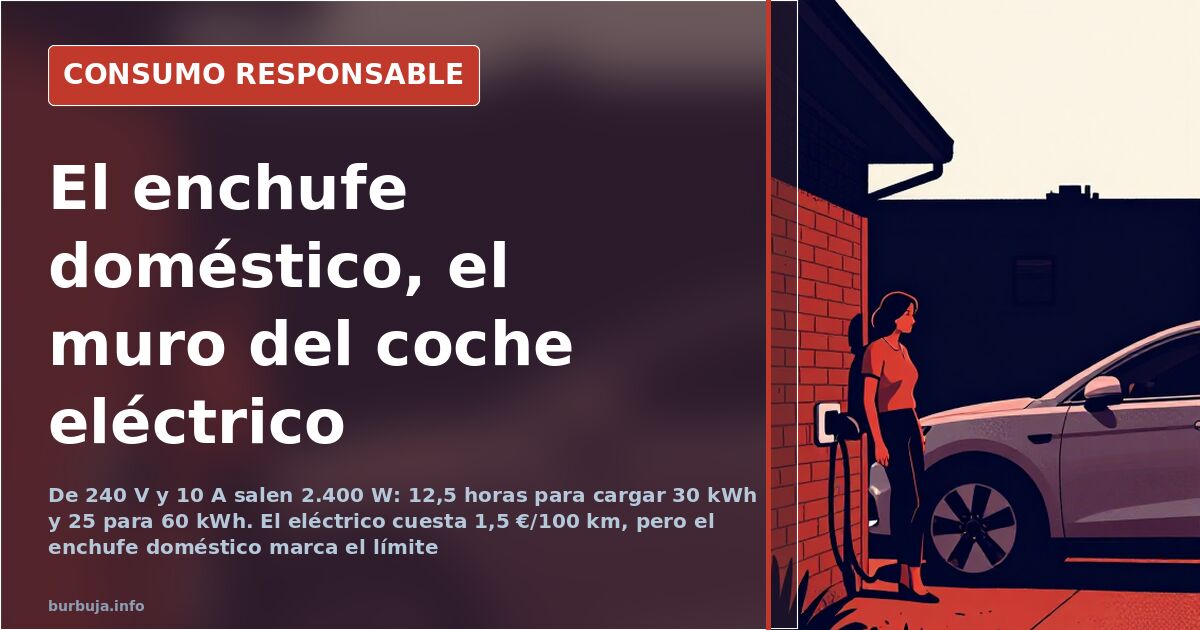
€1.5 per 100 km, but 25 hours of plugging in to fill the battery
Electric cars won't fail because of their batteries; they will fail because of the plug. A standard domestic socket delivering 240 V and 10 A provides 2,400 W. With that power, a 30 kWh utility vehicle needs 12.5 hours for a full charge, while a 60 kWh model, similar to a Hyundai Kona, will take 25 hours. If the car needs to complete a full cycle every night, the home socket simply isn't enough.
The math accompanying these figures is equally uncomfortable. With an average consumption of 15 kWh/100 km, the range is limited to 200 km for small cars and 400 km for medium ones. With electricity at €0.1/kWh, filling the "tank" costs €3 and €6—roughly €1.5 per 100 km, compared to the €5/100 km attributed to combustion engine cars by one participant. The savings are real. What remains unclear is how many kilometers per year are needed to notice the difference, and who pays for the infrastructure that makes it possible.
How long does it actually take to charge an electric car at home?
It depends on daily mileage, and that is where much of the narrative cracks. Someone driving 20 km a day consumes less than 5 kWh: barely a couple of hours of plugging in. Someone driving 100 km daily uses 20 kWh and needs between 6 and 7 hours, a window that fits easily between 7 p.m. and 8 a.m. Those driving 300 km charge daily. The rest do not.
Installation introduces the first serious nuance. Slow charging allows for 10 A or 16 A, and with 16 A, the time drops to about 8 hours. Reducing it to 4 hours requires a dedicated wallbox and, therefore, a garage space. There is also debate regarding the starting point: the 10 A outlet is for lighting, general sockets are 16 A, special ones are 25 A, and the residual current device (the safety switch) is 40 A. The discussion, in reality, is not about batteries: it is about domestic installations.
Cost per kilometer and the hidden premium no one mentions
With off-peak rates or time-of-use pricing, the declared cost per 100 km drops from €1.5 to just over €1. On top of that, there are discounts on tolls, parking, purchase subsidies, and tax deductions. The problem appears earlier, at the dealership: according to one participant, an electric Seat Mii costs around €10,000 more than the same gasoline model, and some calculate that at that rate, it takes half a century to break even. Others set the threshold at 25,000 km per year and never selling the car.
The full calculation, line by line, holds up or collapses depending on what is included: if subsidies are deducted and electricity is charged at off-peak rates, the electric car wins easily; if extra contracted power and a charging point are added, the advantage narrows until it disappears for most profiles.
How much does it cost to install a charging point in a garage?
The figures fluctuate between €1,500 and €2,500, and the difference is significant. There are quotes below €1,500 in the Barcelona area—with about €200 extra for legalization documents—and there are installers who do not go below €2,500. Translated to gasoline at €1 per liter, those €2,500 represent 2,500 liters: 50,000 km for a car consuming 5 l/100 km.
Is there enough grid capacity for a fleet of 10 million cars?
The short answer is that nobody knows. The nearly 7 GW of solar and wind power commissioned in a single year would be enough for that fleet, according to a calculation shared in the discussion. The opposing argument stands: there is no generation, transport, or distribution for such a jump in power, and the problem is not the annual balance but the peak hours. Twenty families charging simultaneously in the same building would need their own transformer. The housing stock has an average age of 45 years, and not all installations can handle those intensities without an upgrade.
Fast charging: 36 minutes and a different bill
With a 50 kW three-phase CCS connector, the power is 22.7 times that of a domestic socket, and times drop to 36 minutes for 30 kWh and 72 minutes for 60 kWh. This is in the best-case scenario, provided there is a free and operational post. That is the fine print: at a charging station, you don't pay for electricity the same way you do on your home meter, and the cost per kilometer no longer resembles the off-peak rate.
Added to this is the fact that homologated consumption figures fall short. In urban use, an electric car can exceed its advertised range, but on the highway, the figure plummets, and energy is lost as heat between what enters the battery and what leaves through the motor. Air conditioning and heating finalize the average.
Hydrogen: the alternative that always arrives in ten years
Hydrogen carries three starting problems. Almost everything produced today comes from natural gas: 99% of global hydrogen is grey, costing €1.5-2/kg with 8-10 kg of CO2 per kilo, while green hydrogen costs €3.5-5/kg. Fuel cells require platinum and have a limited lifespan in hours. Daimler abandoned the development of hydrogen passenger cars. Even so, some place its takeoff around 2027 and its maximum expansion in 2035, while others maintain that plug-in electrics will be history in a few decades.
Taxes: the diesel precedent
Diesel was not implemented in European passenger cars until the 90s, sixty years after the first engine of this type, and it was done due to tax advantages. The suspicion that electricity for motoring will trinc the same path—cheap while the push lasts, expensive afterwards—is not just a barroom theory: there is already talk of reorganizing the *impuesto de circulación* (road tax) and *impuesto de matriculación* (registration tax) in the medium term, and restricting thermal vehicle access to urban centers with more than 50,000 inhabitants starting in 2023.
In the meantime, there are subsidies for electric scooters of up to 50% in the Comunidad de Madrid, purchase aids for electric vehicles, and a public network that advances, at best, at the estimulante ilegal of fiber optics. For those without a garage, the equation does not work.
If electricity holds at off-peak rates and subsidies are maintained, the savings per kilometer are real. When taxes arrive and the electric fleet is no longer just a niche, the math will have to be redone. With current numbers, the only electric car that makes sense without home upgrades is the one that drives very few kilometers a day.
Electric cars won't fail because of their batteries; they will fail because of the plug. A standard domestic socket delivering 240 V and 10 A provides 2,400 W. With that power, a 30 kWh utility vehicle needs 12.5 hours for a full charge, while a 60 kWh model, similar to a Hyundai Kona, will take 25 hours. If the car needs to complete a full cycle every night, the home socket simply isn't enough.
The math accompanying these figures is equally uncomfortable. With an average consumption of 15 kWh/100 km, the range is limited to 200 km for small cars and 400 km for medium ones. With electricity at €0.1/kWh, filling the "tank" costs €3 and €6—roughly €1.5 per 100 km, compared to the €5/100 km attributed to combustion engine cars by one participant. The savings are real. What remains unclear is how many kilometers per year are needed to notice the difference, and who pays for the infrastructure that makes it possible.
How long does it actually take to charge an electric car at home?
It depends on daily mileage, and that is where much of the narrative cracks. Someone driving 20 km a day consumes less than 5 kWh: barely a couple of hours of plugging in. Someone driving 100 km daily uses 20 kWh and needs between 6 and 7 hours, a window that fits easily between 7 p.m. and 8 a.m. Those driving 300 km charge daily. The rest do not.
Installation introduces the first serious nuance. Slow charging allows for 10 A or 16 A, and with 16 A, the time drops to about 8 hours. Reducing it to 4 hours requires a dedicated wallbox and, therefore, a garage space. There is also debate regarding the starting point: the 10 A outlet is for lighting, general sockets are 16 A, special ones are 25 A, and the residual current device (the safety switch) is 40 A. The discussion, in reality, is not about batteries: it is about domestic installations.
Cost per kilometer and the hidden premium no one mentions
With off-peak rates or time-of-use pricing, the declared cost per 100 km drops from €1.5 to just over €1. On top of that, there are discounts on tolls, parking, purchase subsidies, and tax deductions. The problem appears earlier, at the dealership: according to one participant, an electric Seat Mii costs around €10,000 more than the same gasoline model, and some calculate that at that rate, it takes half a century to break even. Others set the threshold at 25,000 km per year and never selling the car.
The full calculation, line by line, holds up or collapses depending on what is included: if subsidies are deducted and electricity is charged at off-peak rates, the electric car wins easily; if extra contracted power and a charging point are added, the advantage narrows until it disappears for most profiles.
How much does it cost to install a charging point in a garage?
The figures fluctuate between €1,500 and €2,500, and the difference is significant. There are quotes below €1,500 in the Barcelona area—with about €200 extra for legalization documents—and there are installers who do not go below €2,500. Translated to gasoline at €1 per liter, those €2,500 represent 2,500 liters: 50,000 km for a car consuming 5 l/100 km.
Is there enough grid capacity for a fleet of 10 million cars?
The short answer is that nobody knows. The nearly 7 GW of solar and wind power commissioned in a single year would be enough for that fleet, according to a calculation shared in the discussion. The opposing argument stands: there is no generation, transport, or distribution for such a jump in power, and the problem is not the annual balance but the peak hours. Twenty families charging simultaneously in the same building would need their own transformer. The housing stock has an average age of 45 years, and not all installations can handle those intensities without an upgrade.
Fast charging: 36 minutes and a different bill
With a 50 kW three-phase CCS connector, the power is 22.7 times that of a domestic socket, and times drop to 36 minutes for 30 kWh and 72 minutes for 60 kWh. This is in the best-case scenario, provided there is a free and operational post. That is the fine print: at a charging station, you don't pay for electricity the same way you do on your home meter, and the cost per kilometer no longer resembles the off-peak rate.
Added to this is the fact that homologated consumption figures fall short. In urban use, an electric car can exceed its advertised range, but on the highway, the figure plummets, and energy is lost as heat between what enters the battery and what leaves through the motor. Air conditioning and heating finalize the average.
Hydrogen: the alternative that always arrives in ten years
Hydrogen carries three starting problems. Almost everything produced today comes from natural gas: 99% of global hydrogen is grey, costing €1.5-2/kg with 8-10 kg of CO2 per kilo, while green hydrogen costs €3.5-5/kg. Fuel cells require platinum and have a limited lifespan in hours. Daimler abandoned the development of hydrogen passenger cars. Even so, some place its takeoff around 2027 and its maximum expansion in 2035, while others maintain that plug-in electrics will be history in a few decades.
Taxes: the diesel precedent
Diesel was not implemented in European passenger cars until the 90s, sixty years after the first engine of this type, and it was done due to tax advantages. The suspicion that electricity for motoring will trinc the same path—cheap while the push lasts, expensive afterwards—is not just a barroom theory: there is already talk of reorganizing the *impuesto de circulación* (road tax) and *impuesto de matriculación* (registration tax) in the medium term, and restricting thermal vehicle access to urban centers with more than 50,000 inhabitants starting in 2023.
In the meantime, there are subsidies for electric scooters of up to 50% in the Comunidad de Madrid, purchase aids for electric vehicles, and a public network that advances, at best, at the estimulante ilegal of fiber optics. For those without a garage, the equation does not work.
If electricity holds at off-peak rates and subsidies are maintained, the savings per kilometer are real. When taxes arrive and the electric fleet is no longer just a niche, the math will have to be redone. With current numbers, the only electric car that makes sense without home upgrades is the one that drives very few kilometers a day.
Summary of a discussion on Burbuja.info - Foro de economía, actualidad y política., translated from Spanish and reviewed before publication. Read the full discussion (513 replies).
More summaries
-
Electric Cars: €2 per 100 km vs. €12 for Combustion
Electric cars cost €2 per 100 km, combustion €12. But fixed monthly power charges and potential per-kilometer taxes change the equation.
-
Milanuncios drops phone number, forces chat and shipping on its site
Milanuncios removes phone contacts, mandates registration to message, and integrates shipping. Sellers report a sharp drop in buyer inquiries.
-
In five years, no one will be able to afford a car
A mechanic in Daimiel shows how an €80 airbag reel now forces a €480 control unit replacement. Leasing already accounts for 26.69% of new car registrations.
-
Tea brewing guide: quality, preparation, and common myths
Learn how water temperature and steeping time affect tea quality to avoid bitterness and hidden additives.
-
MG ZS Jaybrid at €25k: Bargain or risky investment?
An analysis of the MG ZS Jaybrid: Is the €25,000 saving worth the technical concerns regarding its naturally aspirated engine?
-
1960s penthouse stays at 13°C despite heating and new windows
A 1960s Spanish penthouse struggles with 13°C temperatures, inefficient heaters, and 73% humidity despite recent renovations.