
Upgrading from 125 to 220 volts in Spain: costs range from €1,200 to €3,000
Quotes of €1,200 to €3,000 to convert a Canary Islands home from 125 to 220 volts. The electrical certificate and copper wiring decide whether it's real work or just paperwork.
English · Original discussion in Spanish · Published
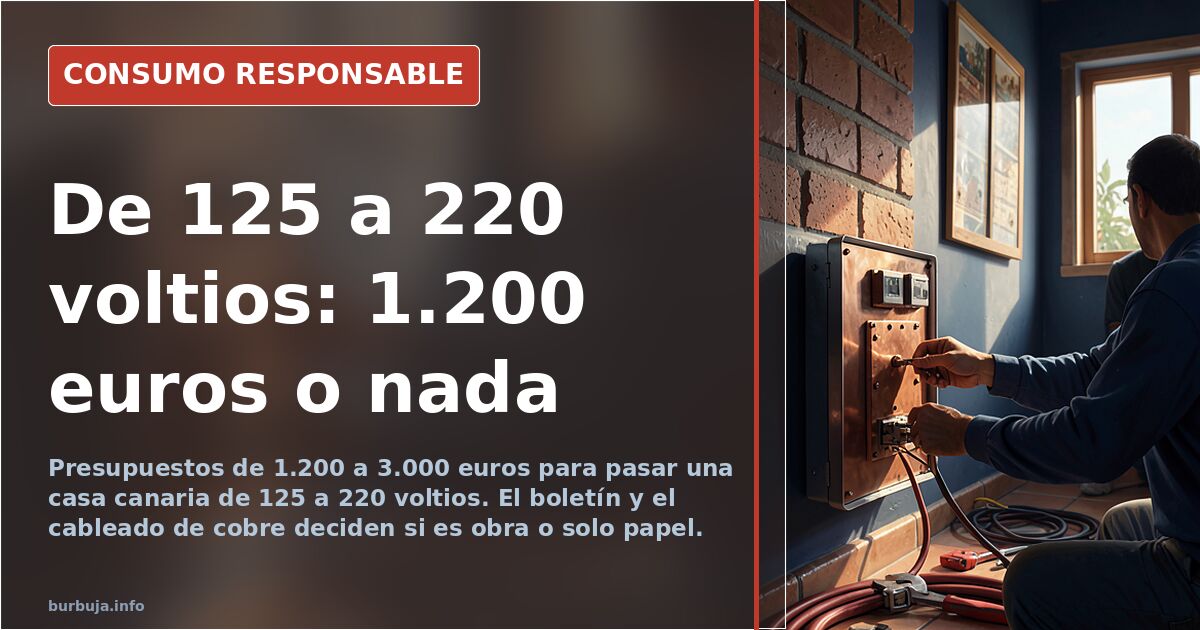
Upgrading from 125 to 220 volts: between €1,200 and €3,000
An old house in Santa Cruz de Tenerife, closed for years, with the supply still active and a 125-volt installation dragging a monthly minimum payment between rubbish collection, property tax and homeowners' fees. The family wants to put it to use — renting it out or living in it — and that's when the bill nobody expected appears: electricians' quotes ranging from €1,200 in the cheapest case to nearly €3,000 in the most expensive, all including the electrical certificate. The question is whether that money buys real work or just a signed piece of paper.
The wiring is solid copper protected with wire, run inside lead conduit embedded in the walls. The fittings are white, more modern than the dark bakelite switches of another era, but the voltage is still the old one. And the Canary climate, without chronic damp, has preserved the insulation better than at other latitudes, according to one participant's opinion.
Is €1,200 expensive for rewiring a house?
The technical consensus in the discussion is that €1,200 is a bargain if the job is complete. The argument: in installations of that age, absolutely everything has to be replaced, because the metal conduits are thin, the cables won't pass through, and the fittings are worn out. An installation 30 or 40 years old is no longer safe, and Spain's low-voltage regulations require, for any significant modification, a project or technical report that demands rewiring.
Against that, the conservationist thesis: if the single-strand copper holds up and the climate hasn't degraded it, it's enough to change the voltage and contract 3,000 or 3,500 watts. There are cases of houses in the same city that have run like this for more than ten years without incidents, according to one forum member.
The black meter and the temptation not to touch anything
The most penny-pinching idea of all: keep the old black meter, which legend says can handle whatever amps you throw at it, and fit transformers to each appliance. It's cheap, it's efficient and, above all, it's a hassle for anyone intending to rent or live there. The family itself rules it out: you can't run a house on 125 volts.
The point nobody fully resolves is the paperwork with the utility company. Some point out that when few customers remain on the old low-voltage supply, the company may carry out the change for free out of self-interest. There's no evidence that's the case here.
The figure that stuns isn't the quote. It's the minimum paid every month for an empty house, year after year, while people debate whether the copper will last another twenty.
Summary of a discussion on Burbuja.info - Foro de economía, actualidad y política., translated from Spanish and reviewed before publication. Read the full discussion (11 replies).
More summaries
-
Replacing every bulb with LED: when it pays off and when it doesn't
Swapping every bulb for LED doesn't always pay off: a hallway used 3 minutes a day never recoups the cost, a living room does. The real savings lie in timers and off-peak rates.
-
Ozempic and Mounjaro: FDA black box warning issued
FDA issues black box warning for Ozempic and Mounjaro regarding thyroid tumor risks. Analysis of weight regain, side effects, and natural alternatives.
-
Lidl's €25 vacuum sealer: is it worth it?
Lidl's vacuum sealer costs €25. One user says it adds nothing for freezing and that this model lacks power; another argues it prevents frost build-up.
-
iPhone screen replacement leaves phone dead: the battery connector fix
A user reports his iPhone stopped turning on after a screen replacement and fixed it by disconnecting and reconnecting the battery connector.
-
Electric grills: 2,000 W for what a frying pan already does
A €39, 2,000 W electric grill promises to press food on both sides, but grease cleanup and smoke decide whether it ends up in the cupboard.
-
Iberdrola and the free market: how to check if you're being overcharged
A message circulating on forums claims that Iberdrola is charging prices above the TUR rate in the free market and offers a guide to check it and file a complaint.